

Kandinsky Lab (MIT License)
Share this post:
Kandinsky S2V 1.0: Open Source Speech Avatar Video
Kandinsky Lab released Kandinsky S2V 1.0 (kandinskylab/Kandinsky-S2V-1.0-Lite-distill, arXiv:2610.19290) on September 25, 2026 under the MIT license. The speech driven video model takes one reference frame and a dialogue audio track, then animates the entire character body, hands, posture, and lip motion at 25 frames per second. You can test Kandinsky S2V 1.0 free in the embedded browser demo below with zero login.
Studio availability. Try the public Hugging Face demo below; Kandinsky S2V 1.0 is not part of a paid AI FILMS Studio plan (use InfiniteTalk Multi LipSync (Image to Video) in the video workspace for example instead).
Try Kandinsky S2V 1.0 Live
Upload a single character frame and a short dialogue audio clip (5 seconds runs on free ZeroGPU quota), then press Generate to preview synchronized full figure speech animation directly in your browser.
Architecture and Technical Design
Kandinsky S2V 1.0 pairs a compact 2.3 billion parameter Diffusion Transformer (32 visual blocks) with three pretrained multimodal encoders inside a flow matching latent pipeline. Qwen2.5-Omni-7B supplies both the text prompt hidden states from its Thinker module and 3584 dimensional audio features sampled at 25 tokens per second from its audio tower. CLIP ViT-L/14 provides a pooled semantic embedding, while the HunyuanVideo 3D VAE handles video compression and decoding.
Speech conditioning enters the visual transformer through per layer cross attention adapters attached to 13 of the 32 DiT blocks. Each latent video frame attends exclusively to its time aligned audio tokens, keeping plosives and facial gestures locked to the waveform. To generate long dialogue scenes beyond a single five second window, the model uses FramePack temporal memory across three time scales to carry appearance and pose context cleanly from chunk to chunk.
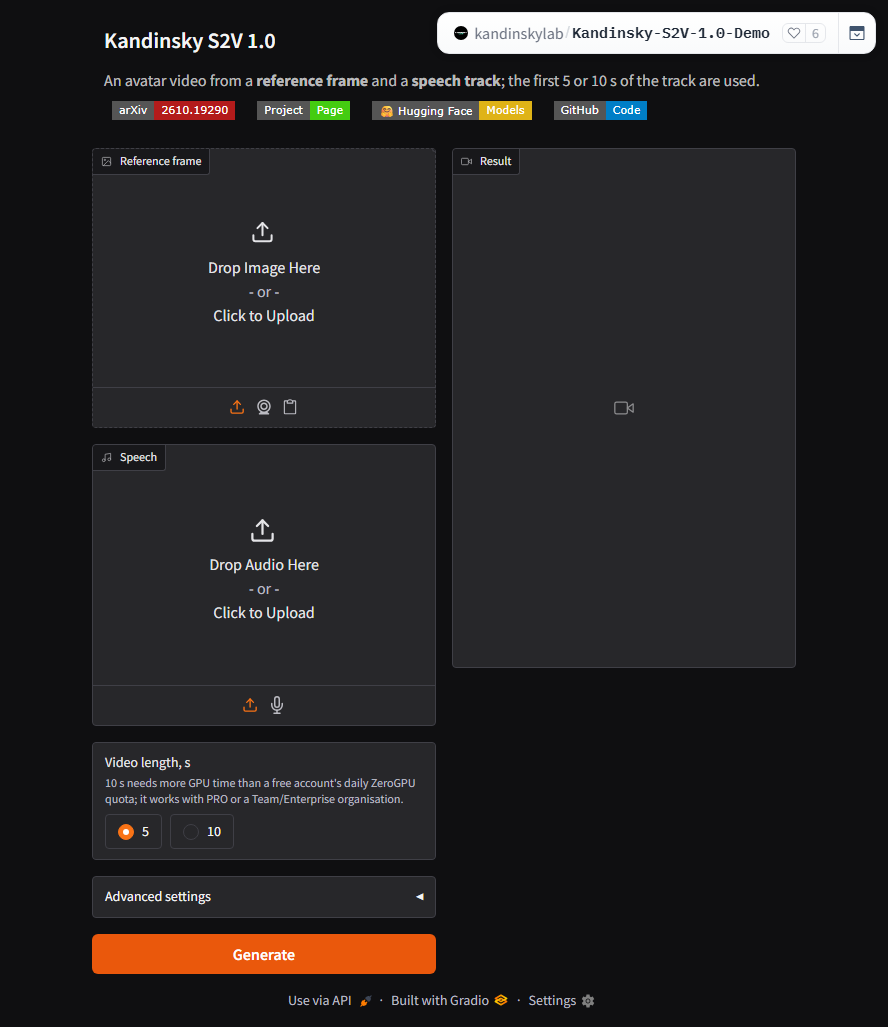
Official Space interface by Kandinsky Lab (MIT)
The distilled Lite checkpoint uses a 16 step pi-Flow sampler with classifier free guidance baked directly into the weights. Removing the negative guidance pass cuts inference cost by roughly 5x compared to the 50 step base checkpoint.
Because the model preserves the exact aspect ratio of the input frame, filmmakers can animate portrait dialogue reels, widescreen 16:9 narrative shots, stylized 2D cartoons, and non human characters with the same weights.
Hardware, VRAM, and License Matrix
The distilled DiT checkpoint (kandinsky_s2v_lite_distill.safetensors) weighs only 4.2 GiB in BF16, though the HunyuanVideo 3D VAE decode dominates peak GPU memory during 125 frame chunks.
| Configuration | Speed (per 1 s of video) | Peak VRAM (512 x 768, 125 frames) | Precision | License |
|---|---|---|---|---|
| Single H100 (Default) | 8.7 seconds | 57 GiB (untiled VAE) | BF16 + FP32 norms | MIT |
Single H100 (torch.compile) |
7.1 seconds | 57 GiB (+20 s one time compile) | BF16 + FP32 norms | MIT |
| 4x GPU Multi Node | 3.8 seconds (DiT only) | Split across 4 GPUs | BF16 | MIT |
| Tiled VAE Workstation | Slower decode | Substantially below 57 GiB | BF16 + VAE Tiling | MIT |
Parameter Reference
| Parameter | Default / Recommended | Technical Notes |
|---|---|---|
--config |
s2v_lite_distill.yaml |
Selects the 16 step pi-Flow distilled pipeline |
| Frame Rate | 25 fps |
Matches the 25 tokens/s Qwen2.5-Omni audio tower rate |
| Chunk Length | 125 frames (5 seconds) |
Longer tracks chain automatically via FramePack memory |
| Sampling Steps | 16 (distilled) / 50 (base) |
No negative prompt pass required on the distilled weights |
| Audio Role | Conditioning input only | Animates the subject to match your WAV; does not synthesize audio |
Local Python and CLI Setup
Clone the official Kandinsky Lab repository and install dependencies with uv. The first run automatically downloads Kandinsky-S2V-1.0-Lite-distill, Qwen/Qwen2.5-Omni-7B, openai/clip-vit-large-patch14, and the HunyuanVideo 3D VAE from Hugging Face.
git clone https://github.com/kandinskylab/kandinsky-s2v
cd kandinsky-s2v
uv sync
Generate a speech driven avatar clip from a reference still and dialogue track:
uv run kandy-s2v generate \
    --config src/kandinsky_s2v/configs/s2v_lite_distill.yaml \
    --audio dialogue_take01.wav \
    --image character_medium_shot.png \
    --out avatar_take01.mp4
For multi chunk dialogue performances exceeding five seconds, supply the complete WAV file directly and let FramePack carry temporal continuity across each 125 frame segment.
Filmmaker Production Playbook
Traditional talking head tools animate only the jaw and eyebrows while freezing the shoulders and hands, which immediately gives away synthetic characters in medium shots. Kandinsky S2V 1.0 animates the full figure from a single keyframe, making it practical for animated pitch reels, stylized indie shorts, multilingual dubbing inserts, and documentary reconstructions.
Record or generate clean dry dialogue first using an open source voice tool such as Libra-TTS or Sopro V2 Turbo, then feed that WAV alongside a well lit medium shot frame into Kandinsky S2V 1.0. Because native output renders at SD resolution, pass the finished clip through a fast open source upscaler like Kandinsky 6.0 VSR 2.0 before cutting it into a 1080p or 4K timeline. For instant cloud lip sync without managing 57 GiB of VAE memory, explore the AI image-to-video page.
Known Limitations and FAQ
Why does a 2.3B DiT need 57 GiB VRAM in the default benchmark? The 3D VAE decode across 125 continuous frames drives most of the peak memory, not the 4.2 GiB transformer itself. Enabling VAE tiling lowers peak VRAM considerably, though faint tile seams can appear on flat studio backgrounds.
Does Kandinsky S2V 1.0 support languages other than English?
Yes. Because speech features come from Qwen2.5-Omni-7B, the model generalizes cleanly across multiple spoken languages, singing, and expressive stylized characters without retraining.
Can I use Kandinsky S2V 1.0 commercially?
Yes. Both the code and the Kandinsky-S2V-1.0-Lite-distill weights are released under the permissive MIT license.
Related Reading
- LongCat-Video-Avatar 1.6: Open Source 10+ Min Lip Sync
- LatentSync and MuseTalk: Open Source Lip Sync for Dubbing
- Kandinsky 6.0 VSR 2.0: Open Source 2 Step Video Upscaler
- JoyVASA: Open Source Audio-Driven Portrait and Character AI
- Compare cloud video pipelines on the AI image-to-video page.

Sources
Continue Reading


Video & LipSync
- Video Generator
- Text to Video
- Image to Video
- Start-End Frame to Video
- Draw to Video
- Motion Control
- Video Enhancer
- Video Upscaler
- Video Extend
- Video to Video LipSync
- Audio to Video LipSync
- Image to Video LipSync
- Video FaceSwap
- Seedance 2.5
- WAN 3.0
- Seedance 2
- FLUX 3
- Minimax H3
- Vidu Q3 Pro
- Grok Imagine Video 1.5
- Gemini Omni
- Google Veo 3.1
- Kling 3.0 Pro
- Luma Ray 3.2
- LTX 2.3
- Happy Horse 1.1
- Kling 3.0 Motion
- ByteDance Upscaler
- InfiniteTalk
- InsightFace
Image & Edit
- AI Character
- AI Actor
- Art Generator
- Text to Image
- Image to Image
- LoRA Image to Image
- Draw to Edit
- Image LoRA Training
- Remove Background
- Image Enhancer
- MidJourney 8.0
- Krea 2
- OpenAI GPT Image 2.0
- Nano Banana Pro Ultra
- Nano Banana 2 Lite
- Nano Banana Pro
- Minimax Image
- Clarity Pro
- Z-Image Turbo LoRA
- Krea 2 Turbo LoRA
- Z-Image LoRA Trainer
- Qwen Image LoRA Trainer
- Background Erase Network 2 (BEN2)