

Ekam Brar, Libra-TTS (Apache 2.0)
Share this post:
Libra-TTS: Open Source 16 Language Voice Acting AI
Released on November 19, 2026 under the Apache 2.0 license, Libra-TTS (Ekam/Libra-TTS) packs 16 languages, 8 voices, and 12 directed acting styles into a 0.3 billion parameter text-to-speech model. Despite being a sixth the size of Qwen3-TTS 1.7B, Libra-TTS beats it on both English word error rate (1.64% vs 2.74%) and 10 language average error (1.77% vs 2.75%), running up to 72x faster than real time on a consumer GPU. You can test Libra-TTS free in the embedded browser demo below with zero login.
Studio availability. Try the public Hugging Face demo below; Libra-TTS is not part of a paid AI FILMS Studio plan (use MiniMax Speech 2.8 HD Text to Speech in the voice workspace for example instead).
Try Libra-TTS Live
Type dialogue or narration in any of the 16 supported languages, pick a voice, acting style (documentary, dramatic, whispering, wry, and more), and pace, then press Read aloud to audition 24 kHz speech directly in your browser.
Architecture and Technical Design
Libra-TTS is distilled from a fine tuned Qwen3-TTS-12Hz-1.7B teacher using singular value decomposition (SVD) to construct a compact 14 layer low rank talker and 5 layer residual code predictor (307M parameters in BF16). Audio waveform synthesis uses the companion 114M parameter 12 Hz codec decoder at 24 kHz output fidelity.
After distilling on more than 9,000 hours of teacher speech across 16 languages, the author applied a final stage of online GRPO reinforcement learning directly on the model's own readings. That reinforcement pass pushed the 10 language average word error rate down from 1.93% to 1.77% while teaching the model to normalize raw numbers, dates, timestamps, and currencies without external text preprocessors.
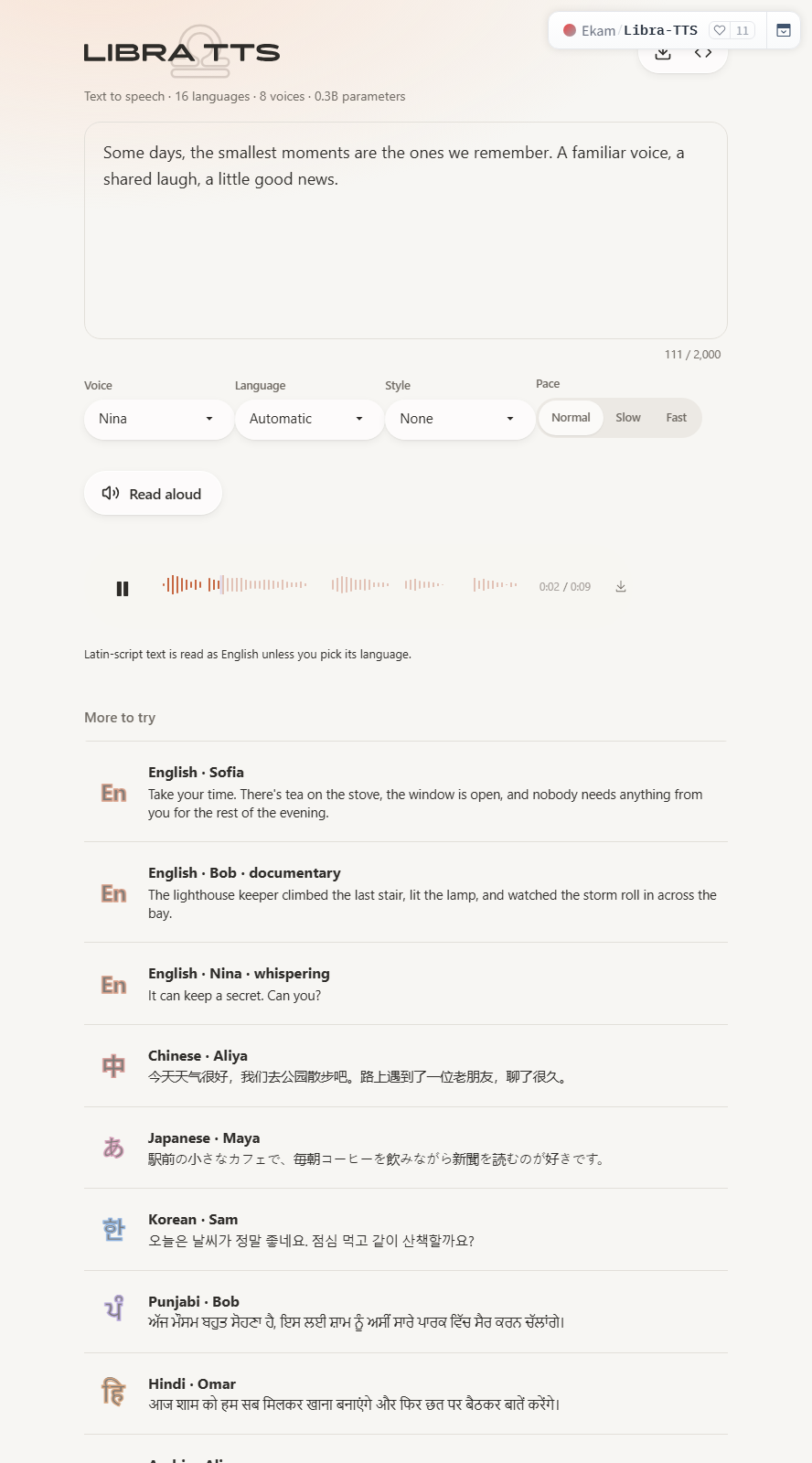
Live demo interface by Ekam Brar (Apache 2.0)
Libra-TTS covers English, Chinese, Japanese, Korean, German, French, Spanish, Italian, Portuguese, Russian, Arabic, Hindi, Punjabi, Bengali, Urdu, and Indonesian, detecting script changes sentence by sentence automatically.
On the 2,215 sentence English Seed-TTS-eval and LibriSpeech-PC benchmark, Libra-TTS posts 1.64% WER, outperforming Magpie-357M (1.77%), Kokoro-82M (1.80%), Qwen3-TTS 1.7B (2.74%), and MOSS-TTS-Nano (3.06%).
Hardware, VRAM, and License Matrix
Libra-TTS ships native PyTorch CUDA, Apple Silicon MLX, and float32 ONNX Runtime graphs in a single Apache 2.0 repository.
| Backend & Hardware | Single Sentence Speed | Long Text Batch (64 utterances) | Peak Memory | License |
|---|---|---|---|---|
| NVIDIA RTX 3090 (CUDA Graphs) | 8.7x real time | 72x real time | 2.4 GB to 3.6 GB VRAM | Apache 2.0 |
| Apple Silicon M5 Max (MLX) | 7.7x real time | 44x real time (15 min in 20 s) | 2.0 GB to 4.0 GB unified | Apache 2.0 |
| Laptop / Desktop CPU (ONNX) | 2.4x real time | CPU bound | Under 2 GB RAM | Apache 2.0 |
Parameter Reference
| Parameter | Allowed Values | Filmmaker Notes |
|---|---|---|
voice |
nina, sofia, aliya, maya, omar, jon, bob, sam |
Eight consistent multi language speakers |
style |
warm, cheerful, excited, sad, frightened, calm, serious, wry, tender, whispering, dramatic, documentary |
Direct emotional delivery without prompt hacks |
pace |
normal, slow, fast |
Tighten scratch track pacing to match picture lock |
lang |
en, zh, ja, ko, de, fr, es, it, pt, ru, ar, hi, pa, bn, ur, id |
Auto detected by script; pass explicitly for non English Latin languages |
Local Python and CLI Setup
Install the matching backend for macOS (Apple Silicon MLX), Windows/Linux NVIDIA GPUs (PyTorch CUDA), or any CPU (ONNX Runtime):
# Apple Silicon (MLX)
pip install "libra-tts[ja] @ https://github.com/ekambrar100/Libra-TTS/archive/refs/heads/main.zip"

# Any CPU (ONNX Runtime)
pip install "libra-tts[onnx,ja] @ https://github.com/ekambrar100/Libra-TTS/archive/refs/heads/main.zip"
Generate a scratch voiceover WAV from the terminal or script directed lines in Python:
libra-tts "The lighthouse keeper climbed the last stair and watched the storm roll across the bay." -o narration.wav
from libra_tts import LibraTTS

tts = LibraTTS()
tts.save("doc_intro.wav", tts.synthesize(
    "In 1974, three cameras documented the entire expedition.",
    voice="bob",
    style="documentary",
    pace="slow",
))
tts.save("whisper_cue.wav", tts.synthesize(
    "Do not open that door until the hallway clears.",
    voice="nina",
    style="whispering",
))
Filmmaker Production Playbook
Editors building animatics, temp voiceovers, and international festival trailers need fast, reliable pronunciation of dates, coordinates, and mixed language dialogue without cloud latency or subscription limits. Libra-TTS handles raw numerals natively and generates 15 minutes of documentary narration in roughly 20 seconds on an Apple Silicon laptop.
Use the 12 built in acting styles (documentary, frightened, tender, whispering, wry) to block emotional beats during rough cuts, then feed the finished WAV tracks directly into speech driven avatar pipelines such as Kandinsky S2V 1.0 or LongCat-Video-Avatar 1.6. When a production needs custom actor voice cloning or studio grade cloud voices, explore the AI FILMS Studio voice workspace.
Known Limitations and FAQ
Does Libra-TTS support zero shot voice cloning from a reference audio clip? No. Libra-TTS ships eight fixed multilingual speakers optimized for ultra low error rate and fast inference. For zero shot voice cloning from a 3 to 15 second reference sample, see Sopro V2 Turbo or Breeze-TTS-2.
Why do Latin script languages need the lang parameter?
Automatic detection inspects Unicode character scripts, so Chinese, Japanese, Korean, Arabic, Russian, Hindi, Punjabi, Bengali, and Urdu switch automatically. Spanish, French, German, Italian, Portuguese, and Indonesian share the Latin alphabet with English, so set lang explicitly for accurate pronunciation.
Can I use Libra-TTS commercially in films and YouTube documentaries? Yes. Both the model weights and the inference library are published under the Apache 2.0 license.
Related Reading
- Sopro V2 Turbo: Open Source 120M CPU Voice Cloning
- Breeze-TTS-2: Open Source Zero Shot Voice Cloning AI
- Audio8-TTS Realistic Air: Open Source 23 Language Voice
- Kandinsky S2V 1.0: Open Source Speech Avatar Video
- Generate cloud narration in the AI FILMS Studio voice workspace.

Sources
Continue Reading


Video & LipSync
- Video Generator
- Text to Video
- Image to Video
- Start-End Frame to Video
- Draw to Video
- Motion Control
- Video Enhancer
- Video Upscaler
- Video Extend
- Video to Video LipSync
- Audio to Video LipSync
- Image to Video LipSync
- Video FaceSwap
- Seedance 2.5
- WAN 3.0
- Seedance 2
- FLUX 3
- Minimax H3
- Vidu Q3 Pro
- Grok Imagine Video 1.5
- Gemini Omni
- Google Veo 3.1
- Kling 3.0 Pro
- Luma Ray 3.2
- LTX 2.3
- Happy Horse 1.1
- Kling 3.0 Motion
- ByteDance Upscaler
- InfiniteTalk
- InsightFace
Image & Edit
- AI Character
- AI Actor
- Art Generator
- Text to Image
- Image to Image
- LoRA Image to Image
- Draw to Edit
- Image LoRA Training
- Remove Background
- Image Enhancer
- MidJourney 8.0
- Krea 2
- OpenAI GPT Image 2.0
- Nano Banana Pro Ultra
- Nano Banana 2 Lite
- Nano Banana Pro
- Minimax Image
- Clarity Pro
- Z-Image Turbo LoRA
- Krea 2 Turbo LoRA
- Z-Image LoRA Trainer
- Qwen Image LoRA Trainer
- Background Erase Network 2 (BEN2)