
Hasbro Is Asking Child Actors on 'Peppa Pig' to Sign Away Their Voices to AI

Share this post:
Hasbro Is Asking Child Actors on 'Peppa Pig' to Sign Away Their Voices to AI
Entertainment One, the Hasbro subsidiary that produces Peppa Pig, sent contracts to child cast members requiring them to sign over AI voice rights as a condition of continued work on the series. The contracts arrived with a take it or leave it ultimatum and no offer of negotiation.
What the Contracts Require
The language in the contracts grants Hasbro rights to replicate and deploy each child performer's voice through AI tools, with no defined limit on where or how that voice could be used in future productions. Families who declined the terms would lose their children's roles on one of the most commercially valuable children's entertainment properties in the world.
Peppa Pig generates billions in annual merchandise and licensing revenue for Hasbro. The commercial weight of holding a role on the series is significant for any performing family, which gives the AI voice clause a particular coercive quality: parents are being asked to sign away an undefined future right or lose a current income stream.
The Commercial Scale That Makes This Coercive
Peppa Pig is one of Hasbro's largest entertainment properties. The show has aired in more than 180 countries and has been translated into over 40 languages. Merchandise revenue from the property runs into billions of dollars annually across toy licensing, apparel, theme park attractions, and digital products.
The Peppa Pig brand valuation gives the show's voice cast a commercial value far beyond typical children's animation. A child actor whose voice is identifiable as Peppa or George is attached to a global brand infrastructure. The AI clause is not capturing a minor creative asset. It is capturing the acoustic identity of a performer whose voice has commercial significance in 40 languages across two decades of content.
That scale is what makes the take it or leave it structure objectionable in legal terms, not just ethical ones. Consent given under economic duress, where the alternative is losing access to a significant commercial opportunity, is qualitatively different from consent given freely. No UK statute currently requires that distinction to be made explicit for children's performers outside union jurisdiction.
The Union Gap That Leaves Children Exposed
UK Equity, the performers' union in Britain, has negotiated AI protections for its adult members in recent years. Those protections do not extend to performers under the age of 10. Most of the child actors voicing Peppa Pig characters fall below that threshold.
Without union membership, those children and their families have no collective bargaining framework, no representative to review contracts on their behalf, and no enforceable minimum standards for what an AI voice clause must contain or exclude. The California Digital Replica Protection Act mandates explicit consent and professional legal or union representation for any AI voice or likeness agreement. No comparable statute exists in UK law for minors working outside union jurisdiction.
AYPA Organizes Against the Contracts
AYPA, an organization representing young performers and their families in the UK, organized a public response once the contracts became known. The open letter gathered approximately 1,000 signatures from performers, families, casting professionals, and industry supporters, calling on Hasbro to withdraw the AI voice clauses from the child actors' contracts.
AYPA escalated the matter to the UK Department of Education, arguing that the contracts place children in AI rights agreements that they cannot legally understand, and that their parents are signing under economic pressure without access to independent legal advice. The escalation marked the first time the UK government's education portfolio was directly petitioned over an AI voice rights dispute in a children's production.
AYPA's demands were specific: withdraw the AI voice clauses entirely from child performers' contracts, establish consent standards suited to the age of the performer for any future AI voice licensing involving minors, and provide independent legal counsel to families before any such agreement is signed. None of those demands had been met as of the time of publication.
Performers and Public Figures React
Charity Wakefield, the British actress known for her roles in The Crown and Wolf Hall, posted publicly when the story broke. Her response was three words: "No No No."
Jo Frost, the television personality known internationally for Supernanny, called the contracts "deplorable". Both statements drew wider press attention to what could otherwise have remained an unreported contractual dispute buried in children's television production.
The public response from Wakefield and Frost mattered because it shifted the story from a trade publication dispute into mainstream entertainment coverage. At that point, Hasbro's silence on the specific contract terms became the story rather than a detail within it. The company's non-denial of the clauses was covered as a confirmation.
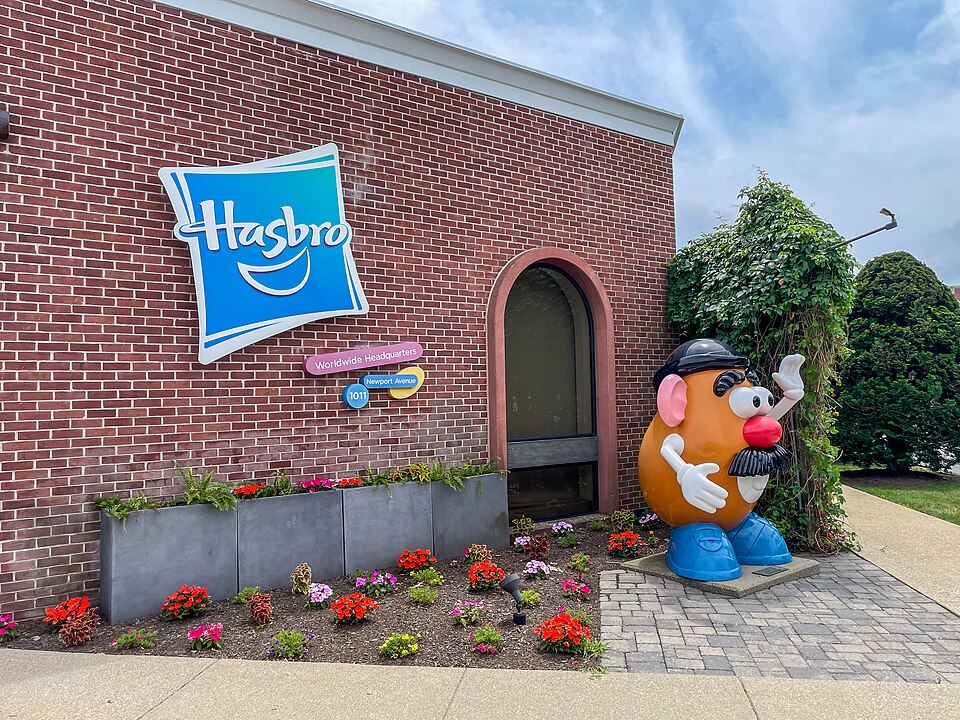
Kenneth C. Zirkel, CC BY 4.0, via Wikimedia Commons
Hasbro's Response
Hasbro issued a statement that did not confirm or deny whether AI voice clauses had been sent to child cast members. The company's response did not address whether it would withdraw the terms, modify the language, or continue to present them as a condition of continued employment.
The statement was notable for what it left out. The Hollywood Reporter and Deadline reported specific contract language. Hasbro disputed neither the existence of the clauses nor their wording.
Where the Peppa Pig Case Fits
The Hasbro situation is one point in a recognizable pattern. Production companies are attempting to secure AI voice rights from performers before those rights become subject to legislation or collective bargaining. The commercial logic is consistent across every case. Capture the voice now, under existing contract conditions, before the regulatory environment catches up.
Harvey Keitel argued at the 60th Karlovy Vary International Film Festival that AI voice cloning cannot reproduce the emotional life behind a performance, regardless of how accurately it captures the acoustic pattern. His argument was directed at consented adult arrangements. The Hasbro case applies the same commercial logic to children whose parents may have no framework for evaluating what they are being asked to sign and no power to refuse without cost.
Michael Caine's partnership with ElevenLabs is the arrangement the AI voice industry presents as its responsible model. It rests on consent given by an adult performer with full legal capacity, negotiated individually, with per use compensation and marketing approval. The child actors on Peppa Pig received the commercial logic of that model stripped of every feature that makes adult consent meaningful. No legal representation was required. No scope limit was specified. No negotiation was offered.
What the Contract Language Would Have Granted
The specific language of the contracts sent to Peppa Pig child cast members, as reported by The Hollywood Reporter and Deadline, granted Hasbro rights to replicate and deploy each child performer's voice through AI tools with no defined scope limit on future productions. The clause was written as a condition of continued employment, not as a separately negotiated addendum with independent consideration.
In contract law, clauses signed under threat of employment loss generally receive scrutiny around the doctrine of economic duress. UK courts have applied this principle in commercial disputes. Children's employment contracts reviewed by courts have also received scrutiny around whether the signing party, a parent or guardian acting for a minor, had independent legal representation or access to advice when signing. Neither condition appears to have been met in the Hasbro case.
The Pattern Across Children's Entertainment
The Peppa Pig situation is not an isolated case. The broader pattern in children's entertainment in 2025 and 2026 involves producers attempting to capture AI voice rights from child performers before legislation or collective bargaining establishes protections. The commercial logic is consistent: a child's voice identifiable with a global character is a licensable asset that becomes more valuable as AI reproduction technology improves.
Every year that passes without legislation is a year in which those clauses can be presented to families as standard terms without legal challenge. The families who signed before AYPA organized its public response had no framework for understanding what they had agreed to. AYPA's escalation to the Department of Education is specifically designed to create that framework prospectively for the families who come after them.
How Adult AI Voice Licensing Typically Works
The comparison cases in adult AI voice licensing involve independent negotiation, defined use parameters, and ongoing compensation. Michael Caine's ElevenLabs partnership specifies payment terms per deployment and requires Caine's approval before the synthesized voice is used in any context. That structure is possible because Caine has legal representation, full contractual capacity, and the commercial position to negotiate.
None of those conditions apply to child performers in recurring television production. They do not have the commercial position to negotiate alternatives, they cannot legally contract on their own behalf, and their parents are making decisions about future rights with no independent assessment of the value being assigned away. The governance gap between how consenting adults negotiate AI voice rights and how children's voice rights are being captured is the central problem the Peppa Pig case has made visible.
What Comes Next
AYPA's demands, as of the time of publication, had not been met by Hasbro or Entertainment One. The Department of Education contact had acknowledged receipt of the escalation. UK children's performers' rights do not currently have a statutory framework covering AI voice replication for minors, and the parliamentary timetable for addressing that gap was not confirmed during the festival period.
The California Digital Replica Protection Act provides the closest existing statutory model. Its requirements, explicit consent, independent legal or union representation, and clearly defined use parameters, represent the standard that advocates in the UK are seeking. Whether those requirements can be transposed into UK children's employment law without legislative revision is the question AYPA's escalation is designed to force into public view.
How the Story Became Public
The contracts became public through AYPA's direct disclosure to The Hollywood Reporter and Deadline, bypassing the production company entirely. AYPA's decision to disclose through trade press rather than through a regulatory body reflects a calculation that public attention would be more effective than a formal complaint process.
AYPA's stated goal is legislative change, not winning the specific Hasbro contract dispute. The Peppa Pig disclosure is the opening move in a public awareness campaign designed to create pressure for legislation that protects child performers in AI voice situations across UK children's television production.
What the Union Gap Actually Means
UK Equity's protections extend to adult performers in union productions. For child performers under 10, and for productions that don't require union membership, no collective bargaining protections apply to AI voice rights. A parent reviewing the Hasbro contract has no union representative to call and no standard contract terms to compare it against.
The gap is not incidental. UK children's employment law was built in a period when the most complex contractual issue in child performance was working hours and tutoring requirements. An AI voice licensing clause with unlimited scope was not a category the law needed to address when the framework was constructed.
The Timing of the Contracts
The contracts reached Peppa Pig child cast members in early 2026, before any UK legislation on AI voice rights for minors had been proposed in parliament. The timing places the contracts in a regulatory window where Hasbro could present the terms as standard production agreements with no existing legal standard to compare them against.
Every month that passes without legislation is a month in which these terms can be presented to more families in more productions. The Peppa Pig case became public. The cases that have not become public represent an unknown volume of AI voice rights captured from child performers across UK children's television without the scrutiny this case received.
The California Model AYPA Referenced
AYPA's public statements have cited the California Digital Replica Protection Act as the model for what UK law should require. The California law mandates explicit written consent, independent legal or union representation at the time of signing, clearly defined use parameters, and ongoing compensation for each deployment of a synthesized replica.
The California law was passed after significant advocacy from SAG-AFTRA and signed into law in 2024. A UK equivalent would need to be adapted to children's employment law, which operates under different consent standards than California's adult performer protections. The framework exists in California. The adaptation work for UK minors has not yet been proposed.
What "Unlimited" Rights Actually Grants
The AI voice clauses in the Hasbro contracts, as reported by The Hollywood Reporter and Deadline, granted rights without defined scope limits on future productions. In commercial licensing terms, that language describes a perpetual and unlimited license: any use the licensee chooses, for as long as the licensee wishes, in any medium or format that exists or will exist.
That grant covers uses that cannot currently be anticipated. A child who signs an unlimited AI voice license in 2026 has no control over how that voice is used in 2036, in productions that use technology not yet invented. The lack of scope limit is not a drafting oversight. It is the commercial objective.
Why Hasbro Wants These Rights Now
The commercial motivation for capturing AI voice rights from child cast members before legislation requires consent standards is direct: the cost of obtaining those rights increases once legal standards apply. A contract signed under economic pressure before consent requirements exist costs only the reputational risk that it becomes public.
Once legislation requires independent legal counsel, defined use parameters, and ongoing compensation, those costs fall on the production company for every future signing. The period before legislation is a window in which the commercial terms are maximally favorable for the production company and minimally protected for the performer.
A broader coalition of 80-plus UK performers launched the Save Our Voices Now petition in August 2026, calling on Parliament to introduce statutory voice protection. Nicola Coughlan and Hugh Bonneville are among the signatories. The campaign targets the same gap the Peppa Pig case made visible: UK law does not currently give individuals a statutory right over the use of their voices by AI systems.
For producers building voice productions that do not require capturing and replicating performers' voices without consent, the AI FILMS Studio voice workspace supports voice generation for film and media production.
Sources
The Hollywood Reporter | Deadline | Variety | Euronews | Kotaku
Continue Reading
.jpg?w=3840)


Video & LipSync
- Video Generator
- Text to Video
- Image to Video
- Start-End Frame to Video
- Draw to Video
- Motion Control
- Video Enhancer
- Video Upscaler
- Video Extend
- Video to Video LipSync
- Audio to Video LipSync
- Image to Video LipSync
- Video FaceSwap
- Seedance 2.5
- WAN 3.0
- Seedance 2
- FLUX 3
- Minimax H3
- Vidu Q3 Pro
- Grok Imagine Video 1.5
- Gemini Omni
- Google Veo 3.1
- Kling 3.0 Pro
- Luma Ray 3.2
- LTX 2.3
- Happy Horse 1.1
- Kling 3.0 Motion
- ByteDance Upscaler
- InfiniteTalk
- InsightFace
Image & Edit
- AI Character
- AI Actor
- Art Generator
- Text to Image
- Image to Image
- LoRA Image to Image
- Draw to Edit
- Image LoRA Training
- Remove Background
- Image Enhancer
- MidJourney 8.0
- Krea 2
- OpenAI GPT Image 2.0
- Nano Banana Pro Ultra
- Nano Banana 2 Lite
- Nano Banana Pro
- Minimax Image
- Clarity Pro
- Z-Image Turbo LoRA
- Krea 2 Turbo LoRA
- Z-Image LoRA Trainer
- Qwen Image LoRA Trainer
- Background Erase Network 2 (BEN2)