
Hollywood's 25 Most Influential AI Players: From Tech Executives to Activist Filmmakers
.jpg?w=3840&q=90)
Pierre André, CC BY-SA 4.0, via Wikimedia Commons
Share this post:
Hollywood's 25 Most Influential AI Players: From Tech Executives to Activist Filmmakers
A ranking of 25 figures shaping Hollywood's AI future spans widely different backgrounds: platform executives overseeing AI development at global scale, film directors building industry coalitions, and entrepreneurs whose companies sit at the core of what major AI systems run on. What they share is real pull over where the entertainment industry goes next.
The Hollywood Reporter published the list as the centerpiece of its first dedicated AI Issue. The editorial position is explicit: this is not a ranking of the most admired. It maps power.
The Two Camps
The AI Issue frames the field around a divide that runs through every major negotiation in Hollywood right now. One camp prioritizes efficiency, cost reduction, and the technology's capacity to put production tools once exclusive to major studios within reach of independent creators. The other camp puts authorship standards, creative rights, and worker protections first.
Both camps are represented on the list. The ranking names 25 specific individuals because those people, not the arguments in the abstract, are making decisions that will determine which camp gets its way.
Mohan and Wang: The Infrastructure Side
YouTube CEO Neal Mohan sits on the list for reasons that extend beyond the platform's scale. He has stated directly that "the next frontier for YouTube is AI", overseeing both the development of generative AI tools for creators and the deepfake detection infrastructure now extended to Hollywood talent agencies. His position puts him at the intersection of AI creation and AI enforcement simultaneously.
Alexandr Wang became a billionaire at 24 when Meta acquired his Scale AI company and named him Chief AI Officer, the youngest to reach that milestone through his own enterprise. Scale AI built the dominant data labeling and evaluation infrastructure that major AI companies depend on. Wang now leads Meta's AI efforts at a moment when Meta is simultaneously spending billions on AI production tools and negotiating with Hollywood over content rights.
.jpg)
Pedro Szekely from Los Angeles, USA, CC BY-SA 2.0, via Wikimedia Commons
Scale AI's data labeling infrastructure underpins a significant fraction of the AI models currently deployed in entertainment applications. When a studio buys access to a large language model or a generative video tool, the training data that model was built on likely passed through labeling pipelines that Scale AI designed or operated. Wang's position is structural. He built the layer that sits beneath nearly every major AI system.
Daniel Kwan: The Organizing Side
Daniel Kwan's place on the list reflects what the Creators Coalition on AI has built since its launch in December 2025. Kwan launched the coalition after Disney announced a $1 billion investment in OpenAI, growing it to more than 500 signatories including Oscar winners, directors, and guild members from SAG-AFTRA, the DGA, and the WGA.
His argument is not that AI must be blocked but that filmmakers need to set the terms before the technology sets them instead. That position has become the central organizing framework the coalition brings to every guild negotiation and legislative push on training data compensation.
.jpg)
Jay Dixit, edited by Fuzheado, CC BY 4.0, via Wikimedia Commons
What Earns a Place on the List
The selection criterion is industry influence. Each person named has both a vision for what Hollywood looks like in the AI age and the practical ability to pursue it. A coalition director with 500 signatories, a platform CEO overseeing AI tools for hundreds of millions of users, and an entrepreneur who built the evaluation infrastructure major AI companies depend on all share the same qualification: they have genuine pull over outcomes.
The range is intentional. The list documents an industry at a moment when decisions over training data rights, authorship standards, platform policies, and what tools actually get built are being made now and will not be revisited for a generation.
The Capital Behind the Choices
VC investment in AI video generation companies reached $3.08 billion in 2025, a near doubling of the prior year. The 25 people on this list are not debating whether AI is coming to entertainment. They are deciding who controls it, who gets paid when it is used, and what the creative floor looks like when the tools become standard across every production.
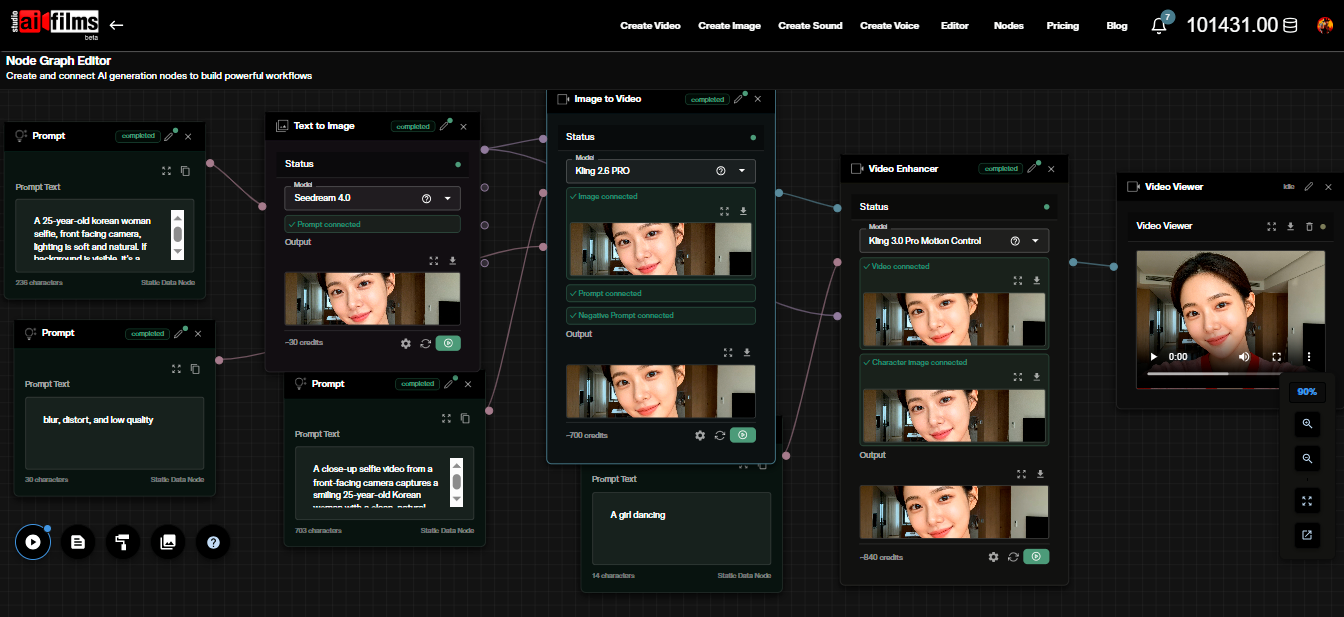
Filmmakers working in AI generation today can access text-to-video and image-to-video tools through AI FILMS Studio, independent of these industry negotiations. For a deeper look at the investment wave see The Hollywood AI Studio Boom: A Breaking Point for Film.
More Names From the 25
The Hollywood Reporter's full list extends well beyond the three figures covered most prominently. Ted Sarandos, Netflix co-CEO, appears for his public framing of AI as a creativity booster and his studio's documented use of generative tools on productions including The Eternaut. His position gives the technology a commercial endorsement from the world's largest streaming platform.
Lisa Joy and Jonathan Nolan, co-creators of Westworld, appear as figures whose career is built on anticipating how AI will transform human experience, and who are now navigating that technology as working producers. Their production company has been actively exploring AI tools for pre-production and development work. Alia Shawkat, who has been publicly vocal about performer AI rights, represents the actor perspective within the 25.
Kwan's Coalition in Practice
The Creators Coalition on AI reached 500 signatories faster than most comparable industry organizations. Its membership includes Oscar-winning directors, staff writers on major TV productions, and union members across SAG-AFTRA, the DGA, and the WGA. The coalition has submitted testimony to California legislative hearings on AB 2602 and AB 1836, the digital replica consent bills that became law in 2026.
Coalition advocacy also shaped specific provisions in the 2026 guild negotiations. The training data compensation framework that appeared in the WGA renewal, which requires studios to disclose when AI training datasets include covered writers' work, reflects arguments the coalition made in public testimony before the negotiation began. That legislative and contractual record is what put Kwan on the Hollywood Reporter list rather than in a category of symbolic protest.
The $3.08 Billion in Context
The $3.08 billion in VC investment in AI video generation companies in 2025 represents a near doubling of 2024 levels. The companies that attracted the most capital were concentrated in three categories: text-to-video generation platforms, AI assisted visual effects tools, and AI training data infrastructure. All three categories have direct Hollywood applications.
That capital level means the tools being tested on productions in 2025 and 2026 were funded to exist, not developed organically within studios. The startups receiving that investment are under pressure to generate revenue, which pushes them toward studio partnerships and production integrations rather than consumer facing products. The result is a direct pipeline from VC investment decisions to what tools show up on Hollywood productions.
Where the Two Camps Collide
The clearest collision between the infrastructure and organizing camps on the list occurred during the drafting of the SAG-AFTRA 2026 studios deal. The consent and disclosure provisions that the coalition had been advocating for synthetic performers and training data were on the table simultaneously with the studio interest in expanding AI tool use without per-use consent requirements.
The final agreement reflects a negotiated position: consent is required for principal performer replicas and for scanning backgrounds, but the thresholds and enforcement mechanisms were outcomes of that specific conflict between the people on this list representing each side. Neither camp got everything it wanted. Both can point to provisions the other side would not have included without their pressure.
What the List Leaves Out
The 25 most influential figures in Hollywood AI are overwhelmingly American, overwhelmingly working within the studio and platform system, and overwhelmingly operating at the executive or directorial level rather than the craftsperson level. International filmmakers building AI production tools in China, Japan, South Korea, and India are not represented. Union rank-and-file members who will be most directly affected by the outcomes of these negotiations are not represented.
The influence criterion is explicit in the Hollywood Reporter's framing, but it produces a specific kind of power map. The people with the most formal power over outcomes are named. The people who will live with those outcomes at the level of their daily work are absent.
The Next Twelve Months
The decisions the people on this list will make between mid-2026 and mid-2027 include: how the first round of training data compensation claims under the new guild agreements are handled; whether California's digital replica consent laws are tested in court or complied with; how the major streaming platforms disclose AI use on productions that have already finished; and what the next generation of guild agreements adds to what the 2026 cycle established.
Each of those decisions will be influenced by the individuals named on the Hollywood Reporter list, in ways that are not yet visible. The list is a map of the people to watch, not a prediction of outcomes.
How the List Was Reported and Its Methodology
The Hollywood Reporter published the AI Issue in May 2026 as a dedicated editorial project, the first time the publication had devoted a full issue to AI in entertainment. The selection methodology is not publicly detailed beyond the influence criterion. The publication's reporters and editors made the final selections based on reporting across the year, which means the list reflects who was making news with demonstrable industry impact rather than who had the largest social media following or the most prestigious title.
That reporting methodology produces a different list than an industry survey or a panel vote. People appear because they did things visible to trade journalists across the reporting period, not because they nominated themselves or were nominated by their peers. The absence of international figures reflects the publication's own coverage geography as much as it reflects actual power distribution.
What the Ranking Does Not Settle
The influence criterion the Hollywood Reporter applies is a useful filter but does not resolve the question of whether any specific person on the list is using that influence well. Mohan's position at YouTube gives him pull over how AI tools reach creators. Whether his decisions about deepfake detection, revenue sharing for AI assisted content, and AI tool development have been good for the creators who use YouTube is a separate question from whether he has industry power. The same applies to every name on the list.
The ranking is a starting point for understanding who is making decisions, not an endorsement of those decisions. The people with the most industry pull are not necessarily the most aligned with the interests of working creators, union members, or audiences. The list documents power as it exists, which is what makes it useful. The assessment of how that power is exercised belongs to the industry coverage that follows.
The Hollywood Reporter AI Issue in Context
The Hollywood Reporter's first dedicated AI Issue is itself an event in the story it covers. A trade publication that has served Hollywood since 1930 committing a full edition to AI in entertainment signals that AI is no longer a sidebar topic in industry coverage. The issue's framing around influence and power rather than enthusiasm or alarm represents an editorial choice that reflects where the industry actually is in mid-2026: past the debate about whether AI matters, into the practical question of who controls it.
The 25 Most Influential list is the most visible element of the issue but not the only one. The surrounding coverage addresses AI in specific production categories, the state of guild AI provisions eighteen months after the major contract cycles, and the investment picture that is funding the tools the list's subjects are deploying. That editorial package represents the trade press catching up to the pace of industry change.
The publication of a dedicated AI Issue also functions as a professional signal to the people on the list. Being named in a publication that has covered the industry for nearly a century carries weight that a digital-native publication's ranking would not carry in the same way. The Hollywood Reporter's imprimatur validates the importance of each person's work in the terms that Hollywood's institutional culture respects, which affects how those people are perceived by studios, guilds, and investors who use trade press as a barometer of who matters in a given moment.
The first dedicated AI Issue is a document of where the industry stood in mid-2026, when the debate had moved past whether AI would affect entertainment into who would control how it did. The 25 people named are the proximate answer to that question for this moment. For the AI filmmaking tools driving this shift, try text-to-video and image generation directly in AI FILMS Studio.
Sources
The Hollywood Reporter
Continue Reading
.jpg?w=3840)


Video & LipSync
- Video Generator
- Text to Video
- Image to Video
- Start-End Frame to Video
- Draw to Video
- Motion Control
- Video Enhancer
- Video Upscaler
- Video Extend
- Video to Video LipSync
- Audio to Video LipSync
- Image to Video LipSync
- Video FaceSwap
- Seedance 2.5
- WAN 3.0
- Seedance 2
- FLUX 3
- Minimax H3
- Vidu Q3 Pro
- Grok Imagine Video 1.5
- Gemini Omni
- Google Veo 3.1
- Kling 3.0 Pro
- Luma Ray 3.2
- LTX 2.3
- Happy Horse 1.1
- Kling 3.0 Motion
- ByteDance Upscaler
- InfiniteTalk
- InsightFace
Image & Edit
- AI Character
- AI Actor
- Art Generator
- Text to Image
- Image to Image
- LoRA Image to Image
- Draw to Edit
- Image LoRA Training
- Remove Background
- Image Enhancer
- MidJourney 8.0
- Krea 2
- OpenAI GPT Image 2.0
- Nano Banana Pro Ultra
- Nano Banana 2 Lite
- Nano Banana Pro
- Minimax Image
- Clarity Pro
- Z-Image Turbo LoRA
- Krea 2 Turbo LoRA
- Z-Image LoRA Trainer
- Qwen Image LoRA Trainer
- Background Erase Network 2 (BEN2)