
'I'm Popo': South Korea's Breakthrough AI Theatrical Feature

Share this post:
'I'm Popo': South Korea's Breakthrough AI Theatrical Feature
On May 21, 2026, two AI theatrical features opened simultaneously in South Korean cinemas. One of them, "I'm Popo," was made almost entirely by one person in two months. Its director, Kim Il-dong, wrote the script and ran every AI prompt himself, with professional voice actors brought in for audio. He had no production crew in the traditional sense.
Kim is a webtoon artist making his feature film debut. His goal was explicit: "What I wanted to argue most with this project is that the era of the one person film has arrived."
Kim Il-dong as a Webtoon Artist
Webtoon is South Korea's native digital comics format, consumed on mobile. Major platforms include KakaoPage and Naver Webtoon. A webtoon artist's relationship with narrative is panel by panel and scroll optimized, which creates different instincts for pacing and visual storytelling than conventional cinema training.
Kim's background means he approached the AI generation workflow as a visual storyteller who was not constrained by traditional film production expectations. Panel composition, pacing across a vertical scroll, and visual emphasis without camera movement are skills from the webtoon format that transferred directly to selecting and assembling AI generated frames. He was not trying to replicate how a film crew would produce the same result. He was working within the logic of the tools he had.
Webtoon storytelling also operates without dialogue direction, sound design, or the kinetic energy that camera movement provides in conventional film. What it relies on instead is still image impact and sequence rhythm. Those are the exact qualities that determine whether an AI generated image is usable in a given scene, which means Kim's professional training is a better preparation for AI film production than conventional cinematography training would have been.
A Story About the Algorithm
"I'm Popo" runs 64 minutes. In it, an AI robot police officer in a near future society identifies a child as a future criminal and moves to eliminate the threat before any crime occurs. The child's father takes the algorithm to court. The film positions algorithmic certainty against human moral judgment without resolving the tension in either direction.
The plot mirrors the real world debate around AI decision systems, written by a director who built the film using exactly those tools. Kim's production company is Interconmedia Intl., with Korean distribution handled by Cinema Newone.
Two Months, No Crew
The production model for "I'm Popo" is the more disruptive story. Kim wrote the script, ran the AI prompts, and assembled the visuals largely alone. There are no on screen performers. The entire runtime is AI generated imagery, with voice actors providing the audio track after the visuals were complete.
The process took roughly two months from start to finish. For context, a conventional Korean theatrical feature at similar runtime would typically involve a crew of dozens and a production timeline measured in years, not weeks.
The two month figure covers the full production cycle: script, generation, assembly, audio post, and delivery. That compressed timeline has implications for production finance as much as for crew structure. A conventional theatrical feature accumulates crew costs over an extended period. A two month production accumulates costs only over two months. The break even point for a film produced in two months is dramatically lower than for a film produced over two years, which is what makes the theatrical release a commercially rational decision even at small screen counts.
What AI Tools a Two Month Feature Required
The 64 minute runtime at 24 FPS is 92,160 frames. AI video generation at current tool speeds does not produce 92,160 consecutive frames from a single prompt. The workflow involves multiple generation passes, visual assembly in a video editor, and continuity management across individually generated clips.
What Kim ran specifically has not been fully disclosed, but the combination of webtoon pacing instincts and AI image generation tools suggests a workflow closer to illustration assembly than to camera production. Each sequence is a series of AI generated images rather than continuous video, which is how webtoon panels translate to motion picture form. The continuity challenges of maintaining character appearance across dozens of separately generated clips are the central technical problem of the format, and solving them is what the two months were spent on.
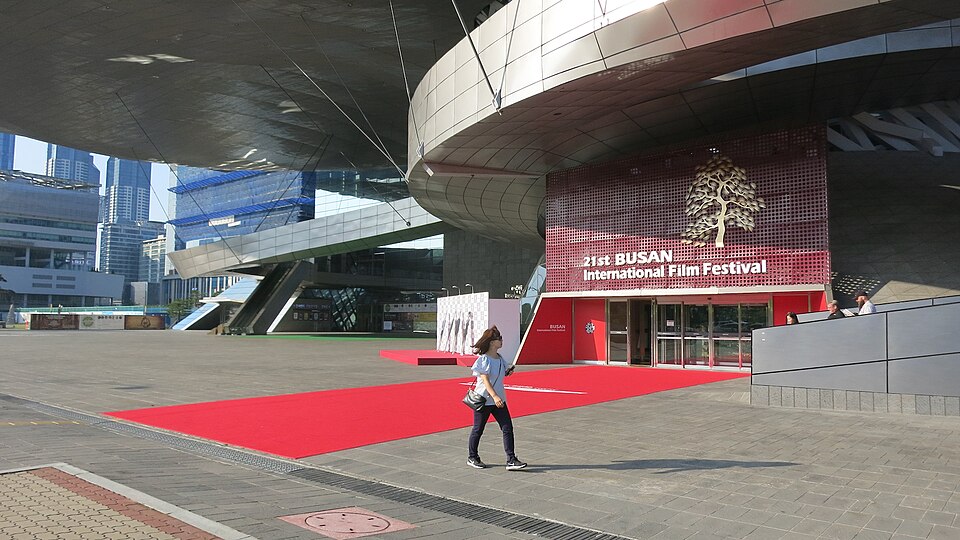
The Busan International Film Festival, the platform that has launched many of South Korea's most internationally recognized films. 399scout, CC BY-SA 4.0, via Wikimedia Commons
Before its Korean theatrical release, "I'm Popo" screened internationally. It played at Spain's Girona Film Festival and at Russia's Amur Autumn International Film Festival, where screenings sold out. The film won the Grand Prize at the Korea AI Content Awards before its theatrical opening.
Festival Circuit and Recognition
The award from the Korea AI Content Awards is significant as a formal institutional recognition of AI generated filmmaking in South Korea, not a niche online competition. The Korea AI Content Awards is the country's primary festival platform dedicated specifically to AI film, awarding productions across multiple categories with a jury drawn from the domestic film industry.
Kim debuted the project at the Seoul Film Center before taking it to international markets. The sequence, domestic award then international festival circuit then theatrical release, is the same path Korean independent films have followed for two decades when building credibility before a commercial opening.
The Seoul Film Center debut is not a small venue. It is operated by the Korean Film Council and functions as the country's primary platform for domestic independent film premieres. Kim chose the institutional venue rather than a digital first release, which signals an intent to be evaluated as a theatrical filmmaker rather than as a technology demonstrator. That distinction matters for how the film is reviewed, who reviews it, and what the subsequent critical record looks like when distributors in other markets assess it.
Cinema Newone and Korean AI Distribution
Cinema Newone handled the Korean theatrical distribution for "I'm Popo". Independent theatrical distribution for AI generated features requires the same infrastructure as conventional independent film: screen count, booking, and marketing support for a title opening in competition with studio releases.
The fact that Cinema Newone booked the film into theatrical release at all is a commercial signal. A distributor takes on costs when they commit to a theatrical run. Cinema Newone's decision to distribute "I'm Popo" is an investment based on projected ticket sales, not a curatorial statement about AI cinema. That is a different and more durable kind of validation than a festival prize.
"I'm Popo" is not South Korea's only AI theatrical release in May 2026. "Man in Hanbok," directed by Lee Sang-hoon and based on his best selling novel, also opened May 21, using AI to reconstruct Joseon court scenes and Renaissance Italy for a historical fantasy. Both films are produced by Interconmedia Intl., and both won recognition at the Korea AI Content Awards.
A third Korean AI feature, MBC C&I's [Raphael, presented at Cannes 2026 by director Eekjun Yang](/blog/raphael-korea-ai-theatrical-feature-kling-cannes), is targeting a September theatrical release on a $700,000 to $2 million budget with a seven person team.

Actress Maggie Kang at the Busan International Film Festival 2025. Outhere505, CC BY-SA 4.0, via Wikimedia Commons
Predictive Crime Prevention as a Korean Subject
Algorithmic decision systems have been debated in Korean public policy in the context of financial credit scoring and social welfare allocation. The premise of "I'm Popo," a robotic police officer using algorithmic certainty to identify and preemptively eliminate a future threat, combines Korean policy concerns with global AI governance debates about accountability and due process.
The film's near future setting makes the premise feel proximate rather than speculative. Korean audiences have watched the country's welfare and credit scoring systems move toward algorithmic automation in visible ways over the past decade. A film that places the same logic inside a policing scenario is not asking them to imagine a distant future. It is extending a familiar pattern into a domain where its implications are more severe.
Kim also chose a father and child as the human opposition to the algorithm, rather than a civil rights lawyer or a technology activist. That casting of the moral opposition is a narrative choice about who the audience is supposed to identify with. A father trying to save his child from a predictive system is a universally comprehensible position that does not require the audience to have strong prior views on AI governance. The film is arguing about algorithmic accountability through the most accessible emotional frame available, which is one reason it crossed language and market boundaries at festivals that had no particular investment in Korean AI policy debates.
The Grand Prize at Korea AI Content Awards
The award from the Korea AI Content Awards formally classifies AI filmmaking as a competitive category within Korean cinema rather than treating it as a subcategory of digital art or experimental film. Winning it before theatrical release gave Kim's film a credential that independent distribution in a commercial market requires.
A film without festival recognition faces a higher burden of proof when approaching a distributor. The Grand Prize functions as a trusted third party signal: a jury of industry professionals evaluated the film and found it worthy of the top award in its category. Cinema Newone's theatrical commitment likely depended on that signal as much as on the film's content.
The Korea AI Content Awards also establishes a competitive ladder for AI filmmakers working in Korea. A director who wins the Grand Prize in one year has a credential that positions them for larger budget and more visible projects in the next cycle. The awards mechanism is the same one that built the Korean independent film industry's international reputation from the 1990s forward: institutional recognition creates the conditions for commercial investment, which creates the conditions for the next generation of filmmakers to attempt more ambitious projects.
Girona and Amur Autumn: International Reception
Girona Film Festival is a Spanish festival with a focus on genre and international independent film. Amur Autumn is a Russian international festival. Sold out screenings in both markets for a 64 minute Korean AI feature without conventional distribution means audience interest in AI cinema exists outside the Korean domestic market and outside the major Western markets where most AI film discourse originates.
The specific markets are also telling. Neither Girona nor Amur Autumn is a top tier festival by the standard ranking systems. Kim and Cinema Newone were not chasing Sundance or Berlin. They were building a record of actual audience attendance at secondary markets, which is evidence of real demand rather than critical interest. Sold out screenings at secondary markets are a more commercially relevant signal than a screening slot at a major festival that fills based on reputation.
International screenings also test whether the film's thematic argument travels without cultural context. The predictive policing premise in "I'm Popo" is a Korean story, made by a Korean director, speaking to Korean policy anxieties. Sold out screenings in Spain and Russia suggest the thematic argument lands for audiences who did not bring Korean political context to it. That portability is what makes international distribution viable and what gives Cinema Newone grounds for optimism about the film's continued festival run before its streaming release.
Where Korea Fits
South Korea has moved faster on AI theatrical releases than most markets. "Run to the West" in October 2025 was the first Korean AI integrated theatrical feature. "I'm Popo" and "Man in Hanbok" arriving together a year later suggests the pace is accelerating rather than plateauing.
The South Korean market is also a proving ground discussed at major Asian film markets. Director Carlos Saldanha addressed AI's role in production at the Busan International Film Festival, and the Hong Kong FilMart hosted extensive AI programming. Jia Zhangke's AI experiments at FilMart drew attention to how Asian directors are approaching the technology from a different angle than Hollywood. At Cannes 2026, Yeon Sang-ho's Colony took a more cautious position, using AI only to generate zombie crowds while making collective AI logic the film's central horror.
The contrast between Yeon Sang-ho's Cannes position and Kim Il-dong's solo production argument represents the range currently visible in Korean AI filmmaking. Yeon is an established director with a produced track record using AI as a specific production tool for specific problems. Kim is a debut director treating AI as the entire production infrastructure. Both approaches appeared at international markets in the same month, which is why Korean AI cinema is being discussed as a movement rather than as a series of isolated experiments.
What the One Person Film Era Requires
Kim's argument is that AI removes the production infrastructure that previously made a feature film require a crew. What AI removes: the need for cinematographers, set designers, prop masters, and on screen performers. What remains: script, editorial judgment, voiceover casting, and the time to manage generation outputs across a two month production window.
Kim's claim is about crew size, not creative quality. The question the film's theatrical release tests is whether audiences respond to the result at the same level they respond to crew made films. The sold out international screenings and Grand Prize suggest that at the length and production scale of "I'm Popo," the answer is yes.
The "one person film" argument also redefines what a film budget means. A two month production with no crew and no performers has a cost structure that consists primarily of the director's time and the generation tool subscriptions or API costs. If the total cost is under $10,000, "I'm Popo" is a theatrical feature made at a budget that would barely cover a short film's location fees in a conventional production. Kim has not published his exact costs, but the crew structure makes the order of magnitude clear. A film that earns more than it costs to generate, even at small screen counts, is commercially viable by the definition that applies to every other film format. Korean distributors are watching whether "I'm Popo" clears that bar.
"Man in Hanbok," produced by the same company with a larger historical scope, operates at a different production scale than "I'm Popo." The two films opening on the same day from Interconmedia Intl. demonstrate that AI theatrical production is not limited to a single budget tier or production model. One film is a solo argument; the other is a larger project with institutional backing. Together they are a range, not a single data point.
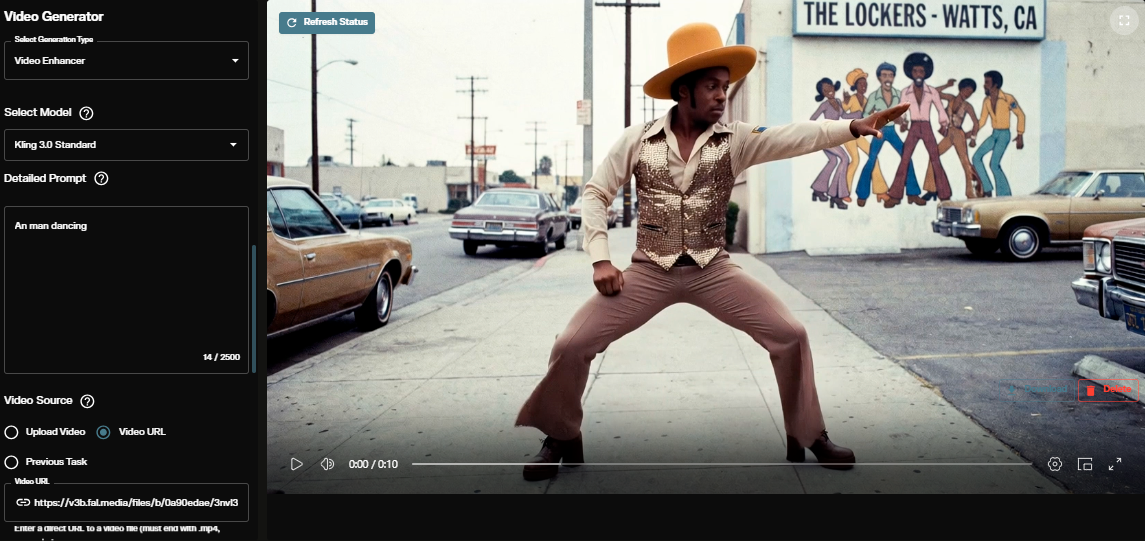
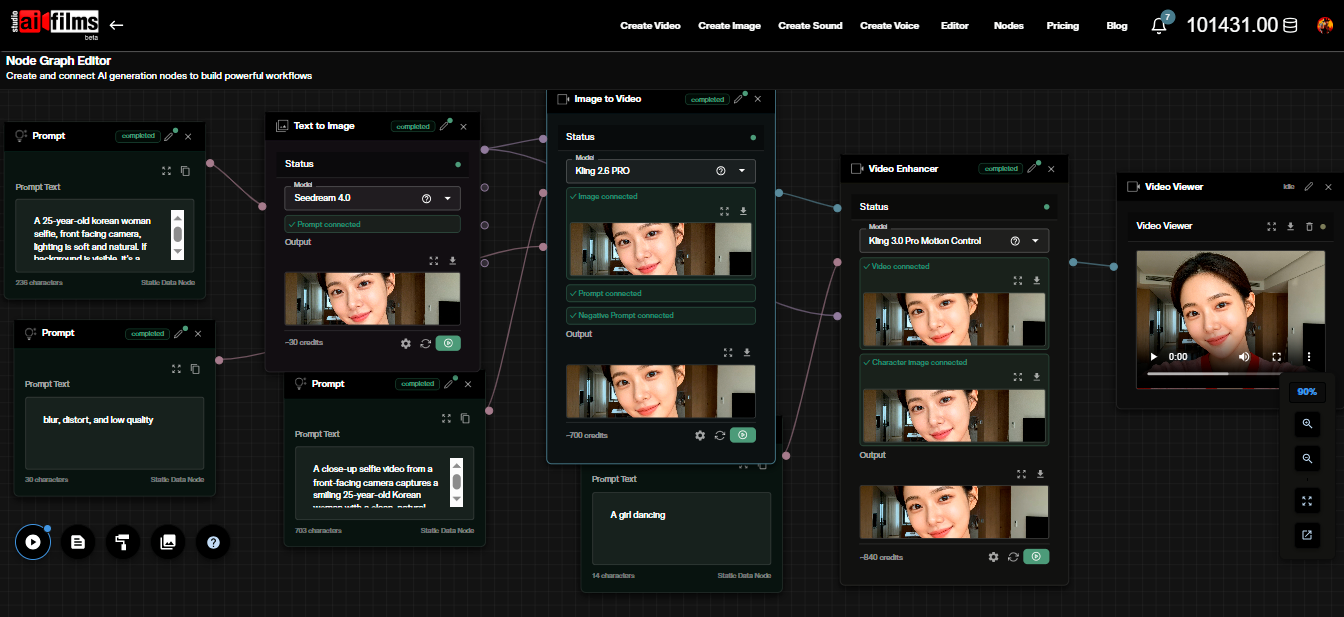
Kim Il-dong's argument, built into the film and stated directly, is that the tools now exist for a single person to take a story from concept to theater without a production infrastructure. Filmmakers exploring the same tools can access the AI FILMS Studio video workspace to test what those workflows look like in practice.
Sources
Variety | The Korea Herald
Continue Reading
.jpg?w=3840)


Video & LipSync
- Video Generator
- Text to Video
- Image to Video
- Start-End Frame to Video
- Draw to Video
- Motion Control
- Video Enhancer
- Video Upscaler
- Video Extend
- Video to Video LipSync
- Audio to Video LipSync
- Image to Video LipSync
- Video FaceSwap
- Seedance 2.5
- WAN 3.0
- Seedance 2
- FLUX 3
- Minimax H3
- Vidu Q3 Pro
- Grok Imagine Video 1.5
- Gemini Omni
- Google Veo 3.1
- Kling 3.0 Pro
- Luma Ray 3.2
- LTX 2.3
- Happy Horse 1.1
- Kling 3.0 Motion
- ByteDance Upscaler
- InfiniteTalk
- InsightFace
Image & Edit
- AI Character
- AI Actor
- Art Generator
- Text to Image
- Image to Image
- LoRA Image to Image
- Draw to Edit
- Image LoRA Training
- Remove Background
- Image Enhancer
- MidJourney 8.0
- Krea 2
- OpenAI GPT Image 2.0
- Nano Banana Pro Ultra
- Nano Banana 2 Lite
- Nano Banana Pro
- Minimax Image
- Clarity Pro
- Z-Image Turbo LoRA
- Krea 2 Turbo LoRA
- Z-Image LoRA Trainer
- Qwen Image LoRA Trainer
- Background Erase Network 2 (BEN2)