

Sakura Temple Garden Three.js scene render by CCORE (Apache 2.0)
Share this post:
Qwen3.5-4B-3D-Coder: Open Source 3D Scene AI for Film
Previsualization stalls when art departments wait days for rough 3D set blockouts. Qwen3.5-4B-3D-Coder, released by independent developer CCORE in late October 2026 under the Apache 2.0 license, generates standalone interactive Three.js 3D scenes from plain text prompts or optional reference images. Built on the 4B Qwen3.5 backbone and trained on 4,146 curated scene examples, it ships in FP16 Safetensors as well as Q4_K_M and Q8_0 GGUF builds that run on modest local GPUs.
Studio availability. Try the public Hugging Face demo below; Qwen3.5-4B-3D-Coder is not part of a paid AI FILMS Studio plan (use FLUX.2 Pro Text to Image in the image workspace for example instead).
Try Qwen3.5-4B-3D-Coder Live
Test text to 3D scene code generation directly in the embedded Hugging Face Space below. The embed is sized to full height (1500 px) so the controls and interactive 3D viewport stay visible without inner scrolling.
Architecture and Technical Design
Qwen3.5-4B-3D-Coder is an independent fine tune of Qwen/Qwen3.5-4B trained on the public ccore/ThreeJS-3D-Scenes dataset (3,933 training examples and 213 validation examples under the MIT license). Each training sample pairs a spatial description with reasoning traces and complete HTML and JavaScript targeting Three.js 0.160.0 core ES modules. Rather than outputting noisy point clouds or heavy raw meshes, the model emits clean parametric scene graphs with lighting, geometry transforms, and camera orbit controls inside a single HTML file.
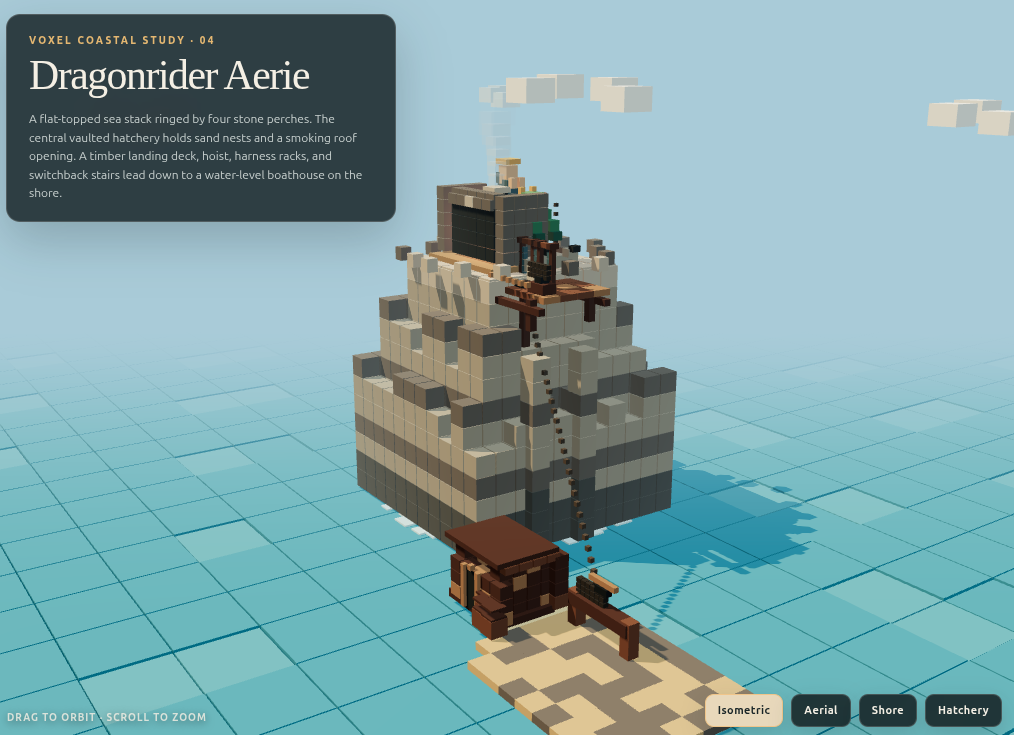
Dragonrider Aerie Three.js render by CCORE (Apache 2.0)
An October 30, 2026 update added optional multimodal vision conditioning for the GGUF builds. By loading the unmodified 644 MiB mmproj-Qwen3.5-4B-BF16.gguf vision projector alongside either the Q4_K_M or Q8_0 checkpoint, directors can attach a concept sketch or location photo and request a matching Three.js set blockout.
Because the output is standard JavaScript, cinematographers can open the generated HTML in any browser, orbit the camera to test lens angles, and edit dimensions or lighting coordinates directly in code without waiting for another diffusion pass.
The October 27 checkpoint refresh substantially raised single pass compile reliability and fixed earlier layer alignment bugs. The creator notes that occasional duplicate variable names can still occur in complex scenes, so a quick browser console check remains part of the workflow.
Hardware, VRAM, and License Matrix
| Format / Build | Precision | Approx. VRAM (with 64K ctx) | Vision Projector (mmproj) |
License | Recommended Use |
|---|---|---|---|---|---|
Qwen3.5-4B-3D-Coder (Safetensors) |
FP16 (4 shards) | ~10 to 12 GB | Built into Transformers config | Apache 2.0 | Local Python pipelines and batch scene generation |
Qwen3.5-4B-3D-Coder-Q8_0.gguf |
8 bit GGUF | ~6 to 8 GB | Optional 644 MiB BF16 projector | Apache 2.0 | High fidelity desktop blocking with llama-server |
Qwen3.5-4B-3D-Coder-Q4_K_M.gguf |
4 bit GGUF | ~4 to 6 GB | Optional 644 MiB BF16 projector | Apache 2.0 | Laptops, compact GPUs, and fast look development |
ccore/ThreeJS-3D-Scenes dataset |
Text + previews | N/A | Optional preview images | MIT | Fine tuning custom studio architectural styles |
Both the model weights and the companion vision projector carry the permissive Apache 2.0 license, while the 4,146 example training dataset carries the MIT license. Studios can run the weights locally on air gapped workstations and incorporate generated scene code into commercial previsualization pipelines without royalty restrictions.
Parameter Reference
| Parameter | Recommended Value | Behavior and Production Impact |
|---|---|---|
temperature |
0.6 to 0.8 (FP16 default 0.6) |
Lower values reduce JavaScript syntax errors; higher values diversify prop layouts |
top_p |
0.90 to 0.95 (FP16 default 0.95) |
Keeps geometric construction coherent while preserving architectural detail |
top_k |
20 to 40 (FP16 default 20) |
Bounds token selection so Three.js API calls remain valid |
repeat_penalty |
1.0 |
Prevents the model from corrupting repeated mesh coordinate loops |
ctx-size |
65536 |
Leaves enough room for vision tokens, reasoning traces, and long HTML scripts |
--cache-type-k / -v |
q8_0 |
Cuts KV cache memory usage during 64K vision conditioned sessions |
| Multi Token Prediction (MTP) | Disabled | Must be turned off in LM Studio or output code degrades |
Local Python and CLI Setup
Run the GGUF checkpoint with vision conditioning locally using llama.cpp (b11889 or newer). Download the quantized weights and the 644 MiB BF16 projector, then launch the local WebUI server.
hf download ccore/Qwen3.5-4B-3D-Coder \
  Qwen3.5-4B-3D-Coder-Q4_K_M.gguf \
  mmproj-Qwen3.5-4B-BF16.gguf \
  --local-dir ./qwen35-3d-coder

llama-server \
  -m ./qwen35-3d-coder/Qwen3.5-4B-3D-Coder-Q4_K_M.gguf \
  --mmproj ./qwen35-3d-coder/mmproj-Qwen3.5-4B-BF16.gguf \
  --n-gpu-layers all --flash-attn on \
  --ctx-size 65536 --parallel 1 \
  --cache-type-k q8_0 --cache-type-v q8_0
For Python pipelines with the full FP16 Safetensors weights (verified on transformers>=5.20.2), always supply the official Three.js system prompt so the model imports only the core ES module and builds camera controls inline.
import torch
from transformers import AutoModelForCausalLM, AutoTokenizer

model_id = "ccore/Qwen3.5-4B-3D-Coder"
tokenizer = AutoTokenizer.from_pretrained(model_id)
model = AutoModelForCausalLM.from_pretrained(
    model_id, torch_dtype=torch.float16, device_map="auto"
)

messages = [
    {
        "role": "system",
        "content": (
            "Use only the Three.js core ES module from "
            "https://cdnjs.cloudflare.com/ajax/libs/three.js/0.160.0/three.module.min.js. "
            "Do not import addons or legacy examples/js paths; "
            "implement any camera controls directly inside the HTML."
        ),
    },
    {
        "role": "user",
        "content": (
            "Create one self-contained HTML file with Three.js showing a "
            "soundstage interior with two overhead lighting trusses, a cyclorama wall, "
            "and a camera dolly track facing center stage."
        ),
    },
]

prompt = tokenizer.apply_chat_template(messages, tokenize=False, add_generation_prompt=True)
inputs = tokenizer(prompt, return_tensors="pt").to(model.device)
out = model.generate(
    **inputs, max_new_tokens=8192, temperature=0.6, top_p=0.95, top_k=20, repetition_penalty=1.0
)
print(tokenizer.decode(out[0][inputs["input_ids"].shape[1]:], skip_special_tokens=True))
Filmmaker Production Playbook
1. Concept art to navigable 3D blockout. Start by generating a wide establishing frame on the AI text to image generator, then attach that still to Qwen3.5-4B-3D-Coder with the vision projector enabled. Within a minute, you get a rotatable 3D spatial layout to verify sightlines and blocking before building physical or Unreal sets.
2. Capture clean camera keyframes for video models. Orbit the generated Three.js scene to frame exact wide, medium, and high angle shots. Export those viewport stills and feed them into an image-to-video pipeline so every cut in your sequence shares consistent spatial geometry.
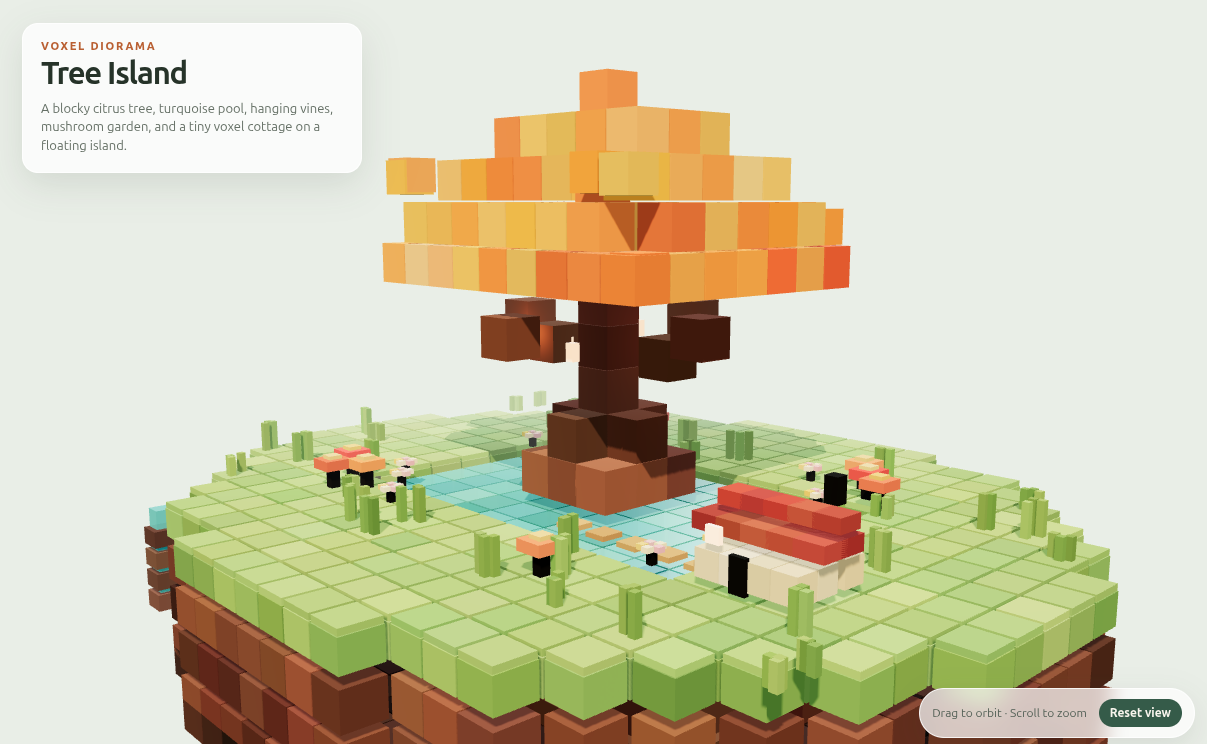
Vision guided Three.js output by CCORE (Apache 2.0)
- Iterate lighting and scale by editing plain variables. Unlike opaque 3D diffusion meshes, Three.js scripts expose directional lights, fog density, and prop positions as readable numbers. Directors can nudge a key light angle or widen a corridor in five seconds and reload the browser tab.
- Watch for the companion GLB release. CCORE has already published an early preview of
Qwen3.5-4B-GLB-3D-Coderaimed at reusable GLB exports for engines like Godot and Blender, making this small model family worth tracking for independent VFX teams.
Related Reading
- SplatAnything & Pi4: Open Source 3D & 4D Scene AI
- Idol & OOOSplat: Open Source 3D Gaussian Splatting for Film
- HY-World 2.0: Open Source 3D World and 360 Panorama AI
- HunyuanWorld Mirror: Generate Complete 3D Scenes from Single Image
For production concept art and storyboard keyframes in the cloud, explore the text to image page or launch the image workspace.


Sources
Continue Reading


Video & LipSync
- Video Generator
- Text to Video
- Image to Video
- Start-End Frame to Video
- Draw to Video
- Motion Control
- Video Enhancer
- Video Upscaler
- Video Extend
- Video to Video LipSync
- Audio to Video LipSync
- Image to Video LipSync
- Video FaceSwap
- Seedance 2.5
- WAN 3.0
- Seedance 2
- FLUX 3
- Minimax H3
- Vidu Q3 Pro
- Grok Imagine Video 1.5
- Gemini Omni
- Google Veo 3.1
- Kling 3.0 Pro
- Luma Ray 3.2
- LTX 2.3
- Happy Horse 1.1
- Kling 3.0 Motion
- ByteDance Upscaler
- InfiniteTalk
- InsightFace
Image & Edit
- AI Character
- AI Actor
- Art Generator
- Text to Image
- Image to Image
- LoRA Image to Image
- Draw to Edit
- Image LoRA Training
- Remove Background
- Image Enhancer
- MidJourney 8.0
- Krea 2
- OpenAI GPT Image 2.0
- Nano Banana Pro Ultra
- Nano Banana 2 Lite
- Nano Banana Pro
- Minimax Image
- Clarity Pro
- Z-Image Turbo LoRA
- Krea 2 Turbo LoRA
- Z-Image LoRA Trainer
- Qwen Image LoRA Trainer
- Background Erase Network 2 (BEN2)