
ReCamMaster & Uni3C: Open Source Camera Control Video AI

Jianhong Bai et al., ReCamMaster (ICCV 2025 Best Paper Finalist, MIT License)
Share this post:
ReCamMaster & Uni3C: Open Source Camera Control Video AI
ReCamMaster (Camera-Controlled Generative Rendering from A Single Video, arXiv:2503.11647, ICCV 2025 Best Paper Finalist under the MIT license) and Uni3C (Unifying Precisely 3D-Enhanced Camera and Human Motion Controls for Video Generation, arXiv:2504.14899, Apache 2.0) are two open source frameworks built on Wan 2.1 that give filmmakers post production control over camera trajectories and actor blocking. ReCamMaster (KwaiVGI/ReCamMaster-Wan2.1) takes any monocular video clip and re-renders the exact dynamic action along a new pan, tilt, arc, or dolly trajectory. Uni3C (ewrfcas/Uni3C) pairs a lightweight PCDController point cloud module with 3D SMPL-X body meshes to steer both 6-DoF camera movement and full body human choreography simultaneously.
Studio availability. ReCamMaster and Uni3C are not available in AI FILMS Studio. This article covers public research releases. To direct camera and character motion in the Studio, see the models listed on the Motion Control page or open the video workspace.
ReCamMaster reshooting single input videos along novel 3D camera trajectories on Wan 2.1
Uni3C joint 3D camera orbit and SMPL-X human character motion control
How ReCamMaster Reshoots Monocular Footage Along New Camera Paths
Text-to-video and image-to-video camera controllers can move the camera around a static starting frame, but they cannot preserve the exact timing, lip sync, and secondary motion of an already filmed video clip. ReCamMaster solves video-to-video camera rerendering by conditioning Wan2.1-T2V-14B on an entire source video token sequence alongside a target 6-DoF extrinsic trajectory.
- Frame dimension token concatenation. After encoding the source video
V_sinto latent tokensz_sthrough the 3D VAE, ReCamMaster concatenates the source video tokens with the noisy target video tokensz_talong the frame dimension ([z_t, z_s]). Full 3D self attention across both sequences synchronizes moving limbs, water splashes, and background motion frame for frame. - 3D camera extrinsic projection. Each frame's
R, tcamera matrix (3x4) is projected into the transformer token dimension and added before the spatial and temporal attention blocks. - MultiCamVideo-Dataset training. To teach the model multi view synchronization, the authors released the open source
KwaiVGI/MultiCamVideo-Dataset(136,000synchronized multi camera videos rendered in Unreal Engine 5 across 34 scenes and 10 focal lengths).
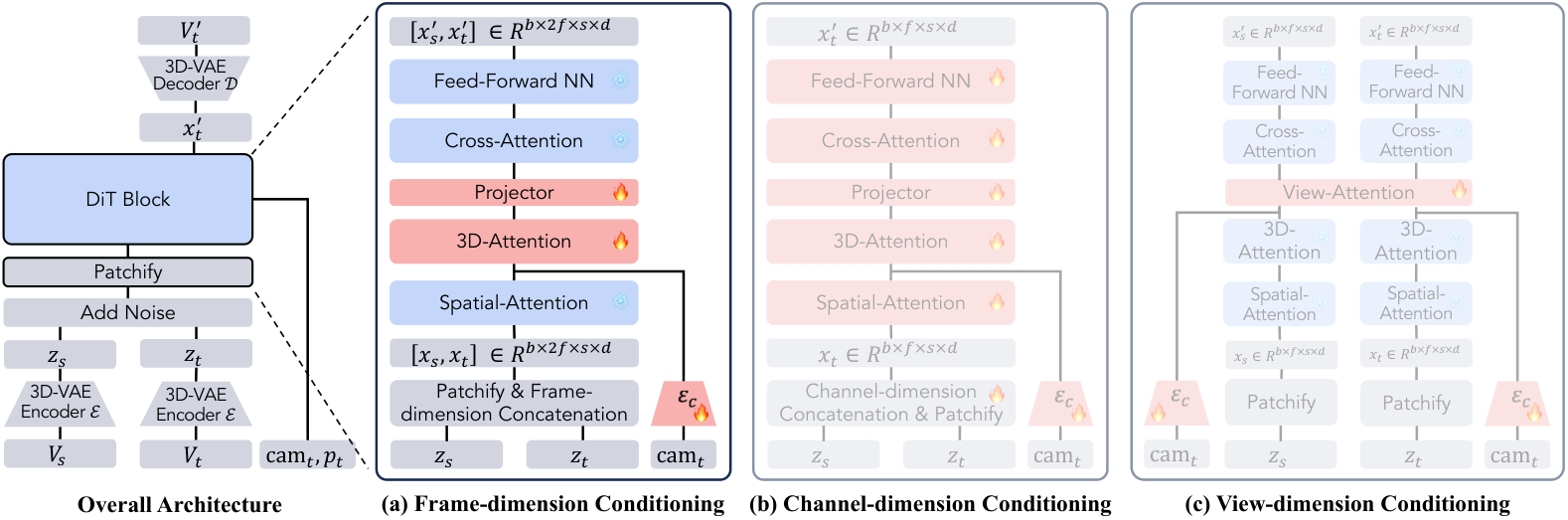
ReCamMaster concatenates source and target video tokens along the frame dimension for synchronized rerendering. Credit: Jianhong Bai et al. (MIT License).
Concatenating source and target tokens along the frame dimension outperforms channel concatenation and cross attention adapters on both appearance fidelity and temporal synchronization.
Directors can feed a static tripod shot into ReCamMaster and output 10 preset camera arcs, pans, tilts, and dolly zooms while every actor gesture stays locked to the original take.
How Uni3C Unifies 3D Point Cloud Camera and SMPL-X Human Motion Control
When generating a shot from a single reference frame where both the camera and the actor perform complex 3D choreography, 2D skeleton stick figures (DWpose) collapse under steep camera tilts or 360 degree orbits. Uni3C unifies camera and human motion in shared 3D world coordinates so camera translation and actor movement never conflict.
Uni3C unprojects the reference image using monocular depth (`Depth-Anything-V2`) into a 3D point cloud and places a parametric 3D SMPL-X human body mesh inside the same metric world space.
A plug and play control module called PCDController (`943M` parameters, trained with a frozen `Wan2.1-14B` backbone) ingests the rasterized point cloud and SMPL-X depth maps, enabling zero shot transfer between camera control and character animation checkpoints.
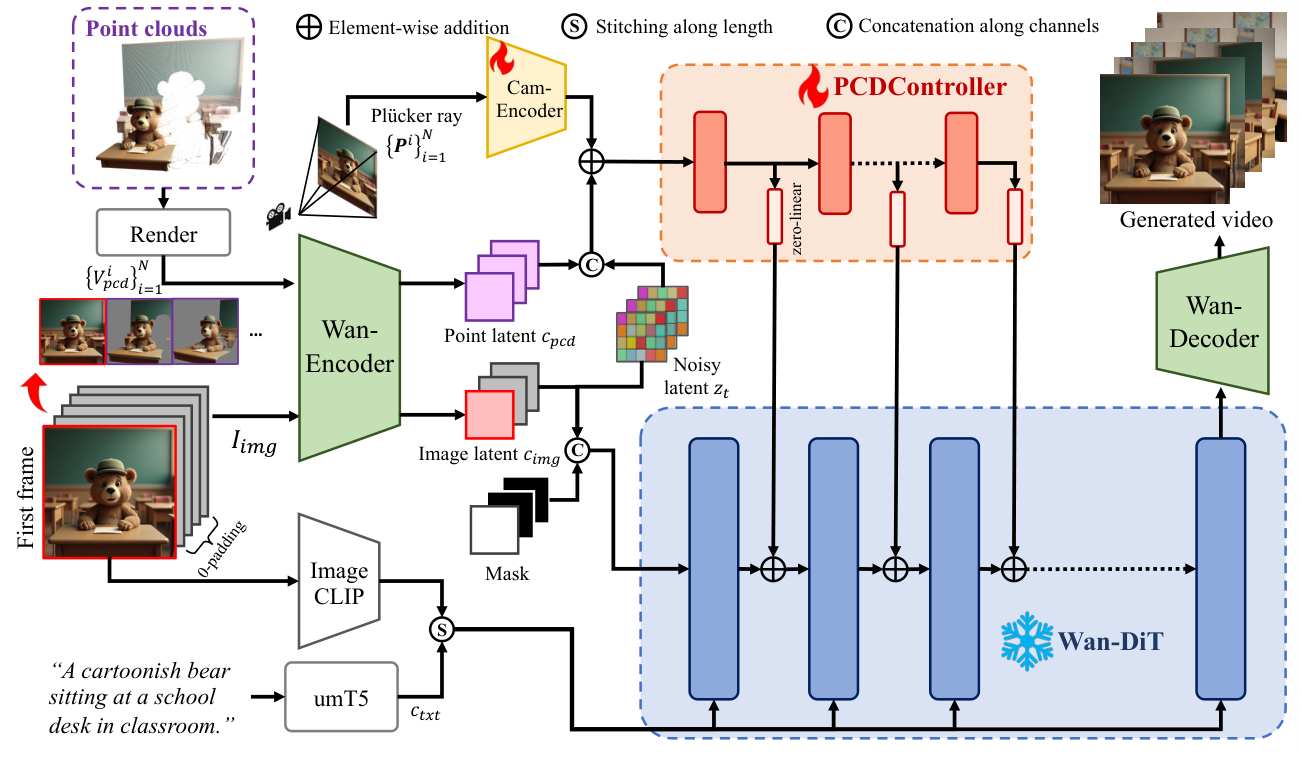
Uni3C unifies unprojected 3D background point clouds and SMPL-X human meshes through the PCDController. Credit: Chenjie Cao et al. (Apache 2.0).
Hardware, VRAM & Model Comparison
| Framework | Checkpoint & Backbone | Core Capability | Hardware & VRAM | License |
|---|---|---|---|---|
| ReCamMaster | KwaiVGI/ReCamMaster-Wan2.1 (Wan2.1-T2V-14B) |
Video-to-video camera trajectory rerendering (81 frames, 832x480) |
24 GB to 40 GB VRAM (supports DiffSynth VRAM management) | MIT License |
| Uni3C PCDController | ewrfcas/Uni3C (943M plug and play controller on Wan2.1-I2V-14B) |
Joint 6-DoF 3D camera + SMPL-X human motion control (480p / 720p) |
24 GB VRAM (with CPU offload / FP8) to 48 GB VRAM | Apache 2.0 |
| MultiCamVideo Dataset | KwaiVGI/MultiCamVideo-Dataset |
136K multi camera UE5 training clips with exact extrinsics | Dataset download (CC BY 4.0) |
CC BY 4.0 |
Running ReCamMaster and Uni3C Locally
To run ReCamMaster on an existing video clip, install DiffSynth-Studio, download Wan-AI/Wan2.1-T2V-14B and KwaiVGI/ReCamMaster-Wan2.1/step20000.ckpt, and specify the target camera trajectory type (1 through 10 for pan, tilt, arc, and zoom moves).
git clone https://github.com/KwaiVGI/ReCamMaster.git
cd ReCamMaster
pip install -e .

huggingface-cli download KwaiVGI/ReCamMaster-Wan2.1 step20000.ckpt --local-dir ./models/ReCamMaster/checkpoints

python inference_recammaster.py \
  --cam_type 1 \
  --dataset_path ./example_test_data \
  --ckpt_path ./models/ReCamMaster/checkpoints/step20000.ckpt \
  --output_dir ./results
To run Uni3C with joint 3D camera and SMPL-X human motion guidance, clone ewrfcas/Uni3C and execute the unified inference pipeline.
git clone https://github.com/ewrfcas/Uni3C.git
cd Uni3C
pip install -r requirements.txt

python infer_uni3c.py \
  --reference_image data/demo_uni3c/reference.png \
  --motion_seq data/demo_uni3c/smplx_motion.pkl \
  --cam_traj orbit_360 \
  --output_path ./outputs/uni3c_shot.mp4
Filmmaker Blocking Workflows & AI FILMS Studio
In editorial and visual effects pipelines, ReCamMaster rescues flat or locked off takes by adding virtual dolly arcs or crane rises after principal photography. When designing action sequences from storyboard stills, Uni3C lets previsualization artists animate 3D character blocking and camera work together in one pass.
For related open source camera and motion control pipelines, explore our guides on OmniDirector camera motion cloning, RealisMotion 3D world space motion control, CameraNoise, TriMotion, and FlashMotion camera control, and SplatAnything and Pi4 feed forward 3D and 4D scene AI.
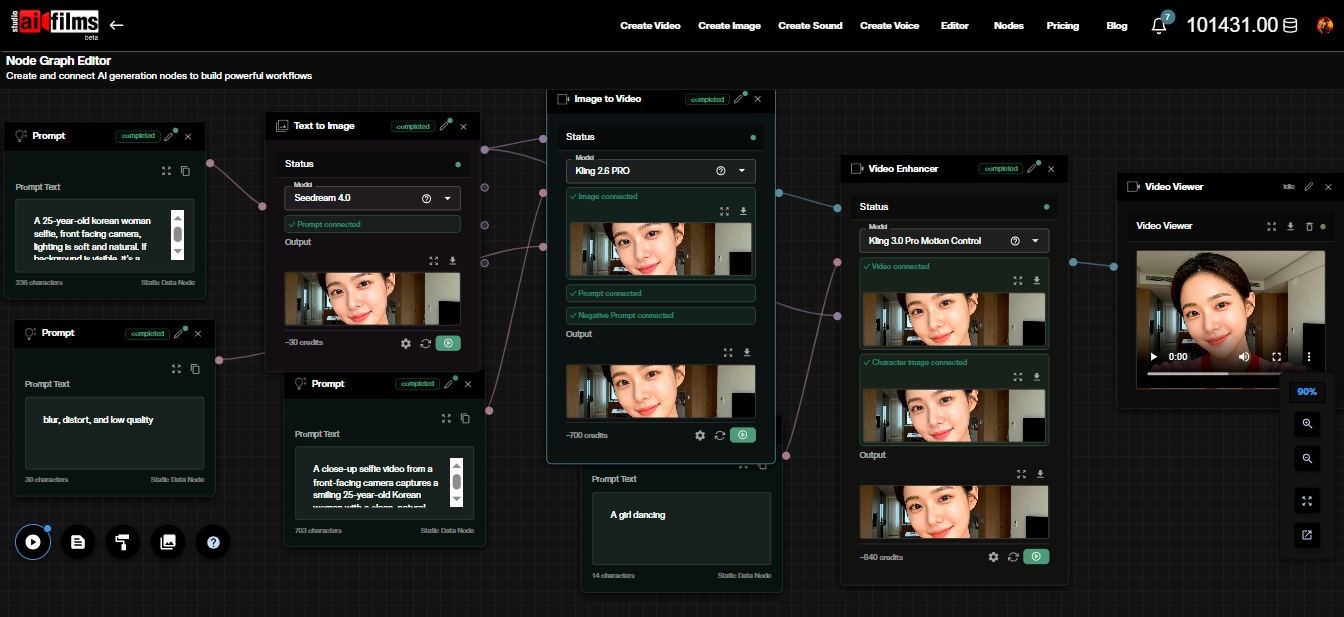
To apply motion transfer and camera control directly in the browser without local 14B model setup, visit the Motion Control page or build multi model pipelines inside the Nodes Graph Editor.
Sources
- KwaiVGI/ReCamMaster Official GitHub Repository (MIT License)
- ReCamMaster Official Project Page (ICCV 2025 Best Paper Finalist)
- ReCamMaster: Camera-Controlled Generative Rendering from A Single Video (arXiv:2503.11647)
- ewrfcas/Uni3C Official GitHub Repository (Apache 2.0)
- Uni3C: Unifying Precisely 3D-Enhanced Camera and Human Motion Controls for Video Generation (arXiv:2504.14899)
Continue Reading


Video & LipSync
- Video Generator
- Text to Video
- Image to Video
- Start-End Frame to Video
- Draw to Video
- Motion Control
- Video Enhancer
- Video Upscaler
- Video Extend
- Video to Video LipSync
- Audio to Video LipSync
- Image to Video LipSync
- Video FaceSwap
- Seedance 2.5
- WAN 3.0
- Seedance 2
- FLUX 3
- Minimax H3
- Vidu Q3 Pro
- Grok Imagine Video 1.5
- Gemini Omni
- Google Veo 3.1
- Kling 3.0 Pro
- Luma Ray 3.2
- LTX 2.3
- Happy Horse 1.1
- Kling 3.0 Motion
- ByteDance Upscaler
- InfiniteTalk
- InsightFace
Image & Edit
- AI Character
- AI Actor
- Art Generator
- Text to Image
- Image to Image
- LoRA Image to Image
- Draw to Edit
- Image LoRA Training
- Remove Background
- Image Enhancer
- MidJourney 8.0
- Krea 2
- OpenAI GPT Image 2.0
- Nano Banana Pro Ultra
- Nano Banana 2 Lite
- Nano Banana Pro
- Minimax Image
- Clarity Pro
- Z-Image Turbo LoRA
- Krea 2 Turbo LoRA
- Z-Image LoRA Trainer
- Qwen Image LoRA Trainer
- Background Erase Network 2 (BEN2)