

Zhengming Yu et al., DMAD (arXiv:2610.02188, MiniMax-H3 Community License)
Share this post:
DMAD & DuoMatching: Open Source 4 Step Audio-Video AI
DMAD (Distribution Matching as Adversarial Distillation, arXiv:2610.02188) and DuoMatching (Joint-Marginal Distribution Matching for Few-Step Video Generation, arXiv:2610.03543) are October 2026 open source step distillation frameworks that compress 50 step video and joint audio and video Diffusion Transformers down to 4 or 8 inference steps at CFG=1.0. Led by ZhengmingYu/DMAD (downloaded nearly 90,000 times on Hugging Face), DMAD distills MiniMax-H3 into a 4-step student capable of rendering synchronized 5 second audio and video shots on an 8 GB VRAM consumer GPU or 15 second multi shot dialogue scenes in 4 to 8 steps.
Studio availability. DMAD and DuoMatching are not available in AI FILMS Studio. While MiniMax H3 Text to Video and MiniMax H3 Image to Video are live in the Studio, the DMAD and DuoMatching distilled student checkpoints covered here are separate public research releases. To generate video in the Studio, see the models listed on the Text to Video and Image to Video pages.
DMAD 4 step and 8 step joint audio and video showcase reel on MiniMax-H3 (unmute for synchronized audio)
Few step coastal aerial shot with synchronized ocean wave acoustics and crisp surface detail
Solving Mode Collapse in 4 Step Audio-Video Distillation
Standard Distribution Matching Distillation (DMD) trains a few step student generator by minimizing the reverse KL divergence between real and fake score functions. When applied to massive multimodal backbones like MiniMax-H3 that generate video frames and synchronized audio waveforms simultaneously, pure DMD often suffers from mode collapse, desaturated colors, or muffled speech transients at 4 steps.
DMAD and DuoMatching address few step degradation from two complementary mathematical angles released in October 2026.
- Distribution Matching as Adversarial Distillation (
DMAD,arXiv:2610.02188). Author Zhengming Yu and collaborators prove that reverse KL distribution matching can be reformulated as a unified adversarial objective on the teacher's feature space. By pairing score matching with hinge adversarial discriminator heads directly on the joint audio and video DiT latents, DMAD preserves high frequency visual textures and crisp vocal formants at 4 steps without classifier free guidance (CFG=1.0,10xto20xspeedup over 50 stepCFG=5.0). - Joint-Marginal Distribution Matching (
DuoMatching,arXiv:2610.03543). Released under the Apache 2.0 license (JohnZhan2023/DuoMatching), DuoMatching prevents spatial detail loss during temporal distillation by enforcing marginal per frame distribution matching alongside joint spatiotemporal sequence matching. - 8 GB VRAM 5s and 15s podcast/narrative profiles.
ZhengmingYu/DMADships ready to run LoRA and student weights forMiniMax-H3covering both 4-step 5 second generation on 8 GB VRAM GPUs and 4-step or 8-step 15 second continuous audio and video generation.
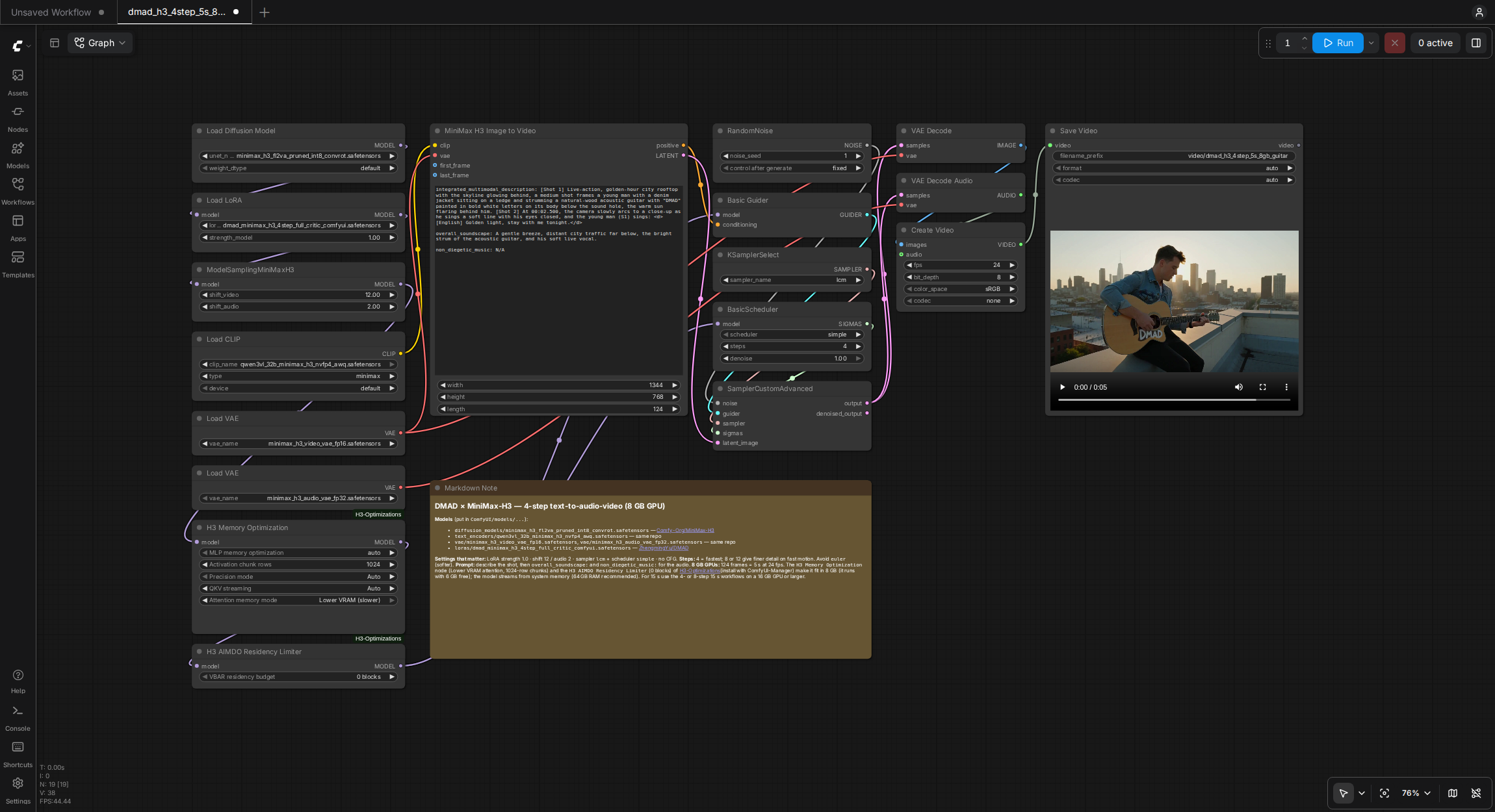
DMAD 4-step 5-second joint audio and video profile optimized for 8 GB VRAM GPUs. Credit: ZhengmingYu/DMAD.
Cutting sampling from 50 guided steps (100 network evaluations with CFG) down to 4 unguided steps (4 network evaluations) reduces compute by 96 percent.
Paired with memory offloading and quantized text encoders, indie filmmakers can preview 5 second shots with synchronized acoustic guitar, foley, or dialogue on an 8 GB laptop or desktop card.
Try DMAD 4-Step MiniMax-H3 Live in the Browser
Test the official DMAD interactive Gradio Space embedded below (zhengmingyu-dmad.hf.space), which loads directly without login. You can also compare the 4-step student space hosted at ksyja-minimax-h3-4step-dmad.hf.space.
For longer dialogue scenes, interviews, or cooking and action sequences, DMAD includes a dedicated **15 second** (`361 frame` at `24 fps`) configuration in both 4-step and 8-step variants.
Stepping up from 4 steps to 8 steps on 15 second clips sharpens fast hand movements, sizzling pan foley, and two person conversational lip sync while still running more than 10x faster than the 50 step base teacher.
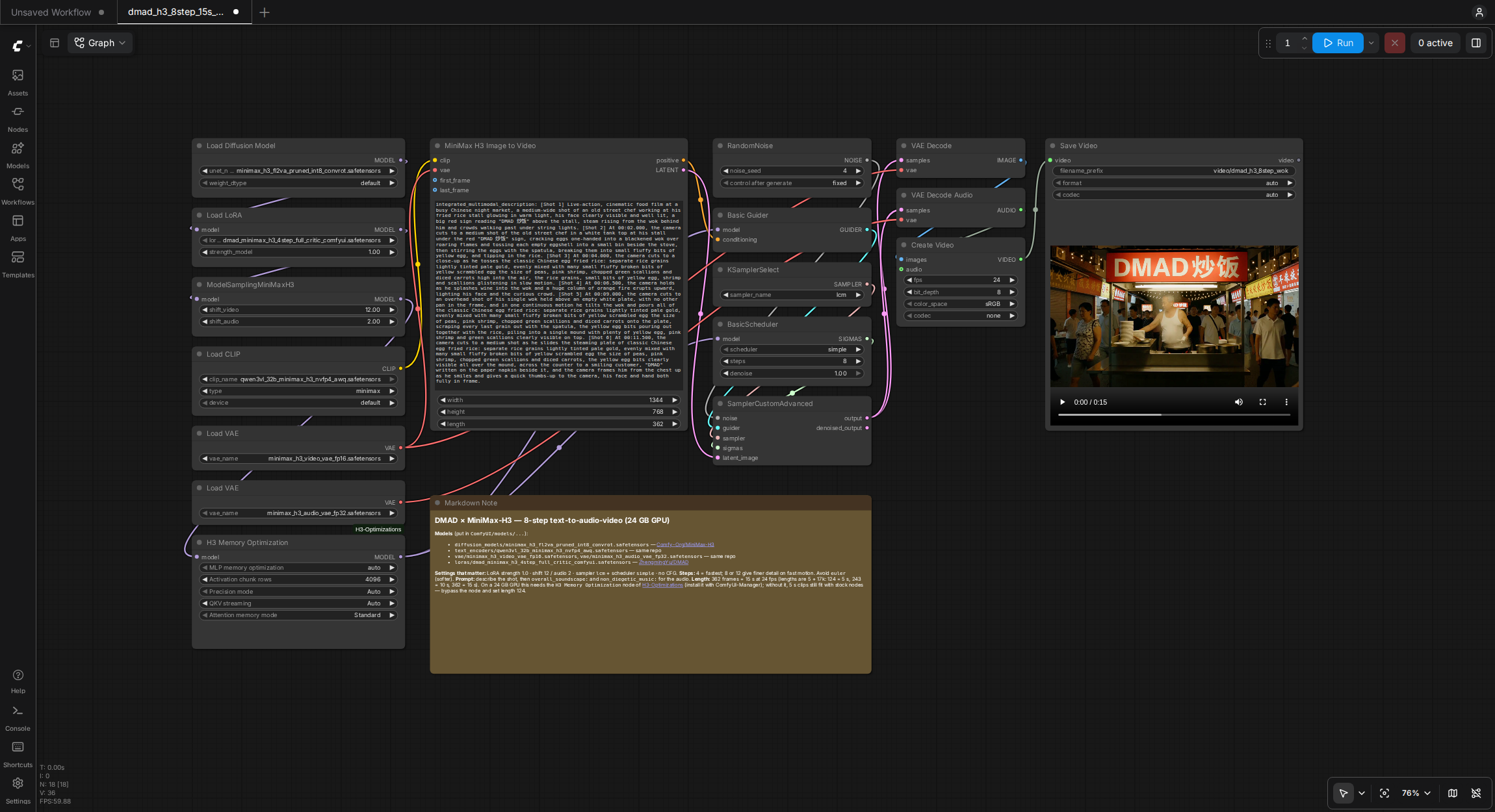
DMAD 8-step 15-second continuous audio and video workflow. Credit: DMAD Project Page.
Checkpoints, Step Counts & Hardware Matrix
| Model / Student Variant | Repository / Paper | Inference Steps & CFG | Duration & Target VRAM | License |
|---|---|---|---|---|
DMAD-H3 4-Step (5s Low VRAM) |
ZhengmingYu/DMAD (arXiv:2610.02188) |
4 steps (CFG=1.0, 4 NFEs) |
5 seconds (121 frames), 8 GB+ VRAM with offload |
MiniMax-H3 Community |
DMAD-H3 4-Step (15s Long) |
ZhengmingYu/DMAD |
4 steps (CFG=1.0) |
15 seconds (361 frames), 16 GB to 24 GB VRAM |
MiniMax-H3 Community |
DMAD-H3 8-Step (15s Master) |
ZhengmingYu/DMAD |
8 steps (CFG=1.0) |
15 seconds (361 frames), 24 GB+ VRAM |
MiniMax-H3 Community |
DuoMatching |
JohnZhan2023/DuoMatching (arXiv:2610.03543) |
4 steps (CFG=1.0 joint and marginal) |
5 seconds video generation, 16 GB to 24 GB VRAM |
Apache 2.0 |
Running DMAD and DuoMatching Locally
Clone Yzmblog/DMAD, download the 4-step and 8-step student checkpoints from ZhengmingYu/DMAD on Hugging Face, and run joint text-to-audio and video inference with diffusers.
git clone https://github.com/Yzmblog/DMAD.git
cd DMAD
pip install -r requirements.txt

# Download DMAD 4-step and 8-step MiniMax-H3 student weights
huggingface-cli download ZhengmingYu/DMAD --local-dir ./weights/dmad
Run a 4-step joint audio and video generation pass in Python with CPU offloading enabled for consumer GPUs.
import torch
from diffusers import DiffusionPipeline

pipe = DiffusionPipeline.from_pretrained(
    "MiniMaxAI/MiniMax-H3",
    torch_dtype=torch.bfloat16,
)
pipe.load_lora_weights("./weights/dmad", weight_name="dmad_h3_4step.safetensors")
pipe.enable_model_cpu_offload()

result = pipe(
    prompt=(
        "Close up of an indie guitarist playing a warm acoustic fingerstyle melody "
        "in a sunlit wooden cabin, crisp string plucking audio and room ambience."
    ),
    num_frames=121,
    num_inference_steps=4,
    guidance_scale=1.0,
)
For Apache 2.0 licensed few step video distillation research, clone JohnZhan2023/DuoMatching (https://github.com/JohnZhan2023/DuoMatching) to run joint and marginal 4-step inference on Wan and CogVideo backbones.
Production Playbook for Filmmakers
- Draft in 4 steps, master in 2K. Pair
DMAD4-step generation at768pwith Open-H3-Regenerate-2K 3-step 2K and 4K refinement. That combination renders a complete 5 second2560x1440audio and video shot in 7 total diffusion steps (4draft steps +3refinement steps). - Use 8 steps for 15 second dialogue. On 15 second (
361 frame) two person podcast or dialogue shots, the 8-stepDMADstudent prevents mouth sync drift in the final 5 seconds while still finishing in a fraction of standard 50 step runtime. - Compare across fast open source audio and video generators. Read our related guides on HyperFlow H3 Flash 4-step and 8-step LoRA and GGUF, Kandinsky 6.0 10-step PiFlow audio and video generation, FreeVideo, MiniMax-H3, and Pika-H3-Flex, and LTX-2.5 open weights multishot audio and video.
To run MiniMax H3, Kling 3.0, and WAN 3.0 directly in the cloud without local setup, open the Text to Video and Image to Video pages, or chain fast generation and upscaling nodes visually in the Nodes Graph Editor.


Sources
- DMAD Official Project Page (Zhengming Yu et al.)
- Yzmblog/DMAD Official GitHub Repository
- DMAD: Distribution Matching as Adversarial Distillation for Fast Visual Generation (arXiv:2610.02188)
- ZhengmingYu/DMAD 4-Step & 8-Step Checkpoints on Hugging Face
- ZhengmingYu/dmad Interactive Space on Hugging Face
- JohnZhan2023/DuoMatching Official GitHub Repository (Apache 2.0, arXiv:2610.03543)
Continue Reading


Video & LipSync
- Video Generator
- Text to Video
- Image to Video
- Start-End Frame to Video
- Draw to Video
- Motion Control
- Video Enhancer
- Video Upscaler
- Video Extend
- Video to Video LipSync
- Audio to Video LipSync
- Image to Video LipSync
- Video FaceSwap
- Seedance 2.5
- WAN 3.0
- Seedance 2
- FLUX 3
- Minimax H3
- Vidu Q3 Pro
- Grok Imagine Video 1.5
- Gemini Omni
- Google Veo 3.1
- Kling 3.0 Pro
- Luma Ray 3.2
- LTX 2.3
- Happy Horse 1.1
- Kling 3.0 Motion
- ByteDance Upscaler
- InfiniteTalk
- InsightFace
Image & Edit
- AI Character
- AI Actor
- Art Generator
- Text to Image
- Image to Image
- LoRA Image to Image
- Draw to Edit
- Image LoRA Training
- Remove Background
- Image Enhancer
- MidJourney 8.0
- Krea 2
- OpenAI GPT Image 2.0
- Nano Banana Pro Ultra
- Nano Banana 2 Lite
- Nano Banana Pro
- Minimax Image
- Clarity Pro
- Z-Image Turbo LoRA
- Krea 2 Turbo LoRA
- Z-Image LoRA Trainer
- Qwen Image LoRA Trainer
- Background Erase Network 2 (BEN2)