
SAG-AFTRA Members Are Voting on the Four Year AI Deal Through June 4
Share this post:
SAG-AFTRA Members Are Voting on the Four Year AI Deal Through June 4
The SAG-AFTRA National Board voted 89% on May 11 to recommend ratification of the guild's new four year deal with the AMPTP. Members began voting on May 14 and have until June 4 to cast their ballots.
The vote follows a tentative agreement first announced on May 2. That announcement confirmed expanded AI provisions but withheld full terms pending board review. The board summary released after the May 11 vote made the specific AI language public for the first time.
What the Board Summary Reveals on AI
The deal "strengthens consent and compensation and establishes new and enhanced guardrails on synthetics", according to the board summary published by SAG-AFTRA on May 11. The language confirms the 2026 contract targets specific weaknesses in the 2023 agreement, which allowed studios to obtain performer consent at the point of hiring rather than on a per project basis.
Duncan Crabtree-Ireland, SAG-AFTRA's Executive Director, made expanded AI protections a condition he would not drop. The four year contract length, longer than the guild's standard three year cycle, was the studios' primary ask, and Crabtree-Ireland held firm on AI until studios conceded.
Financial terms include a 5% residuals increase for streaming and a pension fund merger between SAG-AFTRA and AFTRA. The merged fund takes effect January 1, 2028. Specific compensation figures for digital replica use remain confidential pending full contract publication.
What the 2023 Deal Lacked
The 2023 Theatrical and Television Basic Agreement addressed AI in two provisions: productions had to obtain performer consent before creating a digital replica, and studios could not use AI to perform background work without telling the performers involved. Neither provision set a compensation floor. Neither established a process for auditing AI use. Consent could be obtained at the point of hiring as a general condition of employment rather than on a specific project basis.
Crabtree-Ireland described the 2023 provisions as a foundation, not a ceiling. The 2026 negotiations started from that baseline and aimed to close the gaps. The "consent and compensation" language in the May 11 board summary indicates the new contract addresses both elements. The "enhanced guardrails on synthetics" language suggests additional constraints on how studios can use AI generated performers beyond the consent and compensation framework.
Three Guilds, One Contract Year
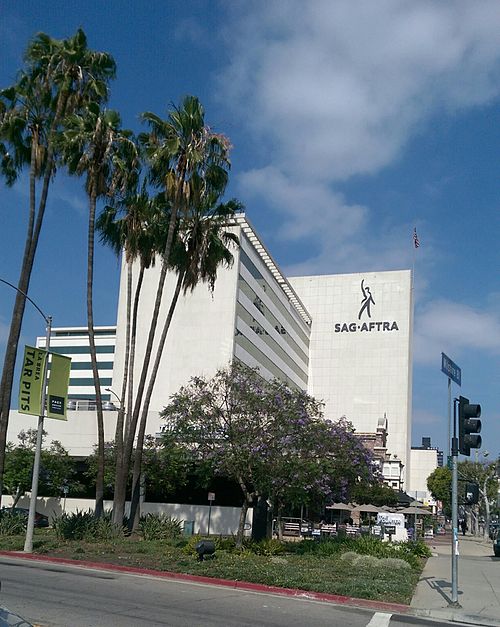
%20(2).jpg)
Chris Long from Los Angeles, CA, USA, CC BY 2.0, via Wikimedia Commons
The [WGA ratified its own four year deal in April 2026](/blog/wga-studios-deal-2026-ai-protections), securing $321 million for writer health plans and new AI licensing requirements. That deal established consent and disclosure rules for AI use of written material but stopped short of requiring studios to pay writers for training data use.
The DGA opened formal negotiations on May 11, the same day the SAG-AFTRA board voted. Their contract expires June 30, making DGA negotiations the most urgent remaining piece of the 2026 contract cycle. The guild's central position is that generative AI cannot be delegated to handle work that falls under DGA jurisdiction.
If SAG-AFTRA members ratify by June 4, all three major Hollywood guilds will have completed new contracts with enforceable AI provisions in a single year. IndieWire's analysis described the SAG-AFTRA deal as evidence that "Hollywood, for now, still values human actors."
Three Contracts in One Year
With SAG-AFTRA ratification, all three major Hollywood guilds completed new contracts with enforceable AI provisions within a single calendar year. WGA ratified in April, DGA ratified in late May, and SAG-AFTRA was scheduled to finish on June 4. No comparable sequence had happened in Hollywood labor history. The previous cycle, in 2023, produced AI provisions described at the time as a historic first. The 2026 cycle built on those provisions with enforcement mechanisms the 2023 deals lacked.
The combined effect creates a layered framework. WGA provisions govern AI use of written material. DGA provisions cover direction and the duties that fall within directorial jurisdiction. SAG-AFTRA provisions address performer likenesses, voices, and synthetic performance. Studios operating on any AMPTP production now operate under all three simultaneously.
What Members Are Voting On
Members vote through the guild's online ballot system, with results announced after June 4. A simple majority is required for ratification. The guild has not disclosed a turnout threshold.
The full contract will be published after ratification is confirmed. Until then, the board summary and Crabtree-Ireland's public statements are the only public record of what the AI provisions contain. Filmmakers and producers can generate text-to-video and image-to-video projects through the AI FILMS Studio workspace while the industry's new contract framework takes shape.
The Ratification Result
SAG-AFTRA announced ratification on June 4, 2026. The deal passed by 78.5% of participating members. That result was expected given the board's 89% recommendation to approve, but the margin above 75% signaled stronger member support than the baseline required to pass.
The complete contract terms were published after ratification. The digital replica compensation provisions confirmed a baseline fee tied to use-day rates, a departure from the 2023 approach of treating consent as a condition of employment rather than a specific transaction. Under the 2026 terms, every synthetic use of a performer's likeness generates a separate payment.
What Studios Must Now Do
Studios must obtain specific written consent for each synthetic use of a performer's likeness under the 2026 deal. The consent must specify what the synthetic performance will be used for, not just acknowledge that synthetic work may occur during a production. General background consent at hiring no longer suffices for digital replica use.
Productions that were using broad consent language from the 2023 contract period will need to update their processes. SAG-AFTRA's business representatives have enforcement authority to flag productions where synthetic performer use occurs without compliant consent documentation. The 2026 deal includes production hold authority that the 2023 deal did not provide.
The Tentative Agreement That Preceded the Vote
The May 2 tentative agreement was not disclosed in full at the time of announcement. SAG-AFTRA published a summary that confirmed expanded AI provisions and the four year term. Specific language was withheld pending the board vote, which is standard guild practice: releasing the full text before the board considers it can create pressure from specific member constituencies before the official review process is complete.
The May 11 board meeting produced the summary document that made AI provisions public for the first time. By that point, both sides had agreed to the terms. The board vote was on whether to recommend, not whether to accept: acceptance had already occurred at the tentative agreement stage. That sequence is important context for interpreting the 89% board approval. It reflects how the board viewed the deal after full review, not the degree of controversy during negotiations.
Duncan Crabtree-Ireland's Negotiating Position
Crabtree-Ireland entered the 2026 negotiations with a stated red line: the AI provisions would be strengthened, not just renewed. He had described the 2023 deal's consent structure as inadequate at multiple industry panels throughout 2024 and 2025. When the AMPTP's opening position in early 2025 proposed rolling over the 2023 AI provisions largely unchanged, Crabtree-Ireland rejected it publicly.
The studios' leverage was the four year contract length. Longer contracts provide budget certainty for productions in development and reduce the frequency of work stoppages. Studios agreed to enhanced AI provisions in exchange for the extended term. The negotiating record, as described by both sides in post-deal press, indicates that the AI language was the central trade in the final weeks of talks, not a settled matter from early discussions.
Crabtree-Ireland's public communication during the voting period emphasized the specificity of the new provisions. He declined to characterize the deal as resolving every AI question, which would have been unpersuasive to members with ongoing concerns. He described it instead as the most protective AI language any major entertainment guild had achieved, a claim competitors have not disputed.
The Broader Ratification Pattern
The 89% board recommendation is unusually high for a contentious contract negotiation. Board votes on recommended contracts in Hollywood guild history have clustered between 70% and 85%. The 89% figure suggests that even members with reservations about specific provisions concluded the overall package was worth recommending.
Member ratification votes typically run lower than board recommendations. Historical SAG-AFTRA ratifications have ranged from the low 60s to the high 70s as a percentage of participating members. The final 78.5% result fell within the expected range but at the higher end, indicating that the AI provisions specifically generated more support than opposition among the broader membership.
Enforcement and the Next Three Years
The 2026 contract runs through 2030. In that period, AI video generation tools will improve significantly, and the gap between what a synthetic performer can do and what the 2026 contract anticipated may widen. SAG-AFTRA built a monitoring provision into the deal: a joint labor-management committee reviews AI deployment twice per year and can trigger renegotiation if either side identifies a material change in how synthetic performance technology operates.
That review mechanism is one of the 2026 deal's most significant structural differences from 2023. The 2023 contract had no process for mid cycle adjustment. Studios could introduce substantially improved AI tools during the contract period without triggering any consultation obligation. The 2026 deal changes that, at least in theory. How effectively the committee uses its authority will depend on the specific cases that come before it.
The DGA ratified its own contract in late May 2026, completing the three guild sequence. That deal addressed generative AI's role in pre-production and production planning, establishing that certain decisions requiring directorial judgment cannot be delegated to AI systems without consent. The combined effect of all three guild contracts creates a framework that covers the full production pipeline from scripting through performance.
What Independent Producers Need to Know
The SAG-AFTRA 2026 deal applies to AMPTP signatories. Independent productions not signed to the AMPTP are not directly bound by its terms. However, independent producers seeking SAG-AFTRA signatory status, which is required to hire guild members, must agree to terms that incorporate the new AI provisions.
Several independent production companies have signed SAG-AFTRA agreements that adopt the 2026 AI provisions by reference. The practical effect is that any production hiring SAG-AFTRA members, regardless of budget or distributor, operates under the consent and compensation framework the 2026 deal established. The compliance cost depends on how extensively a production uses synthetic performers.
The union extended its AI protection push beyond the contract itself. SAG-AFTRA gathered more than 16,000 signatures demanding Congress pass the NO FAKES Act, which cleared the Senate Judiciary Committee by unanimous voice vote in June 2026. The federal bill would extend similar likeness protections to every American, not only union members.
The Commercials Contract Precedent
The 2026 Theatrical and Television Basic Agreement is not the first SAG-AFTRA contract with a digital replica payment framework. The guild's 2025 Commercials Contract, ratified in March 2025, established the first formal per use payment structure for synthetic performers in advertising. It required explicit per use consent and set minimum session fees based on performer scale rates.
The 2026 Theatrical deal applied the same logic to a more complex production environment. Features and episodic television involve longer production cycles, more iterations of synthetic content, and distribution across more platforms and territories than advertising. The consent documentation requirements in the 2026 deal specify consent by project and by use type rather than only at the session level.
For productions operating under both the Commercials and Theatrical SAG-AFTRA agreements, the two contracts now present a unified framework: documented consent, per use compensation, and audit rights. The operational task for production companies is building workflows that capture the required documentation consistently across both contract environments.
The Contract in International Co-Productions
SAG-AFTRA's 2026 deal has implications beyond the United States. International co-productions involving American guild members must comply with its terms regardless of where principal photography takes place. A European feature that hires SAG-AFTRA performers operates under the consent and compensation requirements the 2026 deal establishes for synthetic performer use.
That reach matters as AI generated content production grows in European markets, where regulatory frameworks are still forming. A production that structures its AI workflow to comply with the 2026 SAG-AFTRA deal is already aligned with the consent based approach that EU AI regulators are codifying, even before those regulations are finalized. The practical overlap between guild requirements and EU regulatory direction reduces the compliance burden for productions working across both jurisdictions.
How Studios Are Updating Their Documentation Workflows
The per use consent requirement is an administrative change as much as a legal one. Productions that previously obtained a single broad consent at hiring now need to generate a separate consent document for each synthetic use of a performer's likeness. For a production with five principal performers and thirty synthetic uses across a series, that means thirty separate documents rather than five.
Several major studios have reported updating their production management software to track synthetic performer consents alongside standard release and clearance documentation. The administrative infrastructure required to comply with the 2026 deal is an underreported part of its impact: the cost is not only the compensation itself but the systems needed to track and audit compliance across large productions. Smaller production companies without dedicated legal and business affairs departments face a proportionally larger burden, since compliance requires the same documentation regardless of production scale. Third-party compliance services have already emerged to fill that gap, offering consent documentation management as a subscription product aimed at mid-sized productions.
The long-term question is whether the documentation burden will drive smaller productions toward non-union casting or toward AI generated performers as a way to avoid the compliance overhead entirely.
Sources
Deadline | Hollywood Reporter | IndieWire | Variety | The Wrap | UPI
Continue Reading
.jpg?w=3840)


.jpg)
Video & LipSync
- Video Generator
- Text to Video
- Image to Video
- Start-End Frame to Video
- Draw to Video
- Motion Control
- Video Enhancer
- Video Upscaler
- Video Extend
- Video to Video LipSync
- Audio to Video LipSync
- Image to Video LipSync
- Video FaceSwap
- Seedance 2.5
- WAN 3.0
- Seedance 2
- FLUX 3
- Minimax H3
- Vidu Q3 Pro
- Grok Imagine Video 1.5
- Gemini Omni
- Google Veo 3.1
- Kling 3.0 Pro
- Luma Ray 3.2
- LTX 2.3
- Happy Horse 1.1
- Kling 3.0 Motion
- ByteDance Upscaler
- InfiniteTalk
- InsightFace
Image & Edit
- AI Character
- AI Actor
- Art Generator
- Text to Image
- Image to Image
- LoRA Image to Image
- Draw to Edit
- Image LoRA Training
- Remove Background
- Image Enhancer
- MidJourney 8.0
- Krea 2
- OpenAI GPT Image 2.0
- Nano Banana Pro Ultra
- Nano Banana 2 Lite
- Nano Banana Pro
- Minimax Image
- Clarity Pro
- Z-Image Turbo LoRA
- Krea 2 Turbo LoRA
- Z-Image LoRA Trainer
- Qwen Image LoRA Trainer
- Background Erase Network 2 (BEN2)