
Jon Erwin Breaks Down 'Young Washington' AI Production: 100+ Shots, 5 AI Artists, Safer and More Affordable

Share this post:
Jon Erwin Breaks Down "Young Washington" AI Production: 100+ Shots, 5 AI Artists, Safer and More Affordable
Jon Erwin publicly disclosed that his historical epic "Young Washington" used AI to augment more than 100 shots, making the Angel Studios theatrical release one of the most detailed accounts of AI in a major commercial film since SAG-AFTRA ratification. The director laid out every application in an exclusive Variety interview published July 3, 2026, the same day the film opened nationwide. The interview names each AI use by category: environmental extension, crowd augmentation, cannon fire scale, period establishing shots.
That level of specificity is rare. Most productions that use AI tools either absorb them into standard contracts or describe their use in general terms during press rounds. Erwin treated the disclosure as a production choice with the same deliberateness as any other creative decision the film contains.
The disclosure comes with a level of specificity that most productions still avoid. Erwin credited five AI artists and one AI producer in the official credits, named roles that place AI contributors on the same footing as any other department head. Those credits reframe AI use from an informal technical decision to a fully staffed production discipline with defined accountability.
The Variety interview represents the most detailed public account of AI use in a major theatrical release since the guild negotiations of 2023 established formal frameworks for AI disclosure. Productions at this scale typically describe AI use in general terms during press rounds. Erwin's decision to go application by application through the specific uses, and to name the contributors who executed them, is itself a production decision with industry-wide implications beyond this particular film.
Five Artists, One Producer, Over One Hundred Shots
Erwin's production team included five AI artists and one dedicated AI producer. Few theatrical productions have listed AI contributors by title at this level of detail, and the practice challenges the prevailing assumption that AI use can remain absorbed into standard production categories without acknowledgment.
The number of AI augmented shots exceeds 100 across the finished film. Erwin described the technology as making production "safer and more affordable," a framing that grounds the argument in practical outcomes rather than aesthetic speculation. Safety and cost efficiency speak to studios and financiers in terms that abstract claims about creative possibility often do not.
The distinction between those two credit categories is meaningful for how the industry tracks AI contributions. An AI artist generates visual assets: individual shots, environmental extensions, crowd elements, and effects. An AI producer coordinates integration of those assets with the broader production pipeline, manages workflow between AI generation and traditional VFX departments, and makes creative decisions about which AI outputs are used, modified, or discarded. The credit acknowledges that AI use at the scale of 100 shots is a production discipline with its own expertise, not a technical process absorbed into standard VFX work.
The decision to list AI contributors by department-level role rather than by specific technical function reflects how credits work in industry practice. Studio executives, guild representatives, and future production teams reading the credits need to understand what category of work is being attributed, not which specific frame was generated by which individual. Erwin's format communicates that clearly.
Angel Studios released "Young Washington" on July 3, 2026, timed to the July Fourth holiday weekend and the broader American 250th anniversary summer. The film had already premiered at the Tribeca Festival on June 13, 2026, giving it a festival run before its wide commercial release. Advance tracking put the opening weekend at approximately $20 million.
The Icy River Scene: AI as a Safety Tool
The most technically striking AI use in "Young Washington" comes in the icy river rescue sequence. Erwin staged the scene in a water tank measuring 50 feet in Ireland, keeping the actors, the raft, and practical ice elements physically present on set. AI then extended that contained environment into a vast frozen river landscape filling the entire frame.
The technique kept performers out of genuinely dangerous cold water while delivering visual scale the tank alone could never produce. The actors were safe. The danger was rendered.
Erwin's stated principle, do everything you can for real, is most clearly demonstrated in this sequence. The production committed to a full tank build, to real actors on a real raft, to practical ice the camera could read at close range. The AI extension only works because the foundation it is building on is physically real. That sequence is the clearest example in the film of what the hybrid approach means in practice: the AI does not replace the real, it extends from it.
Additional AI applications included establishing shots of period environments, expansion of cannon fire sequences, and the duplication of period extras to fill 18th century battle formations with a realistic number of colonial soldiers. Each application followed the same principle. Shoot as much as possible for real, then use AI to amplify what practical production alone cannot achieve.
The cannon fire sequences used the same hybrid logic as the river scene. Practical effects handled the discharge, the smoke, and the immediate blast radius on set. AI extended the battlefield scale outward from those practical elements: soldiers falling at distance, environmental chaos across the full terrain, the width of a period battle that a limited production crew could not populate for real. Every detail the camera needed to read as unambiguously present was captured practically. Everything the camera needed only for scale and period atmosphere was generated.
Period extras followed the same calculation. Real colonial soldiers filled the foreground and medium shots where period accuracy and physical performance mattered. AI then multiplied those extras to fill the battle formations that an 18th century military engagement would realistically contain. No AI element in the film carries the narrative or performance weight that a human performer would normally carry. AI handles scale. Humans handle character.
The Ireland location was chosen partly for cost and partly for landscape. The Irish countryside provided terrain that matched the colonial period for exterior scenes set in America's eastern wilderness, a substitution that required AI to bridge the visual gap between locations in a way audiences would not notice.
The Ireland decision also demonstrates how AI changes the economics of location selection. A production that can complete a scene practically in a contained environment and then extend it digitally into any landscape is no longer constrained to locations that physically match the script's requirements. Ireland stood in for colonial America not just because it was affordable, but because the AI workflow made the geographic substitution visually convincing at production costs that the correct location would not have permitted.
A Historical Epic Built for a Patriotic Summer
"Young Washington" follows George Washington during the French and Indian War, the decade of conflict in the 1750s and 1760s that shaped the future revolutionary general before the events for which he became famous. Erwin built the production with the 250th anniversary of American independence in mind, positioning it as a theatrical event for patriotic summer audiences approaching the 2026 milestone.
The choice of subject gives the film a commercial logic that pairs with Angel Studios' audience base. The studio has established itself through films with faith aligned and culturally patriotic themes, reaching audiences that major studio distributors often miss. "Sound of Freedom" demonstrated the model at scale. "Young Washington" extends it to historical epic filmmaking at an ambition level the company has not previously attempted.
Washington as a subject also provides one advantage over fictional IP: the historical record. Audiences arrive at a Washington film with prior emotional investment in the figure that a fictional character requires years to build. Erwin's specific choice of the years before the Revolutionary War, when Washington served as a British colonial officer in the French and Indian campaigns rather than as the rebel general most audiences know, gives the story an angle that the 250th anniversary summer does not already have covered by other releases.
Angel Studios used a crowdfunding model in the months before release, allowing supporters to back the film's distribution before it opened. That model, which the studio developed before "Sound of Freedom," gives Angel productions an audience commitment before theatrical wide release that most films do not have.
Innovative Dreams and a Partnership Built Into the Pipeline
Erwin did not bring AI in through outside vendors after the shoot. He founded Innovative Dreams together with Luma AI, through his company Wonder Project, specifically to develop this hybrid production methodology from the earliest stage of every project. "Young Washington" is that company's first major theatrical release.
That distinction changes the nature of the integration. When a production company is built around a specific AI model provider from the start, the tools are not adopted midway through a project. The workflow is designed before a single frame is shot.
His guiding principle, stated directly in the Variety interview, applies across every production the company takes on: "Do everything you can for real, everything you possibly can, and then use these tools to amplify your vision and give you a bigger canvas." It is the same approach he brought to a prior major streaming production, which deployed AI across more than 250 shots and is covered in detail in our earlier piece on his hybrid production methodology.
Erwin's approach reflects a broader argument he has been making publicly since House of David: that filmmakers who invest in AI methodology as a production discipline from the start of a project, rather than bringing in AI tools during post-production, gain structural advantages in both cost and creative control. Innovative Dreams is a live test of that thesis at theatrical distribution scale. Angel Studios' release model will produce commercially meaningful data not just about this film's performance but about whether a production company structured around AI integration from its founding can compete at the multiplex against productions built on traditional models.
.jpg)
Gadi Elkon, CC BY-SA 3.0, via Wikimedia Commons
Innovative Dreams gives Erwin access to Luma AI's model development as it happens rather than through licensing finished software after the fact. That proximity means the AI workflow is shaped alongside the production rather than applied to it after principal photography ends.
Luma AI brings a specific model philosophy to the partnership. The company has developed video generation approaches grounded in physical world understanding, training models to simulate how light, motion, and three-dimensional space behave rather than relying entirely on pattern matching from existing footage. That approach changes what the AI can accomplish when asked to extend the tank environment into a convincing frozen river landscape. The model can reason about how ice catches light, how water moves under pressure, and how those physical properties would shape what a camera positioned above the raft would see.
Erwin described the Innovative Dreams partnership as foundational to his creative process rather than supplementary to it. A production company built on AI integration from its founding writes different screenplays, scouts different locations, and makes different casting decisions because the AI workflow changes what is achievable before cameras roll. A production that licenses AI tools after a screenplay is locked and principal photography is finished is adopting a service. Innovative Dreams is structured as a methodology.
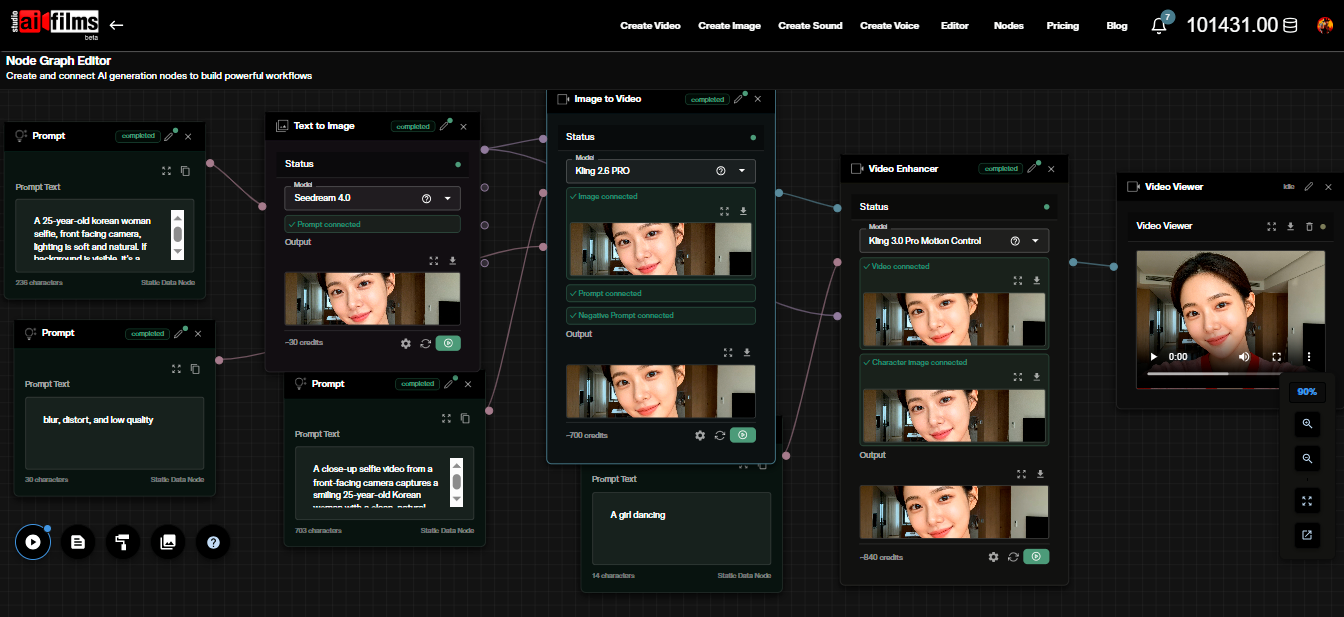
For filmmakers building comparable workflows at any budget, the AI FILMS Studio video workspace provides text-to-video and image-to-video generation tools in a single production interface. The same principle of combining live footage with AI generated environments scales across productions at every level.
Young Washington Opens in a Commercial Turning Point
"Young Washington" opened on July 3 at a moment when the industry's conversation about AI in theatrical film had shifted from festival panels to wide release schedules. Several directors publicly documented AI use at Cannes 2026, but the transparency pattern that emerged across the festival season finds its clearest commercial test in Erwin's July 4 holiday release.
Rotten Tomatoes critics gave the film 63%, a mixed response that puts it in the range of commercially viable but contested releases. The critical reception reflects ongoing uncertainty about AI augmented productions rather than a clear verdict on the film itself. Opening weekend tracking at $20 million would represent a strong performance for an independently distributed summer historical film.
The Tribeca premiere on June 13 put the film in front of a festival audience 20 days before the nationwide release. For Erwin, the festival screening served as a final public exhibition before the commercial opening rather than a platform for building critical momentum. That reflects Angel Studios' distribution strategy more than it reflects how Tribeca typically functions for its official selections. No critical reception from that premiere was severe enough to alter the distribution plan, and the holiday weekend timing was fixed regardless.
The patriotic calendar timing and the 250th anniversary context give the film positioning few studio competitors can replicate in that window. The combination of Angel Studios' established audience, the holiday timing, and the crowdfunding commitment secured before release put "Young Washington" in a stronger commercial position than a comparable film releasing without that infrastructure.
What These Credits Establish for the Industry
The specific figures in Erwin's disclosure create a working benchmark. One hundred shots, five credited AI artists, one credited AI producer: these numbers give studios, guilds, and independent productions a reference point for how AI use can be quantified and acknowledged in official production documentation. They also give journalists, researchers, and audiences a number to compare future productions against as AI use in theatrical film becomes more common.
Most productions that use AI tools either absorb them into standard contracts or describe them in general terms during press rounds. Erwin's approach, refined across multiple productions, treats AI artists as named contributors with defined roles rather than as technical operators running software in the background. That difference will be visible to anyone who reads the production credits carefully.
The industry has been moving toward more structured AI disclosure since the 2023 guild negotiations. What Erwin has done voluntarily in "Young Washington" anticipates the direction that mandatory disclosure requirements are heading. The credits he chose to include function less as a statement about this particular film and more as a template for how the next wave of hybrid productions can account for the technology they use.
The guild context matters here. The SAG-AFTRA and WGA contracts updated through 2023 and 2025 established conditions requiring disclosure when AI plays a significant role in production or in work adjacent to writing. Erwin's voluntary format anticipates those provisions.
The same framework made a different kind of production possible the same week. Arcana Labs, cofounded by former Millennium Media president Jonathan Yunger, secured a SAG-AFTRA contract on Echo Hunter, a short film produced for under $50,000 using the gray stage method. The gray stage approach, where performers work in minimal physical sets while AI generates all environments, achieved union compliance at a budget level where union contracts have historically been uncommon. Erwin's Young Washington established what AI-assisted production looks like at theatrical scale; Echo Hunter established what it looks like at the budget floor. He is demonstrating what structured AI disclosure looks like in a major theatrical production before it becomes mandatory, and doing it in a form specific enough to give guilds, agents, and studios a practical reference point.
Naming five AI artists and one AI producer in the official credits, without requiring itemized breakdowns of each contributor's specific shots, gives productions a disclosure path that is honest without being operationally prohibitive. Other productions facing the same question can adopt the same format immediately without waiting for industry-wide standards to be codified.
The broader implication is that AI use in film production is entering a documentation era. For the first decade of serious AI adoption in Hollywood, from roughly 2018 through 2024, producers treated AI contributions as a technical detail absorbed into existing credit categories. Erwin's transparency, voluntary and in a mainstream theatrical context, changes the default. Once the standard exists, productions that do not meet it face a different kind of scrutiny than productions that predate it.
Industry observers have noted that WGA contract provisions around AI disclosure were written broadly enough that a production could technically comply while still obscuring the specific nature of AI contributions. Erwin's approach shows what disclosure looks like when a filmmaker treats it as a creative statement rather than a compliance obligation: it is specific enough to be meaningful, and it appears where it cannot be missed.
What AI Assisted Theater Means for the Industry at Scale
Young Washington opens into a theatrical market where AI assisted production has been a festival and streaming conversation but not yet a wide commercial one. The films that used AI most extensively through late 2025 and early 2026 premiered at Tribeca, Sundance, or Cannes before moving to streaming platforms. An Angel Studios wide theatrical release, targeting a domestic audience over the July Fourth holiday, is a different test than any of those distribution contexts.
The commercial result from the July 4 weekend will be the clearest evidence yet of whether disclosing AI use, rather than concealing it, affects audience turnout at the multiplex. Angel Studios' crowdfunding model already provided an early signal: enough supporters committed to distribution funding before opening day that the film reached its threshold before a single ticket was sold at the box office. That audience segment was aware of the AI use and chose to support the film. The broader multiplex audience is a different, less prescreened sample.
Sound of Freedom opened to $14.2 million on July 4, 2023, on a comparable Angel Studios release model, and earned $184 million domestically. The opening weekend tracking of $20 million for Young Washington, if accurate, would put it in comparable territory and would make it the first wide theatrical release of a major AI assisted production to demonstrate holiday box office viability in a mainstream multiplex environment.
Angel Studios has not marketed the AI use as a selling point. The film's promotional campaign focused on the historical subject, the patriotic timing, and the values the studio's audience expects. The AI credits are in the production documentation, not in the trailer. That choice tells us something about how the studio expects its audience to respond to the disclosure: as a production detail rather than a selling proposition.
The distinction between an audience that committed funding before opening day and the broader multiplex audience is what makes the July 4 weekend result particularly informative. If the film performs at or above the $20 million tracking figure, it will show that AI assisted production is viable with Angel Studios' established base. Whether it is viable with audiences who did not commit to the film before opening day is the larger question. It will require a production without that existing audience infrastructure to answer.
The July 4 weekend provided the answer. "Young Washington" opened to $20.8 million, beating the $15 million tracking estimate by 38 percent and earning a CinemaScore of A from audiences. The full opening weekend breakdown and the sequel announcement are in our report on the box office result.
Sources:
Variety | Yahoo Entertainment | World of Reel | ComingSoon | Netflix Junkie | Deadline
Continue Reading
.jpg?w=3840)


.jpg)
Video & LipSync
- Video Generator
- Text to Video
- Image to Video
- Start-End Frame to Video
- Draw to Video
- Motion Control
- Video Enhancer
- Video Upscaler
- Video Extend
- Video to Video LipSync
- Audio to Video LipSync
- Image to Video LipSync
- Video FaceSwap
- Seedance 2.5
- WAN 3.0
- Seedance 2
- FLUX 3
- Minimax H3
- Vidu Q3 Pro
- Grok Imagine Video 1.5
- Gemini Omni
- Google Veo 3.1
- Kling 3.0 Pro
- Luma Ray 3.2
- LTX 2.3
- Happy Horse 1.1
- Kling 3.0 Motion
- ByteDance Upscaler
- InfiniteTalk
- InsightFace
Image & Edit
- AI Character
- AI Actor
- Art Generator
- Text to Image
- Image to Image
- LoRA Image to Image
- Draw to Edit
- Image LoRA Training
- Remove Background
- Image Enhancer
- MidJourney 8.0
- Krea 2
- OpenAI GPT Image 2.0
- Nano Banana Pro Ultra
- Nano Banana 2 Lite
- Nano Banana Pro
- Minimax Image
- Clarity Pro
- Z-Image Turbo LoRA
- Krea 2 Turbo LoRA
- Z-Image LoRA Trainer
- Qwen Image LoRA Trainer
- Background Erase Network 2 (BEN2)