

gertelrina (AADD v3.1 interactive audio QC report, MIT)
Share this post:
AADD v3.1: Open Source Film Audio Quality Control AI
A single clipped syllable, a 50 Hz generator hum buried under location dialogue, or an accidental low bitrate MP3 export inside a voice cloning dataset can ruin a final mix if nobody catches it before sound lock. AADD v3.1 (Automatic Audio Degradation Detection, gertelrina/aadd, released November 2026 under the MIT license) scans speech and dialogue tracks at 20 ms frame resolution to flag 12 overlapping audio faults at 43x real time on CPU. You can test AADD v3.1 free in the embedded browser demo below with zero login.
Studio availability. Try the public Hugging Face demo below; AADD v3.1 is not part of a paid AI FILMS Studio plan (use Mirelo SFX 1.6 Text to SFX in the sound workspace for example instead).
Try AADD v3.1 Live
Upload a location dialogue take, ADR clip, or voice cloning reference sample inside the public Hugging Face Space below to inspect frame by frame degradation probabilities directly in your browser.
Architecture and Technical Design
AADD v3.1 fine tunes the 88M parameter Whisper Small encoder end to end, combining a learnable weighted sum across all 13 hidden layers with two 1D convolutions and a 12 output sigmoid classification head. Processing audio in sliding 8 second windows resampled to 16 kHz, it predicts independent probabilities every 20 milliseconds for background noise, music, reverberation, clipping, low pass bandwidth loss, high pass filtering, codec artifacts, packet loss, 50/60 Hz mains hum, clicks, pitch shift, and time stretch.
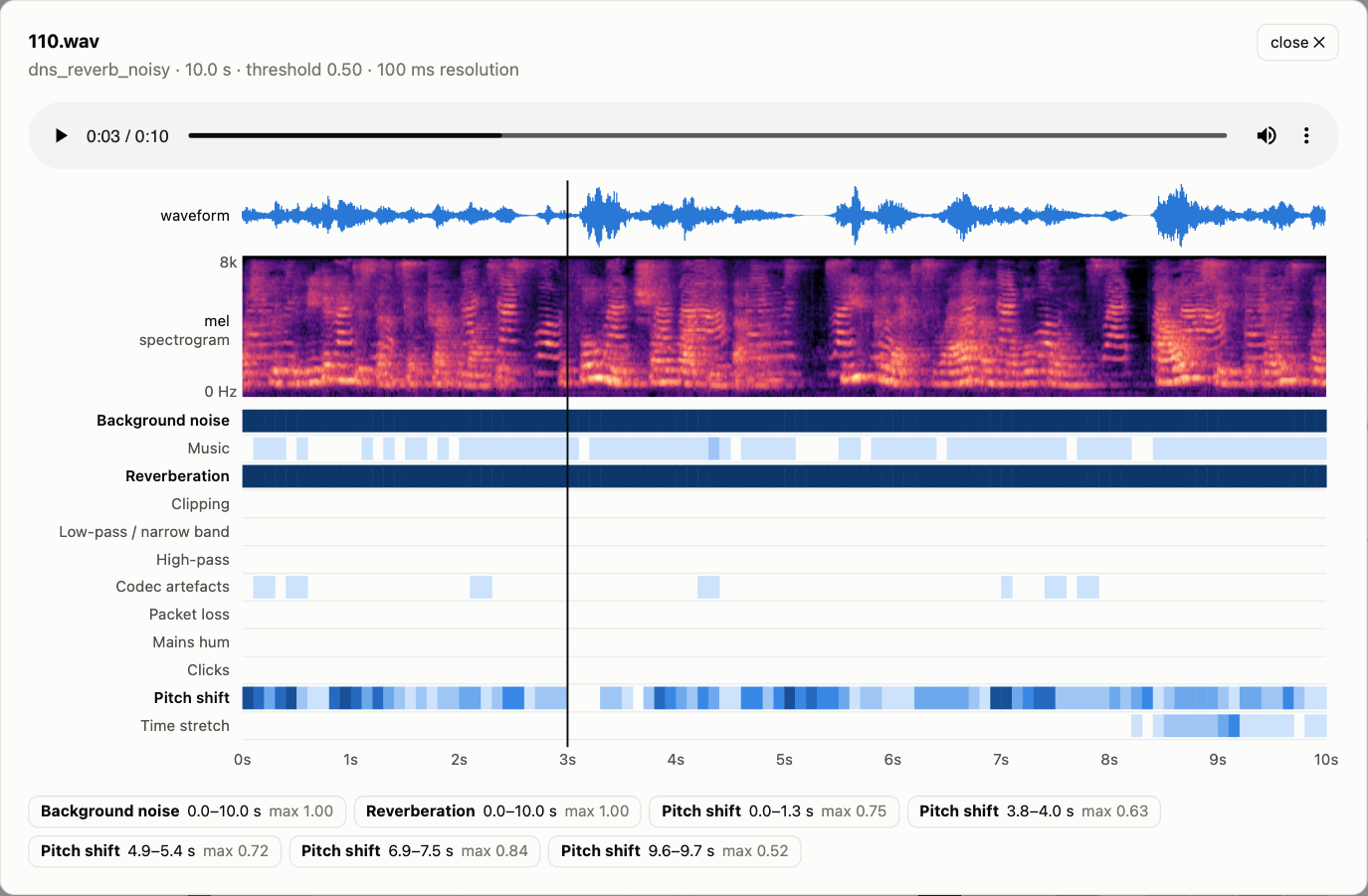
Interactive HTML degradation inspector by gertelrina/aadd (MIT)
The November 2026 v3.1 update specifically fixed a common failure in v3.0 where cafe, street, and bus crowd babble triggered false music alerts. Fine tuning on roughly 36 hours of real FSD50K environmental noise plus synthetic crowd babble cut false music flags on VoiceBank-DEMAND noisy clips from 42% down to 28% (and cafe scenes from 40% down to 13%).
On unseen real room benchmarks, AADD v3.1 achieves 0.998 ROC-AUC on DNS Challenge 2020 noise, 1.000 ROC-AUC on DNS reverberation with 0.0% false alarms on clean studio speech, and 0.955 / 0.960 frame macro AP on English and Russian held out tests.
Because multiple degradations frequently stack on location sets (such as room reverb plus boom mic clipping and wireless RF clicks), every 20 ms slot outputs 12 independent sigmoids rather than forcing one single label per clip.
Speed makes full feature audits effortless even without a dedicated GPU. End to end inference (including decoding and feature extraction) takes 23 ms per second of audio on CPU (43x real time), auditing an entire hour of dialogue dailies in about 84 seconds on an Apple M3 Pro CPU, or 6.5 ms per second on Apple MPS and faster still on NVIDIA CUDA.
Keep two documented boundaries in mind. Inputs resample to 16 kHz (so artifacts above 8 kHz are invisible), and validation focuses on speech rather than standalone orchestral stems.
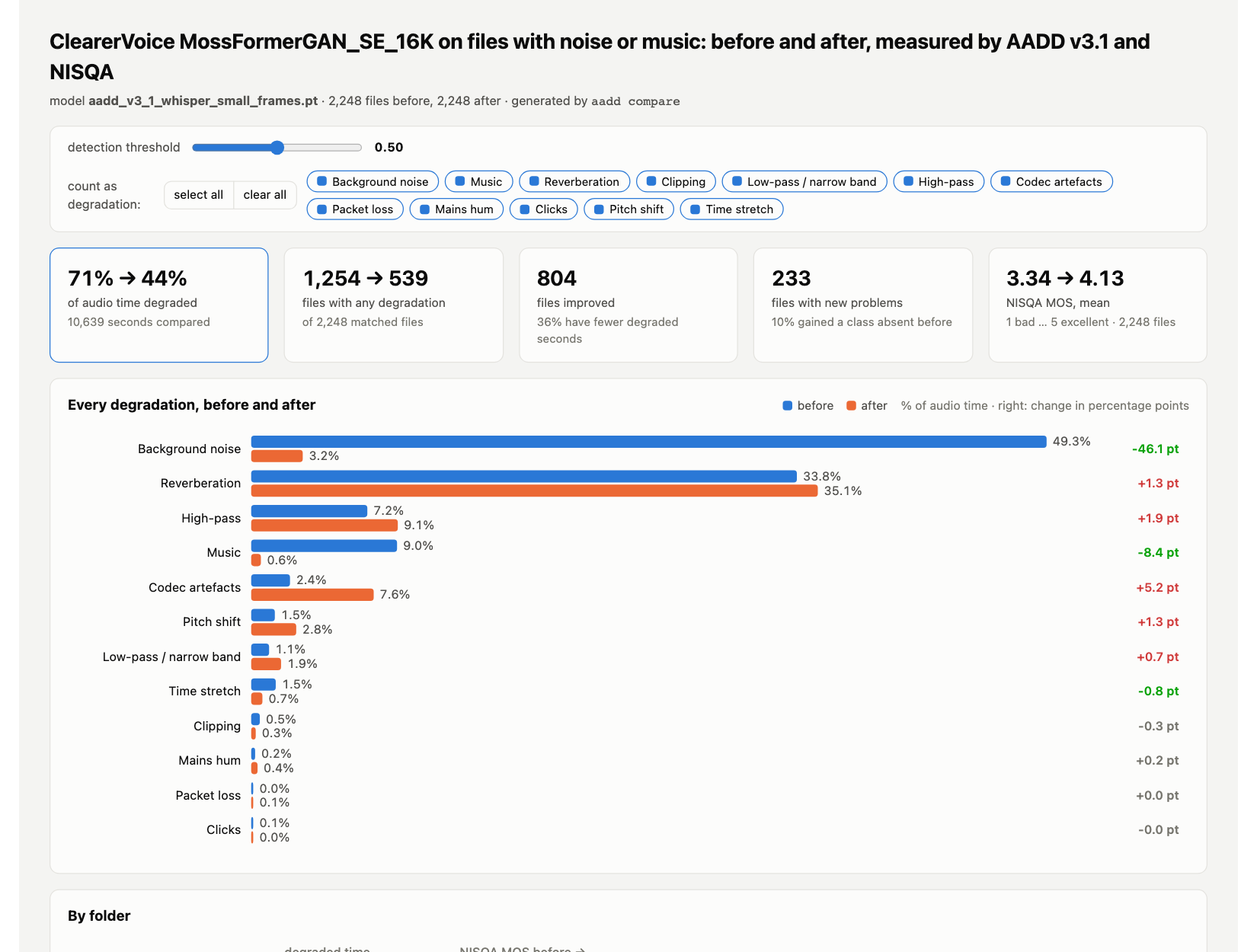
Multi file comparison report from AADD Official GitHub (MIT)
Hardware, VRAM, and License Matrix
| Checkpoint | Parameters / Size | Speed (M3 Pro CPU / MPS) | Accuracy Notes | License | Best Use |
|---|---|---|---|---|---|
aadd_v3_1_whisper_small_frames.pt (v3) |
88M (177 MB) | 23 ms/s CPU (43x RT) / 6.5 ms/s MPS | 0.998 DNS noise AUC, 1.000 reverb AUC, 0.0% clean FA |
MIT | Default production dialogue QC and TTS dataset curation |
aadd_v3_1_lite_crnn_frames.pt (v3-lite) |
1.3M CRNN (2.7 MB) | ~2x faster than v3.1 on CPU | 0.96 VoiceBank noise AUC; higher time_stretch FA |
MIT | Ultra fast edge pre filtering on huge speech archives |
aadd_v2_efficientnet_b0_mel.pt (v2) |
4M (16 MB) | 39 ms/s CPU | 7 synthetic classes only (0.919 macro F1) |
MIT | Legacy synthetic pipeline compatibility |
All checkpoints and CLI tools ship under the MIT License on top of Apache 2.0 Whisper Small, permitting unrestricted commercial integration inside post houses, ADR labs, and custom AI voice data pipelines.
Parameter Reference
| Setting / CLI Flag | Default / Recommended | Audio Post Production Behavior |
|---|---|---|
--model / Detector("v3") |
v3 (loads v3.1) |
Selects the 88M 12 class 20 ms Whisper Small detector |
--resolution |
1.0 s (0.1 s for tight spotting) |
Controls timeline segment granularity in exported CSV |
| Clip flag threshold | 0.5 at 95th percentile frame prob |
Lower to 0.25 to 0.35 when catching mild location hiss |
--report report.html |
Interactive HTML output | Builds a self contained visual QC dashboard for sound editors |
--segments per_100ms.csv |
Timecoded CSV table | Imports directly into spotting logs or Python cleanup scripts |
Local Python and CLI Setup
Install directly from GitHub with pip. The first run downloads the 177 MB v3.1 checkpoint automatically from Hugging Face.
pip install "aadd @ git+https://github.com/gertelrina/aadd"

# Scan an entire folder of location dialogue dailies and build an HTML QC report
aadd scan ./production_audio_dailies/ --report qc_report.html

# Export tight 100 ms spotting timestamps for a specific ADR stem
aadd scan scene12_boom.wav --resolution 0.1 --segments scene12_faults.csv
from aadd import Detector

det = Detector("v3", resolution=0.1)
res = det.predict_file("scene12_boom.wav")

# Dictionary of triggered degradations at 95th percentile score
print("Detected issues:", res.detected)

# Raw 20 ms frame probability matrix: shape (n_frames_20ms, 12)
print("Frame matrix shape:", res.frame_probs.shape)
Filmmaker Production Playbook
Pre screen voice cloning references before training or dubbing
Zero shot voice cloning models copy every flaw hidden inside a 10 second reference clip, baking subtle MP3 codec ringing or room reverb permanently into every synthesized line. Run aadd scan over actor reference clips first and accept only takes with zero clipping, codec, or reverb triggers.
Flag hidden mains hum and mic clicks on set before wrap
Because AADD v3.1 runs at 43x real time on a laptop CPU, a production sound mixer can scan an hour of dailies in under 90 seconds to verify whether lighting ballasts introduced 50/60 Hz hum or wireless packs dropped RF clicks before releasing the location.
Route only degraded spans into neural dialogue restoration
Instead of running heavy neural denoisers across an entire clean dialogue track (which can dull natural voice timbre), export --segments at 100 ms resolution and apply neural cleanup strictly to timestamps where noise or reverb crosses threshold.
Per Class Detection Precision (20 ms Frame AP)
On held out English and Russian evaluation suites with up to three simultaneous overlapping faults per 8 second window, AADD v3.1 maintains strong frame level average precision across all 12 classes:
| Fault Class | English Frame AP | Russian Frame AP | Typical Production Source |
|---|---|---|---|
| Pitch shift / Time stretch | 0.999 / 0.999 |
0.993 / 0.994 |
Sample rate mismatch or pull down errors |
| Low pass / High pass | 0.996 / 0.991 |
0.994 / 1.000 |
Telephone ADR or muffled lavalier mics |
| Clipping / Packet loss | 0.993 / 0.991 |
0.997 / 0.992 |
Hot preamp peaks or remote interview dropouts |
| Music / Reverberation | 0.985 / 0.985 |
0.990 / 0.991 |
Location bleed and untreated concrete rooms |
| Clicks / Codec artifacts | 0.976 / 0.925 |
0.979 / 0.961 |
RF wireless pops and low bitrate proxy audio |
| Background noise / Mains hum | 0.898 / 0.726 |
0.799 / 0.825 |
HVAC, street traffic, and 50/60 Hz ballast hum |
Frequently Asked Questions
Why did AADD v3.1 retrain on FSD50K environmental noise?
Earlier v3.0 weights frequently misclassified background cafe and street babble as music. Fine tuning v3.1 on 36 hours of real CC0 and CC BY environmental noise reduced music false positives on noisy clips from 42% down to 28%.
Can AADD v3.1 catch high frequency sibilance above 8 kHz?
No. Inputs are resampled to 16 kHz before Whisper Small encoding, so AADD v3.1 inspects frequencies up to 8 kHz only. Pair it with a dedicated true peak loudness meter for ultrasonic checks.
Should I use v3 or v3-lite for studio dialogue QC?
Use default v3 (v3.1, 177 MB) for production film QC. It already runs at 43x real time on CPU with 0.0% false alarms on studio clean speech, whereas v3-lite triggers higher time_stretch false alerts on clean voices.
Related Reading
- Clean dialogue stems flagged by AADD using Quail Voice Focus open source film dialogue isolation.
- Compare speech restoration tools in Inworld Voice Isolator open source film audio cleanup.
- Explore film scoring and transcription tools in Dettato Audio to MIDI open source film scoring AI.
- Generate cinematic foley and soundscapes directly inside the AI FILMS Studio sound workspace.

Sources
Continue Reading


Video & LipSync
- Video Generator
- Text to Video
- Image to Video
- Start-End Frame to Video
- Draw to Video
- Motion Control
- Video Enhancer
- Video Upscaler
- Video Extend
- Video to Video LipSync
- Audio to Video LipSync
- Image to Video LipSync
- Video FaceSwap
- Seedance 2.5
- WAN 3.0
- Seedance 2
- FLUX 3
- Minimax H3
- Vidu Q3 Pro
- Grok Imagine Video 1.5
- Gemini Omni
- Google Veo 3.1
- Kling 3.0 Pro
- Luma Ray 3.2
- LTX 2.3
- Happy Horse 1.1
- Kling 3.0 Motion
- ByteDance Upscaler
- InfiniteTalk
- InsightFace
Image & Edit
- AI Character
- AI Actor
- Art Generator
- Text to Image
- Image to Image
- LoRA Image to Image
- Draw to Edit
- Image LoRA Training
- Remove Background
- Image Enhancer
- MidJourney 8.0
- Krea 2
- OpenAI GPT Image 2.0
- Nano Banana Pro Ultra
- Nano Banana 2 Lite
- Nano Banana Pro
- Minimax Image
- Clarity Pro
- Z-Image Turbo LoRA
- Krea 2 Turbo LoRA
- Z-Image LoRA Trainer
- Qwen Image LoRA Trainer
- Background Erase Network 2 (BEN2)