

Editorial overview diagram based on nikopueringer/CorridorKey2.0 specifications
Share this post:
CorridorKey 2.0: Open Source Green Screen VFX Keying
Pulling a clean chroma key on frizzy hair, motion blurred hands, semi transparent smoke, or unevenly lit studio cycs remains one of the slowest tasks in visual effects compositing. Traditional color difference keyers force artists to stack core mattes, edge mattes, and manual despill trees on every single shot. CorridorKey 2.0, released by Niko Pueringer and Corridor Digital in October 2026, replaces brittle color thresholds with a native resolution neural keyer that outputs both an alpha matte and a clean despilled foreground plate in HDR scene linear OpenEXR on just 4 GB to 6 GB of VRAM. You can test CorridorKey 2.0 free in the embedded browser demo below with zero login.
Studio availability. Try the public Hugging Face demo below; CorridorKey 2.0 is not part of a paid AI FILMS Studio plan (use BEN2 Background Remover in the image workspace for example instead).
Try CorridorKey 2.0 Live
Upload a green screen, blue screen, or live action clip inside the public Hugging Face Space below to test temporal CorridorKey matting and export transparent ProRes 4444 MOV or animated WebP clips directly in your browser.
Architecture and Technical Design
Instead of training one giant end to end vision backbone from scratch, CorridorKey 2.0 combines normalized features from three frozen foundation models (foundation_stats.safetensors) inside a compact 2.66 GB keyer (corridorkey_v2.safetensors). Every training plate was generated in house at Corridor Digital using physically based 3D rendering so the network learns exact ground truth alpha values and true uncontaminated foreground colors rather than rough hand rotoscoped approximations.
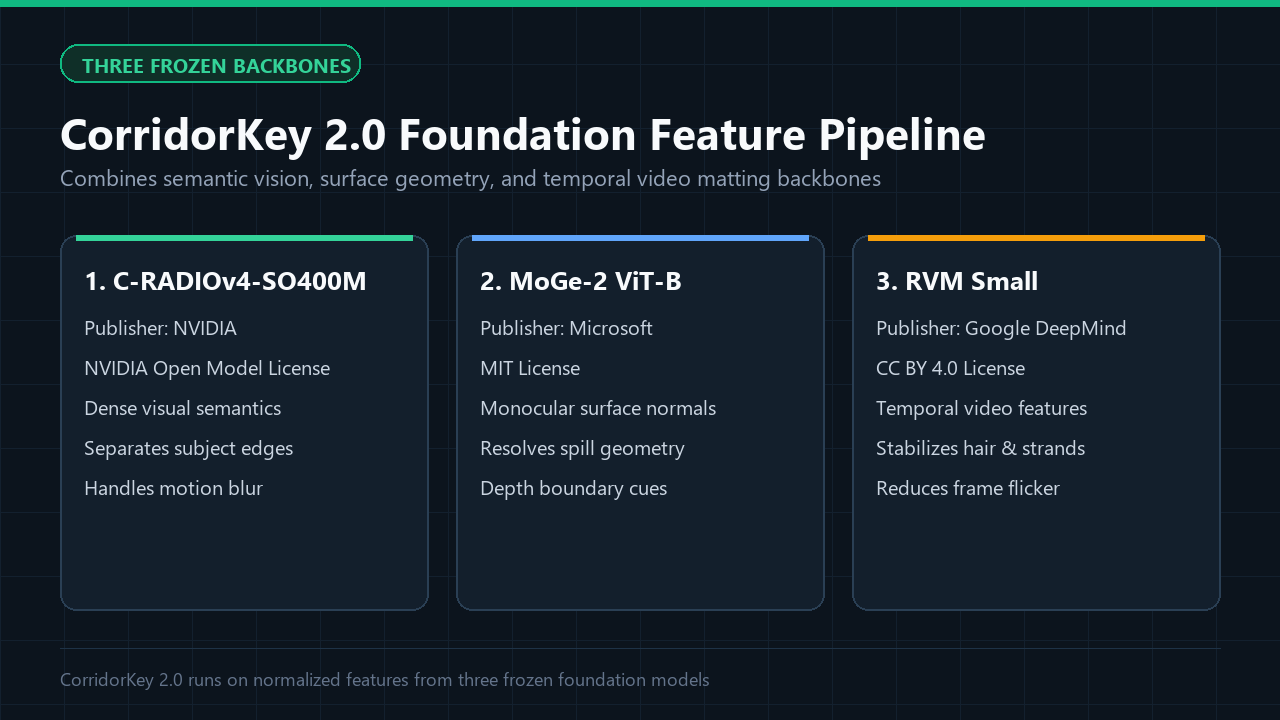
CorridorKey 2.0 multi backbone feature design from nikopueringer/CorridorKey2.0
Each frozen backbone contributes a distinct signal that traditional chroma keyers lack. NVIDIA's C-RADIOv4-SO400M supplies dense semantic understanding of limbs, hair, and props; Microsoft's MoGe-2 ViT-B contributes monocular surface normals and depth boundaries; and Google DeepMind's RVM small injects temporal video context across consecutive frames.
When a shot contains multiple actors or green wardrobe props, compositors can pass optional subject hints so CorridorKey isolates the exact intended foreground without eating into matching costume tones.
Unlike consumer background removers that crush 16 bit cinema plates down to 8 bit sRGB, CorridorKey 2.0 operates at native frame resolution and preserves high dynamic range. It outputs separate clean foreground and matte passes and writes scene linear OpenEXR sequences ready for ACES compositing in Nuke, Fusion, or DaVinci Resolve.
VRAM efficiency makes local deployment viable on virtually any studio or indie workstation. Corridor Digital's published specs require an NVIDIA RTX 30 series GPU or newer with 4 GB VRAM for plates up to 1440p and 6 GB VRAM for full 4K keying.
Licensing is friendly to independent filmmakers. Processing commercial film, YouTube, or client footage is permitted and outputs belong solely to the creator, while commercial software integration, paid API hosting, and studios above the revenue threshold stated in the official license require a commercial agreement with Corridor Digital.
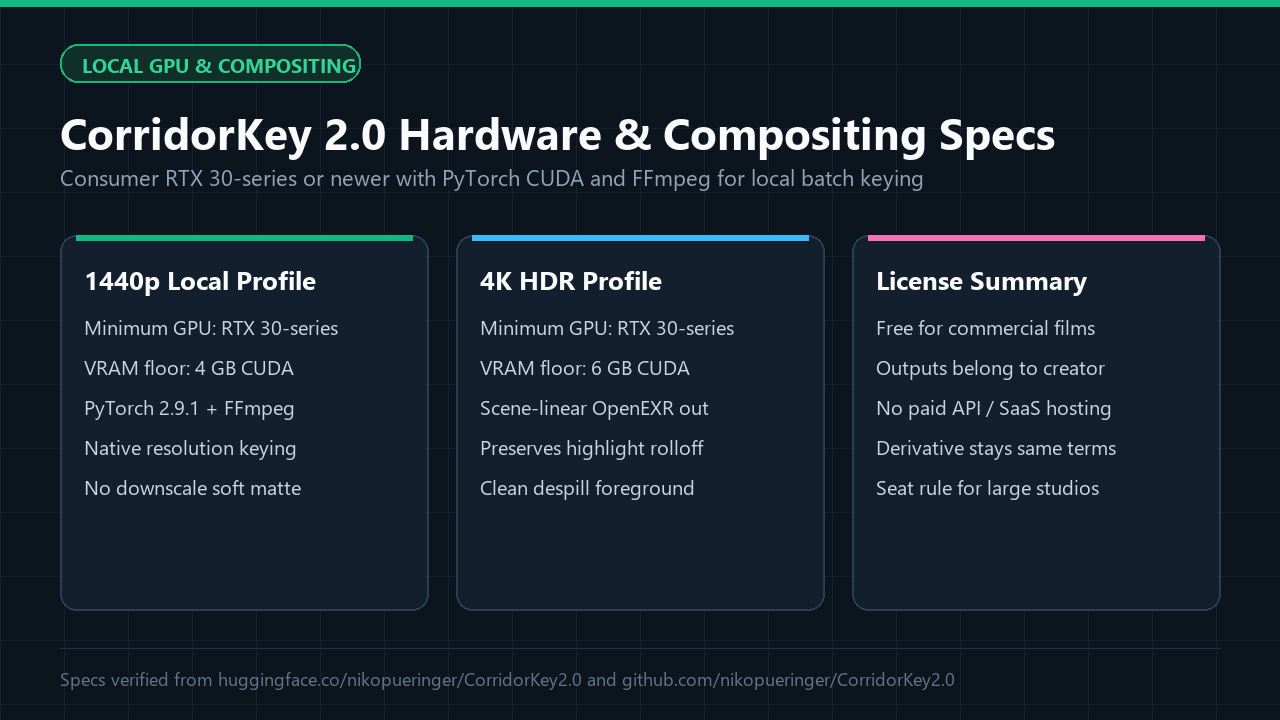
Hardware and HDR OpenEXR pipeline summary from CorridorKey 2.0 GitHub
Hardware, VRAM, and License Matrix
| Component | Publisher / Size | Hardware Floor | License | Pipeline Role |
|---|---|---|---|---|
corridorkey_v2.safetensors |
Corridor Digital (2.66 GB) | RTX 30 series+, 4 GB VRAM (1440p) / 6 GB (4K) | CorridorKey License 2.0 (CC BY-NC-SA 4.0 variant) | Native resolution matte and clean foreground prediction |
foundation_stats.safetensors |
Corridor Digital | Loaded with keyer | CorridorKey License 2.0 | Feature normalization statistics |
nvidia/C-RADIOv4-SO400M |
NVIDIA (auto downloaded) | Shared GPU memory | NVIDIA Open Model License | Frozen semantic vision features |
Ruicheng/moge-2-vitb-normal |
Microsoft (auto downloaded) | Shared GPU memory | MIT | Frozen geometry and surface normal cues |
RVM small (representations4d) |
Google DeepMind (auto downloaded) | Shared GPU memory | CC BY 4.0 | Frozen temporal video matting features |
Review the exact terms in the repository LICENSE file before distributing derivative tools or deploying across large studio seats. Paid inference APIs and model resale are disallowed under CorridorKey License 2.0.
Parameter Reference
| Setting / Flag | Typical Value | VFX Compositing Behavior |
|---|---|---|
--input |
Video file (.mp4, .mov) or image sequence |
Feeds native resolution green or blue screen plates |
--output_dir |
Local output directory | Writes alpha matte and clean despilled foreground passes |
| Resolution profile | Up to 1440p (4 GB VRAM) or 4K (6 GB VRAM) |
Keys at native pixel resolution without soft downscaling |
| Color pipeline | Scene linear HDR OpenEXR | Preserves highlight headroom and linear alpha premultiplication |
| Optional subject hints | Mask or prompt selection | Tells CorridorKey which foreground actor or prop to retain |
Local Python and CLI Setup
The official inference engine requires CUDA enabled PyTorch (tested on PyTorch 2.9.1) and ffmpeg. Running scripts/download_weights.py fetches both CorridorKey 2.0 files and the three frozen foundation backbones automatically.
git clone https://github.com/nikopueringer/CorridorKey2.0
cd CorridorKey2.0
pip install -r requirements.txt

# Fetch CorridorKey 2.0 weights plus C-RADIOv4, MoGe-2, and RVM small
python scripts/download_weights.py

# Run native resolution keying on a green screen plate
python infer.py --input greenscreen_shot_4k.mov --output_dir out/shot_010
Filmmaker Production Playbook
Preserve cinema dynamic range through linear OpenEXR
Export camera RAW plates in linear color space before running CorridorKey 2.0, then bring the resulting clean foreground and matte EXR sequences back into Nuke or DaVinci Resolve. Because CorridorKey predicts true foreground RGB alongside alpha, you avoid the dark green halos that plague traditional spill suppressors around bright backlit hair.
Pair neural keying with simple garbage mattes
Even when lighting stands, C stands, or studio walls creep into the edges of a budget green screen shoot, supply a rough hint or quick garbage matte. CorridorKey uses semantic and geometric features to hold crisp edges around the actor while cleanly dropping uneven shadows across the cyc.
Batch key dailies on a laptop GPU
Because 1440p keying fits inside 4 GB VRAM and 4K fits inside 6 GB VRAM, on set DIT carts can run overnight slap comps on an RTX laptop to verify whether an actor's wardrobe or lighting setup keys cleanly before striking the set.
Why Synthetic 3D Training Data Matters for Keying
Hand rotoscoped training sets almost always suffer from rough soft edges around hair strands, semi transparent glass, and fast shutter motion blur. Because Corridor Digital rendered every CorridorKey 2.0 training plate in house using 3D CG pipelines, the model receives mathematically exact alpha transparency and uncontaminated clean foreground RGB values for every single pixel.
That clean separation allows CorridorKey 2.0 to predict both the matte and the despilled foreground plate simultaneously. Compositors no longer have to fight dark fringe outlines or crushed shadow edges when dropping keyed actors onto bright sunset skies or dark practical interiors.
Frequently Asked Questions
Can independent filmmakers use CorridorKey 2.0 on paid client projects?
Yes. CorridorKey License 2.0 explicitly allows processing footage for commercial films and client deliverables, and every output belongs to the creator. Paid API hosting, model resale, and large organizations above the official license revenue cap require a separate commercial license from Corridor Digital.
Does CorridorKey 2.0 work on blue screens as well as green screens?
Yes. The model supports both green screen and blue screen cinema plates at native resolution, with optional subject hints when foreground props share screen tones.
What software is needed to run CorridorKey 2.0 locally?
You need an NVIDIA RTX 30 series GPU or newer with 4 GB VRAM for 1440p or 6 GB VRAM for 4K, CUDA enabled PyTorch (tested on 2.9.1), and ffmpeg. Running scripts/download_weights.py fetches all required checkpoints automatically.
Related Reading
- Compare general temporal video matting without green screens in MatAnyone 2 video matting.
- Isolate stills cleanly with BRIA RMBG 3.0 open source VFX background removal.
- Build promptable object masks across clips with Meta SAM 3 open source promptable video segmentation.
- Remove image backgrounds directly in the cloud on the AI Background Remover page.

Sources
Continue Reading


Video & LipSync
- Video Generator
- Text to Video
- Image to Video
- Start-End Frame to Video
- Draw to Video
- Motion Control
- Video Enhancer
- Video Upscaler
- Video Extend
- Video to Video LipSync
- Audio to Video LipSync
- Image to Video LipSync
- Video FaceSwap
- Seedance 2.5
- WAN 3.0
- Seedance 2
- FLUX 3
- Minimax H3
- Vidu Q3 Pro
- Grok Imagine Video 1.5
- Gemini Omni
- Google Veo 3.1
- Kling 3.0 Pro
- Luma Ray 3.2
- LTX 2.3
- Happy Horse 1.1
- Kling 3.0 Motion
- ByteDance Upscaler
- InfiniteTalk
- InsightFace
Image & Edit
- AI Character
- AI Actor
- Art Generator
- Text to Image
- Image to Image
- LoRA Image to Image
- Draw to Edit
- Image LoRA Training
- Remove Background
- Image Enhancer
- MidJourney 8.0
- Krea 2
- OpenAI GPT Image 2.0
- Nano Banana Pro Ultra
- Nano Banana 2 Lite
- Nano Banana Pro
- Minimax Image
- Clarity Pro
- Z-Image Turbo LoRA
- Krea 2 Turbo LoRA
- Z-Image LoRA Trainer
- Qwen Image LoRA Trainer
- Background Erase Network 2 (BEN2)