

Shuang Wu et al. / DreamTech (Direct3D-V3 SIGGRAPH Asia 2026 teaser, MIT)
Share this post:
Direct3D-V3: Open Source Native Voxel 3D Mesh AI
Latent 3D mesh generators compress geometry through a 3D variational autoencoder before diffusion ever begins, which frequently melts sharp mechanical bevels, thin wires, and carved hero prop detail into blobby surfaces. Direct3D-V3 (arXiv:2611.26511, accepted to ACM Transactions on Graphics / SIGGRAPH Asia 2026 and released under the MIT license in November 2026 by Nanjing University, DreamTech, HKU, and Oxford) removes the 3D VAE bottleneck completely by running diffusion transformers directly over raw signed distance field (SDF) voxel grids up to 1536 resolution. You can test Direct3D-V3 free in the embedded browser demo below with zero login.
Studio availability. Try the public Hugging Face demo below; Direct3D-V3 is not part of a paid AI FILMS Studio plan (use FLUX.2 Pro Text to Image in the image workspace for example instead).
Try Direct3D-V3 Live
Pick an included normal map and coarse mesh pair (or upload your own aligned reference image and OBJ or GLB proxy) inside the public Hugging Face Space below to refine detailed 3D meshes and download GLB files directly in your browser.
Architecture and Technical Design
Instead of encoding shapes into compressed latent tokens, Direct3D-V3 cascades three native voxel diffusion transformers (shape_transformers_512, shape_transformers_1024, and shape_transformers_1536) directly in sparse SDF voxel space. Starting from an aligned coarse proxy mesh, each stage upsamples occupied voxel patches to carve crisp grooves, bolts, and thin silhouette features without VAE reconstruction blur.
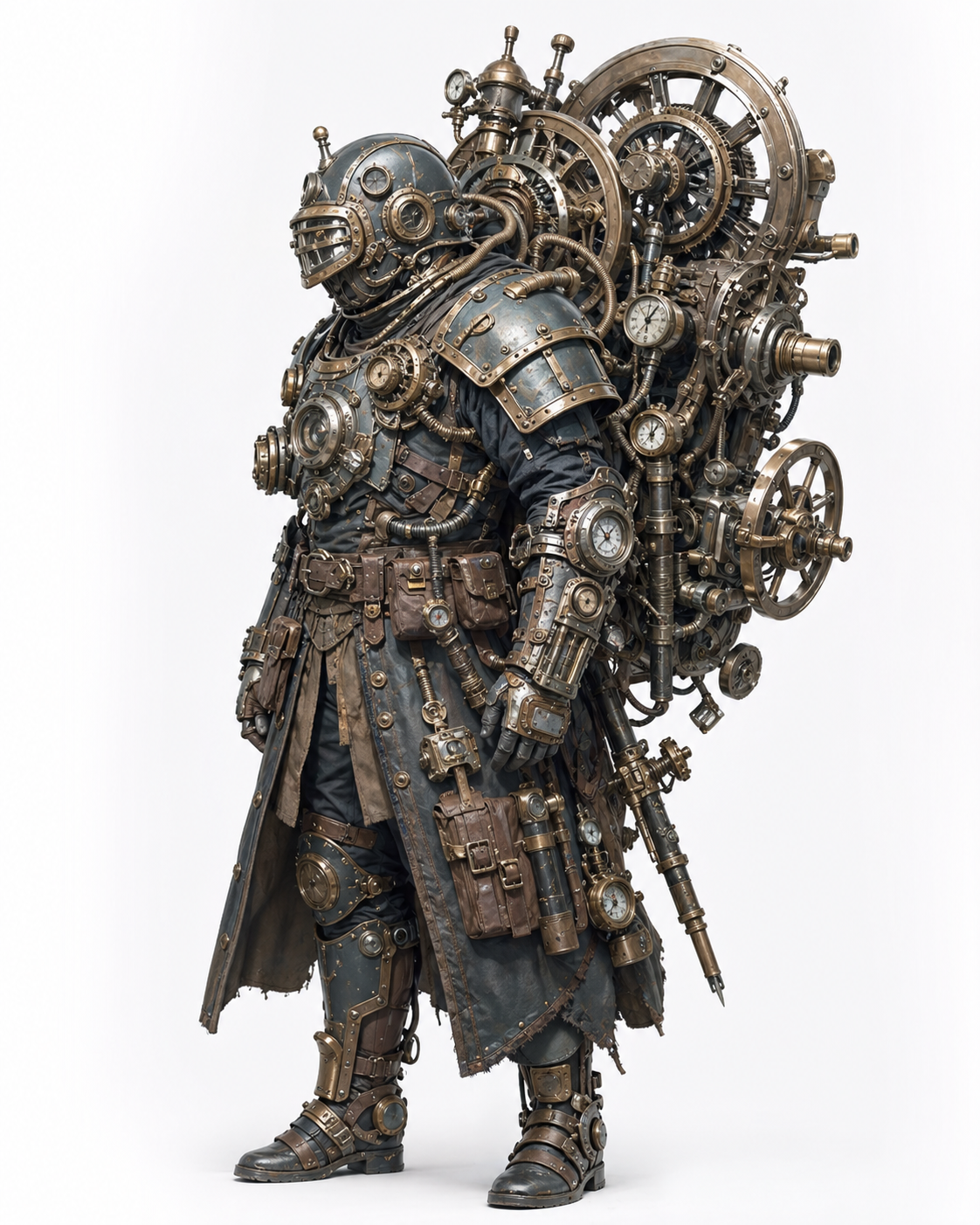
RGB concept prop input from wushuang98/Direct3D-V3 (MIT)
The November 2026 public weights actually outperform the original paper checkpoint. The authors upgraded image conditioning to fuse features across four DINOv3 ViT-H+ layers (paired with BiRefNet foreground segmentation) and switched optimization to the Muon optimizer, accelerating convergence and sharpening fine geometry.
Each stage runs with just 15 default diffusion steps and a guidance scale of 4.0, then passes the extracted surface through pyfqmr mesh decimation to hit a configurable triangle budget (default 2 million faces, adjustable from 100,000 up to 5 million).
Because the authors have not yet released their own coarse mesh generator or latent free texture model, Direct3D-V3 currently acts as a dedicated high resolution geometry synthesizer and refiner. You supply an aligned coarse OBJ, GLB, or PLY mesh (for instance from an upstream image-to-3d generator) alongside a clean geometric reference image.
For maximum surface crispness, the authors recommend converting painted RGB concept art into a surface normal map or untextured white clay render before feeding it to Direct3D-V3. Removing painted albedo shadows stops the denoiser from mistaking painted dirt or highlights for physical indentations.
Memory scaling is controlled cleanly through max_tokens (default 150,000 occupied voxel patches per stage). If a hero asset overflows local GPU memory, lowering --max-tokens automatically rescales the voxel grid to fit available VRAM.
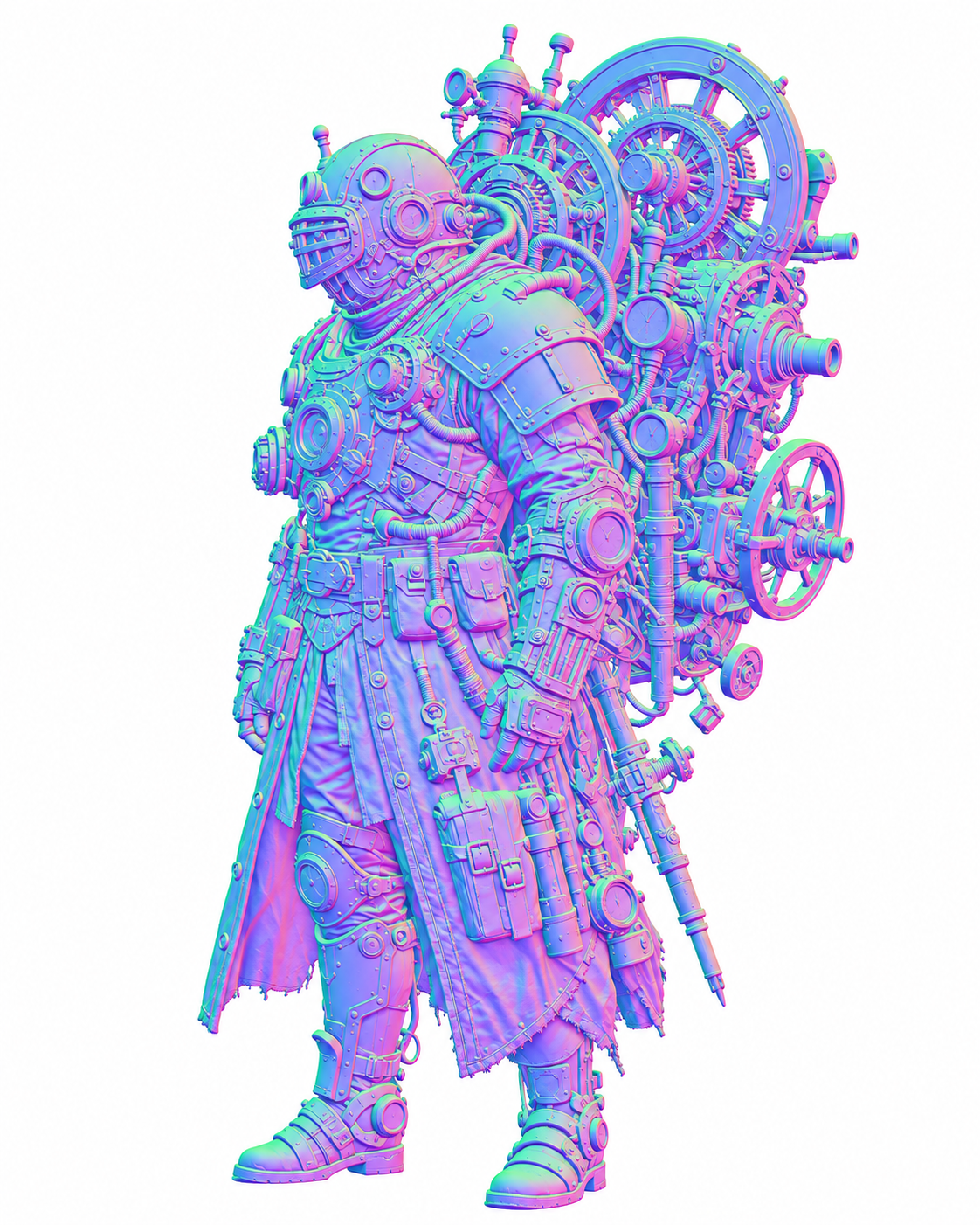
Paired surface normal conditioning pass from DreamTechAI/Direct3D-V3 (MIT)
Hardware, VRAM, and License Matrix
| Component | Details | Hardware & Runtime | License | Role in Pipeline |
|---|---|---|---|---|
shape_transformers_512 |
Stage 1 native voxel DiT | Linux, Python 3.12, PyTorch 2.14.1, CUDA 13.0 | MIT | Base 512 voxel refinement from coarse mesh |
shape_transformers_1024 |
Stage 2 native voxel DiT | Single 24 GB+ CUDA GPU (adjust --max-tokens for lower VRAM) |
MIT | Production 1024 voxel detail synthesis |
shape_transformers_1536 |
Stage 3 native voxel DiT | High memory CUDA GPU + FlashAttention 2 | MIT | Hero close up 1536 voxel surface geometry |
facebook/dinov3-vith16plus-pretrain-lvd1689m |
Four layer visual encoder | Loaded automatically (requires HF gated access) | Upstream Meta DINOv3 license | Image conditioning features |
ZhengPeng7/BiRefNet |
Foreground segmentation | Shared GPU memory | MIT | Automatic subject mask extraction |
Direct3D-V3 source code and weights carry the permissive MIT License. If you pair optional preprocessing tools (such as Qwen-Image-2.1 for texture stripping or external coarse mesh generators), verify each external tool's separate commercial terms first.
Parameter Reference
| Argument / CLI Flag | Default Value | Production Effect |
|---|---|---|
--resolution |
1024 (supports 512, 1024, 1536) |
Sets highest native SDF voxel stage executed |
--steps-1024 / num_inference_steps |
{512: 15, 1024: 15} |
Denoising step count per resolution stage |
--cfg-1024 / guidance_scale |
{512: 4.0, 1024: 4.0} |
Controls adherence to reference normal or clay image |
--max-tokens / max_tokens |
150,000 |
Caps occupied voxel patches to prevent GPU OOM errors |
target_faces / --no-simplify |
2,000,000 (range 100K to 5M) |
Controls pyfqmr decimation budget on exported GLB |
Local Python and CLI Setup
Direct3D-V3 builds two lightweight native extensions (voxelization and fill_holes) alongside FlashAttention 2 on Linux with CUDA 13.0 and a C++20 compiler.
git clone https://github.com/DreamTechAI/Direct3D-V3.git
cd Direct3D-V3
conda create -n direct3d-v3 python=3.12 -y
conda activate direct3d-v3

pip install torch==2.14.1 torchvision==0.29.1 --index-url https://download.pytorch.org/whl/cu130
pip install -r requirements.txt gradio==6.32.0 setuptools wheel packaging psutil ninja
CXXFLAGS="-std=c++20" pip install --no-build-isolation \
  git+https://github.com/Dao-AILab/flash-attention.git@edb5c76ee329b18ed95d1f7ea9aa522a1331ab7d
pip install --no-build-isolation ./third_party/voxelization ./third_party/fill_holes

# Single hero prop refinement at 1024 native voxel resolution
python infer.py \
  --image assets/input_imgs/6_normal.png \
  --coarse-mesh assets/coarse_meshes/6.obj \
  --resolution 1024 --steps-1024 15 --cfg-1024 4.0 \
  --output hero_prop_1024.glb
from direct3d import Direct3DV3Pipeline

pipeline = Direct3DV3Pipeline.from_pretrained("wushuang98/Direct3D-V3").to("cuda")
mesh = pipeline(
    image="assets/input_imgs/6_normal.png",
    coarse_mesh="assets/coarse_meshes/6.obj",
    resolution=1024,
    num_inference_steps={512: 15, 1024: 15},
    guidance_scale={512: 4.0, 1024: 4.0},
    max_tokens=150_000,
    target_faces=2_000_000,
)
mesh.export("hero_prop_1024.glb")
Filmmaker Production Playbook
Prep clean clay or normal references for hard surface props
Before running Direct3D-V3 on spaceships, weapons, statues, or architectural columns, generate a clean untextured clay or surface normal image matching the exact coarse mesh camera angle. Clean normal cues produce crisp mechanical seams that standard RGB conditioning smears out.
Batch refine background set dressing overnight
Pass matching --infer_path ./images and --coarse-mesh ./coarse_meshes directories to infer.py. Reusing one warm pipeline across a folder of 50 prop proxies cuts model load overhead and produces unified GLB assets ready for Unreal Engine, Blender, or Houdini.
Match triangle counts to camera distance
Keep target_faces=2_000_000 (or pass --no-simplify) for foreground close up hero props that need displacement level silhouettes, and drop target_faces to 200,000 for mid ground set dressing to keep viewport frame rates smooth during previz.
Roadmap and Current Scope
Direct3D-V3's November 19, 2026 release ships the complete inference codebase and all three native voxel shape transformers (512, 1024, and 1536) under the MIT License. Three companion components remain on the authors' public roadmap, including their own coarse mesh generation models, a dedicated latent free texture generator, and full training scripts.
Until those companion checkpoints ship, pairing Direct3D-V3 with an aligned coarse mesh from a fast image-to-3d tool plus an untextured clay or surface normal reference gives VFX and game art teams production grade sculpted meshes today.
Frequently Asked Questions
Why does Direct3D-V3 ask for a coarse mesh alongside the reference image?
The current MIT release covers the high resolution native voxel refinement transformers (512, 1024, and 1536) while the authors' standalone coarse generator is still pending release. Any aligned OBJ, GLB, or PLY proxy works as --coarse-mesh.
How do I stop Direct3D-V3 from running out of GPU memory?
Lower --max-tokens (default 150,000) in infer.py or Direct3DV3Pipeline. The pipeline automatically rescales the centered mesh before voxelization so occupied patches stay inside your VRAM ceiling.
Can Direct3D-V3 run completely offline on a secure studio workstation?
Yes. Cache all three shape transformers, the gated DINOv3 ViT-H+ encoder, and BiRefNet locally, then launch inference with HF_HUB_OFFLINE=1.
Related Reading
- Compare high resolution 3D refinement workflows in Hi3D v1.0 open source high resolution 3D refinement.
- Fine tune PBR 3D asset styles with TRELLIS.2 LoRA open source 3D PBR asset fine tuning.
- Generate game ready 3D character hair assets in HairDeck open source 3D character hair cards AI.
- Generate crisp concept art sheets before 3D modeling on the AI Text to Image Generator page.

Sources
Continue Reading


Video & LipSync
- Video Generator
- Text to Video
- Image to Video
- Start-End Frame to Video
- Draw to Video
- Motion Control
- Video Enhancer
- Video Upscaler
- Video Extend
- Video to Video LipSync
- Audio to Video LipSync
- Image to Video LipSync
- Video FaceSwap
- Seedance 2.5
- WAN 3.0
- Seedance 2
- FLUX 3
- Minimax H3
- Vidu Q3 Pro
- Grok Imagine Video 1.5
- Gemini Omni
- Google Veo 3.1
- Kling 3.0 Pro
- Luma Ray 3.2
- LTX 2.3
- Happy Horse 1.1
- Kling 3.0 Motion
- ByteDance Upscaler
- InfiniteTalk
- InsightFace
Image & Edit
- AI Character
- AI Actor
- Art Generator
- Text to Image
- Image to Image
- LoRA Image to Image
- Draw to Edit
- Image LoRA Training
- Remove Background
- Image Enhancer
- MidJourney 8.0
- Krea 2
- OpenAI GPT Image 2.0
- Nano Banana Pro Ultra
- Nano Banana 2 Lite
- Nano Banana Pro
- Minimax Image
- Clarity Pro
- Z-Image Turbo LoRA
- Krea 2 Turbo LoRA
- Z-Image LoRA Trainer
- Qwen Image LoRA Trainer
- Background Erase Network 2 (BEN2)