
.jpg?w=3840&q=90)
Share this post:
Ken Ziffren: Hollywood's AI Adoption Is in Phase 1
Ken Ziffren has spent more than 50 years shaping the legal architecture of Hollywood. He represented the Directors Guild of America, the Television Academy, and producer Stephen J. Cannell. He served as Los Angeles film czar under Mayor Eric Garcetti and founded the UCLA Entertainment Symposium in 1976, which marked its 50th anniversary on June 18, 2026.
In a June 17 Variety interview timed to the symposium, Ziffren offered the clearest structural description of Hollywood's AI moment that any senior entertainment lawyer has put on record. His assessment is not a warning or a celebration. It is a framework: two phases, a historical precedent, and a prediction that courts alone cannot resolve what comes next.
.jpg)
Fifty Years of Context
Ziffren founded the UCLA Entertainment Symposium in 1976 when the post-fin-syn ecosystem was still in its first decade. He has watched Hollywood absorb cable television, home video, the DVD format, digital distribution, and streaming. Each transition produced predictions of collapse that turned out to be wrong. Each one also produced genuine structural change that took a decade to fully materialize.
That record is relevant to his AI framing. When Ziffren says the industry is in Phase 1, he is not offering reassurance. He is identifying where the industry is in a process he has watched repeat itself. Every major technology shift he witnessed began with cost reduction and efficiency tools before moving into deeper disruption of how value was created and distributed.
Ziffren's own career illustrates the range of institutional positions Hollywood requires. He represented creative talent through guild negotiations, supported municipal film production as LA film czar, and built an academic forum for industry dialogue that is now in its sixth decade. His Phase framework is not theoretical.
It is a practitioner's read of a pattern he has seen play out in multiple prior forms.
The Symposium itself, held June 18 at Schoenberg Hall on the UCLA campus, brought together studio executives, talent representatives, and legal professionals to mark 50 years of industry dialogue. The agenda included sessions on streaming economics and AI's role across the production pipeline. Ziffren's framing of Phase 1 and Phase 2 was the through line connecting those discussions to one another.
The setting matters. UCLA's entertainment law program has produced a significant share of working entertainment lawyers, and the Symposium has served as a venue for major industry announcements and policy conversations since 1976. When Ziffren offers a framework at his own 50th anniversary event, he is doing so in front of the people who will operationalize or litigate the positions he describes.
Ziffren graduated from UCLA Law in 1965. His client list over 50 years has included producers, directors, and creative guilds on nearly every side of every major industry transition. That breadth means his Phase framework is not a statement of advocacy for any one constituency. It is a structural observation about where an industry sits in a pattern it has been through before, made by someone who has advised people on all sides of each prior version of that pattern.
His record of observing transitions accurately matters to how his predictions should be weighted. Ziffren advised clients through the home video boom that studios initially resisted and later depended on, through the cable expansion they feared and ultimately absorbed, and through the streaming disruption that dismantled the cable economics they had built. Each of those transitions produced a version of his Phase framework: cost reduction first, structural renegotiation second.
Phase 1: Cost Control
Ziffren's framework begins with a specific claim about where AI stands today. "Phase 1 in our industry is in essence cost control," he said. "That's where AI plays the most prominent role right now."
The cost control phase is already visible in every segment of production. Previsualization that once required weeks of storyboarding can now be produced in days using AI image generation tools. Script coverage, clearances research, and production scheduling tasks that consumed staff hours are being partially automated. In post-production, AI tools are compressing color grading, VFX cleanup, and audio restoration workflows that previously required dedicated specialty teams.
The economic scale of these savings is not trivial. Industry analysts have estimated that AI adoption in post-production alone can reduce finishing costs by 20 to 40 percent on mid-budget productions. Pre-production savings through AI-assisted development and research are harder to quantify, but the budget line items that funded large support departments have started to shrink.
Phase 1 is not structurally disruptive in the way the industry feared. It does not eliminate directors, actors, or writers. It reduces the headcount and cost of the infrastructure around them. Contracts can engage with that movement through minimum call requirements, residual adjustments, and new category definitions. The guild agreements of 2025 and 2026 are Phase 1 contracts. They establish consent and disclosure frameworks for the AI tools already in use.
A related indicator of Phase 1's scope: the major studios have already integrated AI tools into post-production pipelines on tentpole features. The cost efficiencies are being realized now, not in a hypothetical future cycle. That timing is what makes Phase 2 a near-term negotiating reality rather than a speculative concern.
What Phase 2 Looks Like
Phase 2 is where Ziffren's framework becomes more demanding. He describes it as involving workers' positioning on how they share in the cost savings AI generates. No major guild agreement to date addresses this question directly.
The underlying problem is one of distribution. When a studio saves $30 million on a production because AI reduced crew requirements, contracted labor costs, and post timelines, the savings accrue entirely to the studio. Workers who remain on the production, and those who left because their departments were downsized, receive nothing from that efficiency gain. Phase 2 is the negotiation over that gap.
Comparisons to earlier automation waves in other industries are instructive. When auto manufacturers introduced robotic assembly lines in the 1980s and 1990s, the UAW spent years negotiating profit sharing provisions that tied worker compensation to productivity gains. The Entertainment Community Fund has noted parallels between Hollywood's current AI moment and the automation transitions that restructured heavy manufacturing. The guild deals of 2024 and 2025 address consent. Phase 2 will need to address revenue.
The DGA's four year deal and the SAG-AFTRA contract both contain AI provisions that define consent requirements and disclosure obligations. Neither addresses profit sharing on AI efficiency gains. Ziffren's two-phase framework explains why: those provisions are Phase 1 solutions to Phase 1 problems. The negotiations that settle Phase 2 have not started yet.
Phase 2 negotiations are likely to arrive before the current contracts expire. The DGA deal runs four years; the SAG-AFTRA deal four years. If AI cost savings continue to scale during that period, guild members will have documented, quantifiable evidence of the gap between their compensation and studio AI generated savings before the next negotiating cycle opens. That data changes the bargaining position.
The UAW precedent Ziffren references took roughly a decade from the introduction of widespread industrial automation to the first profit sharing agreements. Hollywood is moving faster. Three major guild contracts with AI provisions were negotiated in a single 12-month window. The legal and regulatory framework is being written in parallel. Ziffren's prediction is that Phase 2 is closer than most current industry discussions suggest.
Human Creativity and Copyright
Ziffren's view on AI's limits is grounded in copyright doctrine rather than aesthetics. "You've got to be human to be copyrighted," he said. Under US law, the Copyright Office has consistently held that copyright requires human authorship. Works generated autonomously by AI without sufficient human creative contribution are not eligible for registration.
The Copyright Office formalized this position in a series of guidance documents beginning in 2023, following the Zarya of the Dawn case, in which a federal court found that AI generated images could not be separately protected. Ziffren is restating settled doctrine, not offering a prediction. The legal framework already exists. The question is whether Congress will extend it, modify it, or leave it to courts.
The commercial implications follow from the legal foundation. "If you were presented tomorrow with a non-human program, would you go to the theater or would you turn on the set to watch it, other than for curiosity's sake?" Ziffren asked. The question is rhetorical but captures an economic reality: audiences pay for performances by identifiable humans whose biographical and emotional lives they know. The interest in a performance is inseparable from the person giving it.
Ziffren is not arguing that AI cannot produce useful output. He is describing the structure within which that output operates. "I think there is a worldwide belief that human H-I instead of AI is still under control," he said, using H-I to denote human intelligence. The line between AI as a tool and AI as an author is where both the copyright question and the Phase 2 labor question live.
For studios, the copyright limitation on AI output has a direct commercial consequence: a film whose core creative elements are AI authored cannot be fully protected. Scenes, scripts, and music that lack human creative input enter the public domain immediately. That is not a theoretical risk for productions that rely heavily on AI generation. It is an active business consideration that will shape how studios structure the human creative contribution in AI-assisted projects going forward. Copyright law, in this reading, functions as a guardrail that keeps human creators economically relevant to the production pipeline regardless of what AI tools can generate.

The Fin-Syn Parallel
Ziffren draws his most instructive comparison from history: the Financial Interest and Syndication Rules, known in the industry as fin-syn. The FCC enacted fin-syn in 1970 to prevent broadcast television networks from owning the programs they aired. Networks could distribute programming, but syndication rights and foreign rights had to stay with the studios and producers who made the content.
The rules protected an independent production ecosystem for 25 years. Studios retained library value. Independent producers could finance their own projects and retain rights after the initial network window. The economic structure of Hollywood from the 1970s through the early 1990s depended on that separation of distribution from content ownership.
The FCC repealed fin-syn in 1995. Within a decade, broadcast networks had acquired studios, and the vertical integration that produced today's media conglomerates was complete. By the 2010s, the largest streaming services were producing content exclusively for their own platforms under perpetual licensing terms that no independent creator could exit.
Ziffren sees the same dynamic in streaming's current relationship with independent content. Streamers have locked independent productions into 20-year exclusive agreements, concentrating ownership in a way that mirrors the broadcast model fin-syn was designed to break up. His proposal: require streamers to carry a percentage of independent content under first-cycle-only licenses. The modern equivalent of fin-syn would force streamers to return rights to independent creators after the initial window, preserving a production ecosystem outside the major platforms.
The connection to AI is structural rather than superficial. As studios use AI to reduce production costs, the financial dependence of independent producers on studio financing and distribution deepens. A studio that can produce content at half the previous cost has less incentive to license from outside suppliers. Ziffren's fin-syn revival addresses the distribution layer; AI cost savings address the production layer. Both pressures point in the same direction.
What the Framework Means for Independent Creators
Ziffren's Phase 1 and Phase 2 framework carries a direct implication for independent filmmakers and smaller production companies. Phase 1 cost savings are accessible to any production, at any budget level, using the same AI tools the major studios are deploying. The cost reductions in previsualization, script research, color grading, and VFX cleanup do not require major studio infrastructure to realize.
Phase 2, however, is a collective negotiation that only guild members can participate in directly. Independent filmmakers who work outside guild contracts will not be at the table when the profit sharing question is decided. The outcome of that negotiation will nonetheless shape the labor market they operate in, because it will affect the rates, conditions, and expectations of crew across all of Hollywood.
The copyright question Ziffren raises affects independent creators more acutely than studio productions. A major studio can afford the legal resources to navigate uncertain AI authorship rules individually, production by production. An independent production cannot. A federal standard on AI copyright and authorship would create clarity that disproportionately benefits smaller players, who currently face the same legal uncertainty with far fewer resources to manage it.
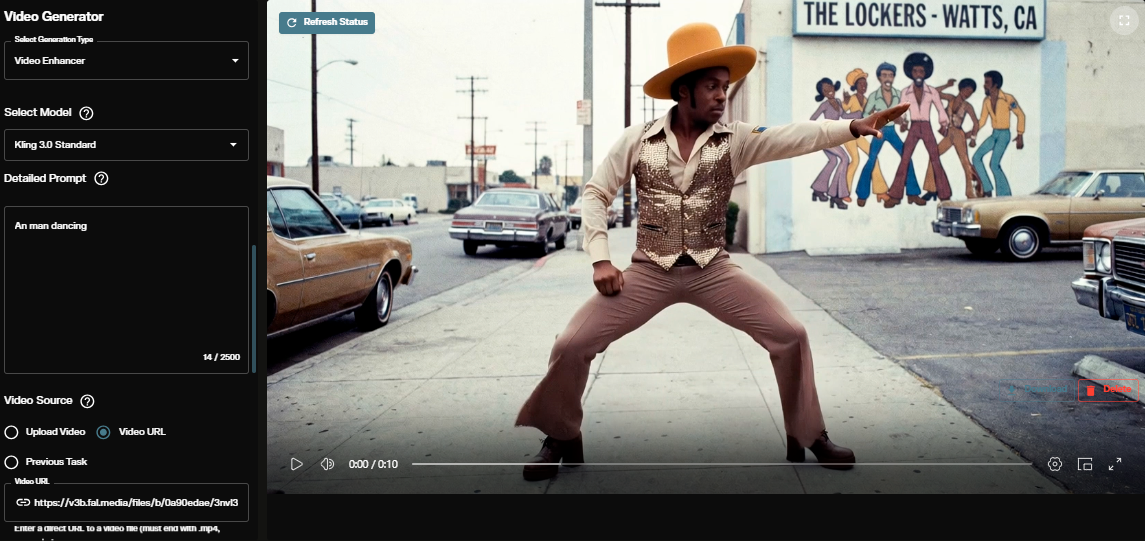
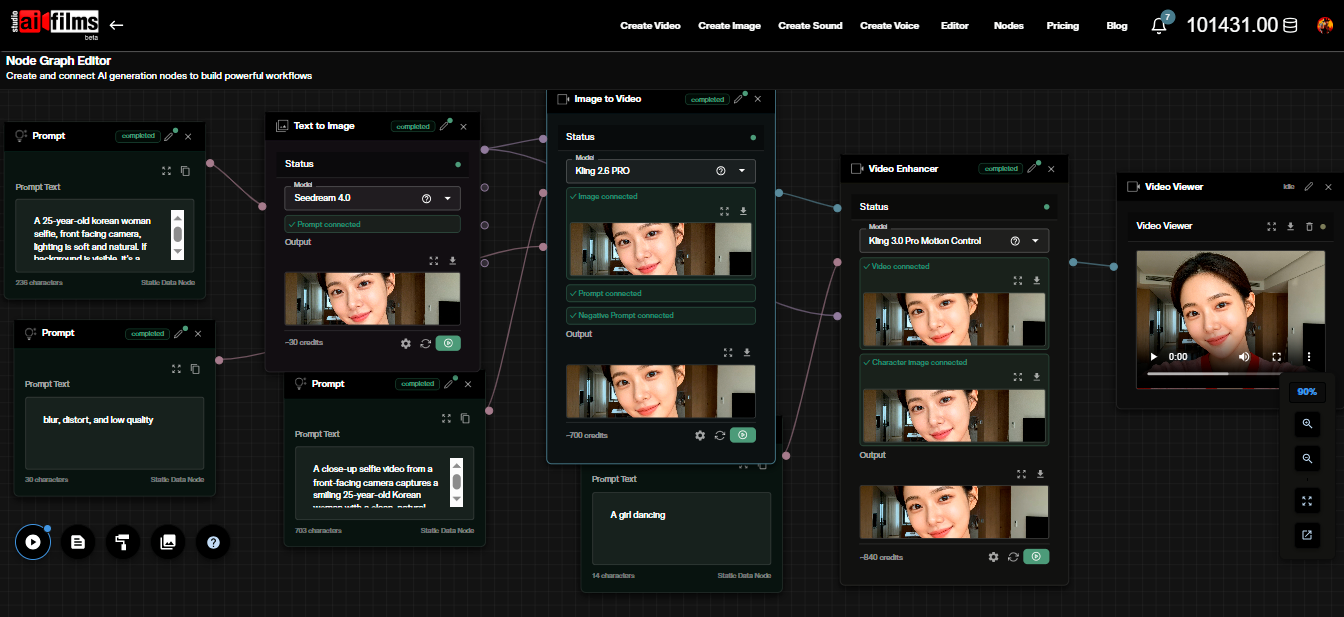
Filmmakers generating content through the AI FILMS Studio video workspace are operating in the Phase 1 window where the tools are available, the rules are still being established, and the cost advantages are real. That window will not last indefinitely as Phase 2 negotiations and federal legislation develop.
The longer-term direction Ziffren's framework suggests is one where AI tools become standard infrastructure, the legal and labor frameworks around them get codified at a federal level, and the creative and commercial value of human authorship becomes more formally defined rather than less. His argument is that human identity and creative attribution matter commercially, not just ethically. That commercial grounding is what makes his framework different from the arguments purely about cultural preservation. Studios have financial incentives to preserve human authorship as a distinct value category. Audiences pay for it. Copyright depends on it. Those incentives survive even in an industry that has fully integrated Phase 1 AI tools.
A Cacophony of Decisions
On the litigation outlook, Ziffren does not predict winners. He predicts volume. "We will have a cacophony of decisions, all of which relate to how we're going to let AI progress," he said. "The solution has to be legislation at a federal level."
The cases he anticipates are already accumulating. Training data copyright cases are moving through federal courts. AI voice and likeness claims are being filed by performers and estates. Fair use arguments over AI output are being tested in the visual art and music sectors. No single case will settle the field. Taken together, they will produce conflicting decisions across different circuits and jurisdictions before any federal appellate court gets to establish a controlling rule.
The specific mechanism Ziffren calls for is not just any federal legislation but preemptive national standards that supersede the patchwork of state laws currently forming. California, New York, and Tennessee have each passed AI likeness laws with different scope, definitions, and enforcement mechanisms. A filmmaker using AI tools across productions in multiple states currently faces three different consent regimes, with more states expected to pass their own versions. Federal standards would collapse that complexity into one set of rules, which is precisely what studios need to invest confidently in Phase 1 tools at scale.
Tom Holland's confidence that human artists are safe and Andy Serkis's call for storytelling responsibility in the AI era speak to the creative dimension of the AI question. Ziffren addresses the legal and commercial dimension, and his conclusion is that courts cannot resolve it cleanly. Federal legislation is the only mechanism that produces uniform national rules. Thursday's unanimous committee vote on the NO FAKES Act is one piece of what that federal framework might look like. The full architecture is still being negotiated, legislated, and litigated simultaneously.
Filmmakers working with AI tools in the AI FILMS Studio video workspace are operating in the Phase 1 environment Ziffren describes: cost reduction, efficiency, and tools that augment existing creative roles. Phase 2 is the conversation the industry has not yet had.
Sources
Variety | Deadline | The Hollywood Reporter | UCLA Law | UCLA Luskin School of Public Affairs
Continue Reading
.jpg?w=3840)


Video & LipSync
- Video Generator
- Text to Video
- Image to Video
- Start-End Frame to Video
- Draw to Video
- Motion Control
- Video Enhancer
- Video Upscaler
- Video to Video LipSync
- Audio to Video LipSync
- Image to Video LipSync
- Video FaceSwap
- Seedance 2.5
- WAN 3.0
- Seedance 2
- FLUX 3
- Minimax H3
- Vidu Q3 Pro
- Grok Imagine Video 1.5
- Gemini Omni
- Google Veo 3.1
- Kling 3.0 Pro
- Luma Ray 3.2
- LTX 2.3
- Happy Horse 1.1
- Kling 3.0 Motion
- ByteDance Upscaler
- InfiniteTalk
- InsightFace
Image & Edit
- AI Character
- AI Actor
- Art Generator
- Text to Image
- Image to Image
- LoRA Image to Image
- Draw to Edit
- Image LoRA Training
- Remove Background
- Image Enhancer
- MidJourney 8.0
- Krea 2
- OpenAI GPT Image 2.0
- Nano Banana Pro Ultra
- Nano Banana 2 Lite
- Nano Banana Pro
- Minimax Image
- Clarity Pro
- Z-Image Turbo LoRA
- Krea 2 Turbo LoRA
- Z-Image LoRA Trainer
- Qwen Image LoRA Trainer
- Background Erase Network 2 (BEN2)