
MOSS-SoundEffect v2.0: Open Source Sound Design at Broadcast Quality

Share this post:
MOSS-SoundEffect v2.0: Open Source Sound Design at Broadcast Quality
The OpenMOSS Team released MOSS-SoundEffect v2.0 on May 26, 2026, a 1.3 billion parameter diffusion model that generates targeted sound effects and environmental audio from text descriptions under Apache 2.0. The model outputs at 48 kHz, above the 44.1 kHz output of most professional AI audio tools released to date.
Studio availability. MOSS-SoundEffect v2.0 is not available in AI FILMS Studio. This article covers a public research release. To generate sound effects in the Studio, see the models in the sound workspace.
MOSS-SoundEffect v2.0 promotional demo from the OpenMOSS Team
What It Generates
MOSS-SoundEffect v2.0 covers the categories most relevant to film sound design. Natural environments include rain, wind, forest, and ocean audio. Urban scenes extend to traffic, crowds, and construction.
The model also handles animal sounds, human action audio, and percussive clips. Each generation runs up to 30 seconds with controllable duration. Both English and Chinese text prompts are supported.
The controllable duration is practically significant. Sound design for film requires effects that match a specific window in the edit: a door closing sound that lasts 0.6 seconds rather than 1.2 seconds, or a crowd ambience that fades at exactly 18 seconds to clear space for dialogue. MOSS-SoundEffect v2.0 allows the editor to specify the output length at generation time rather than trimming or stretching audio in post.
For Foley work, the model accepts descriptive prompts at the level of specificity required by professional sound editors. A prompt like "footsteps on wet stone, measured pace, exterior" returns different audio than "footsteps on wood floor, interior kitchen, quick pace." The model distinguishes surface, environment, and character weight in the output, which reduces the number of iterations required to reach a usable asset.
The model also generates layered ambience effectively. Urban exterior ambience requires a mix of traffic distance, crowd density, and atmospheric conditions. Writing a detailed text prompt allows a sound designer to control those variables without manually layering individual stems. The 30 second output window is sufficient for most cut to cut ambience needs in a feature edit.
Short film productions and student filmmakers gain the most immediate access advantage from MOSS-SoundEffect v2.0. Professional sound libraries charge subscription fees that are proportionally large relative to a short film budget. A model available under Apache 2.0 with no per production fee removes a cost that has historically required either budget allocation or workarounds like reusing library assets from education licenses in commercial contexts.
Generated effects also carry no third party rights claims, which simplifies clearance for festival submissions and distribution. A festival requiring all audio to be original or cleared for non exclusive distribution will not have issues with AI generated effects under a model license that permits commercial use.
Architecture and Specifications
The model uses a Diffusion Transformer (DiT) architecture trained with a Flow Matching objective. Text conditioning runs through a Qwen3-1.7B encoder; audio encoding and decoding are handled by a DAC VAE codec. At 1.3 billion parameters, the model is comparable in scale to other production grade open source audio releases.
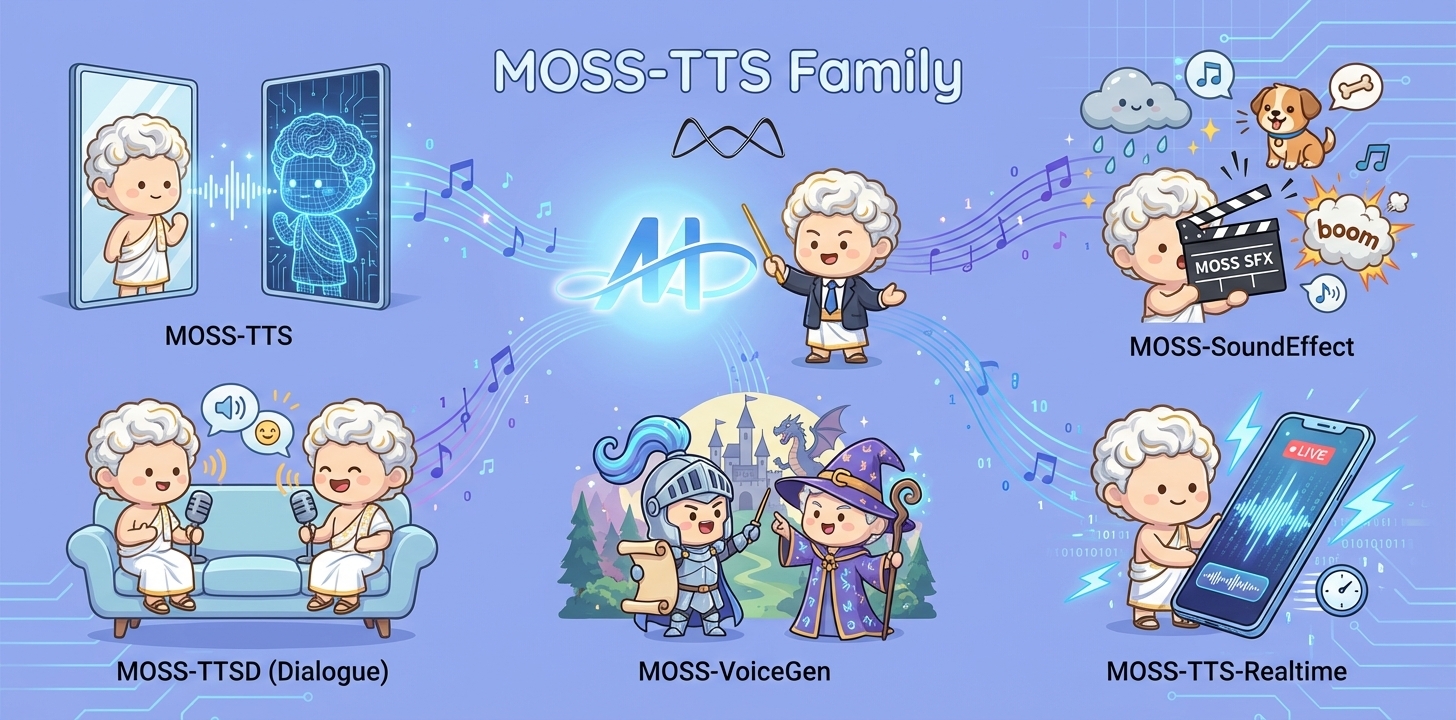
Image courtesy of OpenMOSS Team
The Diffusion Transformer architecture is well suited for audio generation because it handles variable length sequences more gracefully than autoregressive models. Each generation pass produces a complete audio segment rather than building the output token by token, which means the model can optimize for global coherence of the sound rather than just the next segment.
The Qwen3-1.7B text encoder gives the model strong natural language understanding for interpreting descriptive prompts. Sound design prompts often use spatial language, material descriptions, and acoustic qualifiers such as "distant," "muffled," "gravel," and "resonant." The Qwen3 encoder handles this vocabulary reliably.
The DAC VAE codec handles audio reconstruction at the output stage. Unlike mel spectrogram based vocoders used in some earlier audio generation systems, the DAC codec encodes and decodes audio directly in a continuous latent space, which preserves transients and high frequency content more accurately. This matters for percussion, impact sounds, and fricative noise, which are among the categories most commonly distorted by spectrogram based reconstruction.
Flow Matching as the training objective produces smoother probability paths between noise and audio compared to score based diffusion objectives. In practice this means fewer denoising steps are required at inference time, which reduces generation latency without sacrificing output quality. A generation that might take 30 denoising steps with a score based model can be completed in fewer steps with Flow Matching, making the model more practical for iterative sound design sessions where many variations are generated in sequence.
48 kHz and Broadcast Delivery
The 48 kHz output rate is the specification that most clearly separates MOSS-SoundEffect v2.0 from current peers. Stable Audio 3, released three days earlier by Stability AI, outputs at 44.1 kHz, the CD standard for consumer audio. MOSS-SoundEffect v2.0 outputs at 48 kHz, which matches the delivery specification for theatrical and broadcast audio set by the Society of Motion Picture and Television Engineers.
That distinction has a practical consequence. Audio from MOSS-SoundEffect v2.0 integrates directly into professional post production pipelines without sample rate conversion, removing a step that can introduce minor artefacts in DaVinci Resolve, Pro Tools, or similar tools.
The 48 kHz standard also aligns with the rest of the OpenMOSS tool family. MOSS-TTS generates voice at 48 kHz stereo, which means dialogue generated with MOSS-TTS and Foley generated with MOSS-SoundEffect share the same specification. A production mixing AI generated dialogue and AI generated effects does not need to manage different sample rates between tools from the same toolkit.
The broadcast standard matters beyond theatrical delivery. Streaming platforms including Netflix and Amazon Prime require audio masters at 48 kHz for content delivery. A filmmaker who generates sound effects at 48 kHz is producing assets that meet that delivery specification at the generation stage, without an upsampling pass that would otherwise be required.
For Foley and Sound Design
MOSS-SoundEffect v2.0 generates custom Foley and ambience assets directly from a text description, with no sound library required. A filmmaker building a crowd scene or an exterior ambience writes a description; the model returns audio at broadcast quality ready for the edit.
The scope is narrower than music generation models but higher in output fidelity for targeted sound design. HunyuanVideo Foley handles audio generation synchronized to existing video; MOSS-SoundEffect v2.0 operates from text alone, without requiring a video reference. The two models address different points in the post production audio workflow.
The "no library required" framing has concrete cost implications. Professional sound libraries for theatrical production can cost several thousand dollars per year for subscription access. MOSS-SoundEffect v2.0 under Apache 2.0 has no ongoing cost beyond the compute required to run it. For independent filmmakers and short film productions with limited post production budgets, the difference between a subscription library and a locally deployed model is a meaningful budget consideration.
Iterative sound design is also easier with a generative model than with a library. When a specific asset in a library does not quite fit the picture, the editor's options are to use it anyway, find an alternative, or commission a bespoke recording. With MOSS-SoundEffect v2.0, the option is to write a modified prompt and generate a different version of the same effect. The iteration cycle runs on compute rather than on search and licensing.
Custom sound design assets also carry no third party licensing restrictions. Library audio often comes with restrictions on the number of productions or the distribution channels the effect can appear in. Generated audio, produced locally under Apache 2.0, carries only the terms of the model license, which permit commercial use without per production fees.
The 30 second generation window maps naturally to common Foley recording session practices. A Foley recording session typically generates short assets in take by take passes, with each take covering one specific action or sound event. MOSS-SoundEffect v2.0 mirrors that workflow: one prompt per effect, multiple generated takes from slight prompt variations, editor selects the best version. The iteration process is significantly faster than booking studio time and recording physical props.
For productions that already have a sound library and want to extend it with specific assets not available in the library, MOSS-SoundEffect v2.0 fills targeted gaps. Rather than replacing an existing workflow, it adds generation capacity for sounds that would otherwise require a custom recording session or significant search time to find in a license compatible library.
Post production supervisors working across multiple simultaneous projects benefit from a model that can generate on demand without a per use cost. Generating 50 effects for one project and 30 for another in the same month costs the same as generating 5, because the cost structure is compute rather than a per generation or per project fee.
License and Access
MOSS-SoundEffect v2.0 is released under Apache 2.0. Commercial use, redistribution, and modification are all permitted without revenue thresholds or additional licensing steps. The weights are hosted on HuggingFace under the OpenMOSS-Team organization and the source code is available in the MOSS-TTS repository on GitHub.
The OpenMOSS Team is affiliated with Fudan University and has published audio generation research under open source terms since its earlier MOSS language model work.
Local deployment means the model runs on a production machine without sending audio to an external API. For productions working with music and audio that may be under embargo before release, keeping all generation within the production's own infrastructure removes a potential security consideration.
The Apache 2.0 terms also allow derivative models. A production company that trains a fine tuned version of MOSS-SoundEffect v2.0 on their own sound library to improve performance on a specific acoustic environment, such as a historical period or a specific geographic location, can distribute that fine tuned model internally or publicly without restrictions beyond the Apache 2.0 license attribution requirement.
For productions with tight delivery schedules, the combination of local deployment and fast inference means a sound editor can generate, preview, and commit a Foley asset in a single session without waiting for API responses or managing upload and download time. The entire generation cycle, from text prompt to 48 kHz audio file, runs on local hardware.
Access to the model weights and inference code also gives technical production teams the option to integrate MOSS-SoundEffect v2.0 into their own tooling. A studio that operates custom internal post production software can call the model directly rather than relying on the standard interface, building generation into the asset management workflow rather than treating it as a separate step.
The OpenMOSS Team's affiliation with Fudan University means the model was produced in an academic research context with peer reviewed evaluation rather than by a commercial vendor with an interest in overstating benchmark results. The technical reports for MOSS-SoundEffect and the broader MOSS audio family are publicly available for independent review.
For cloud based music generation alongside sound effects, Suno in AI FILMS Studio produces complete vocal and instrumental tracks from text prompts in the same session.
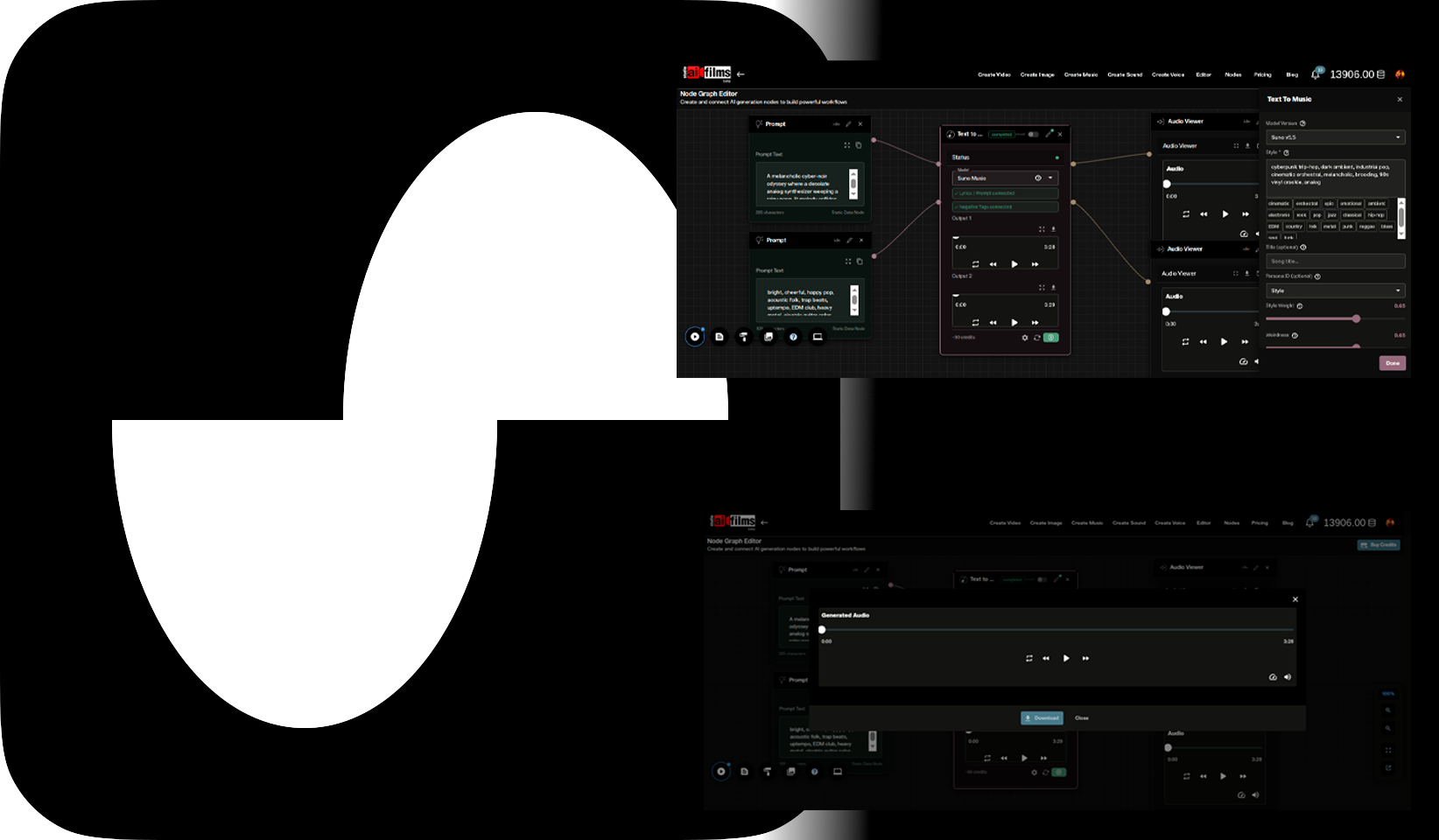
Filmmakers can generate sound effects and ambience for their projects in the AI FILMS Studio sound workspace.
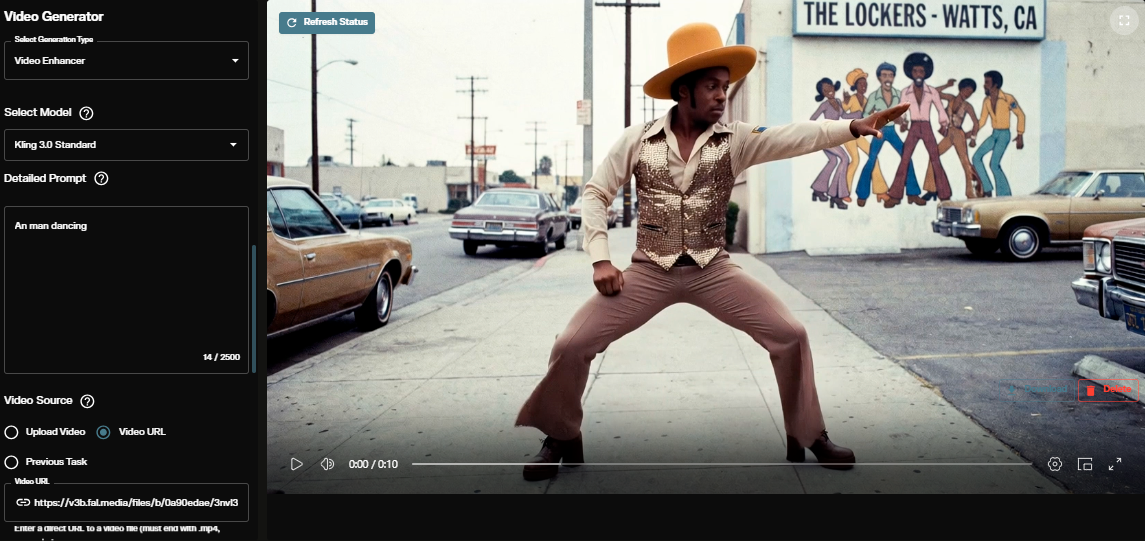
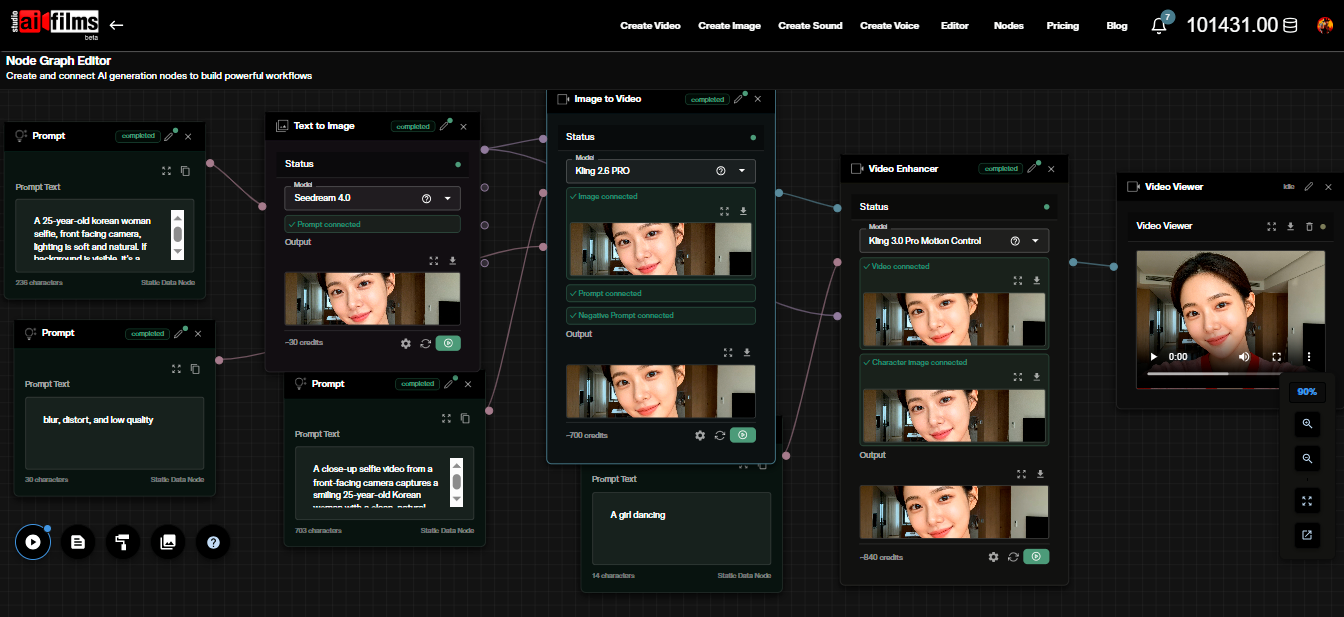
OpenMOSS followed MOSS-SoundEffect with MOSS-Audio, a broader foundation model that understands and reasons about speech, environmental sound, and music. Where MOSS-SoundEffect generates audio from text, MOSS-Audio analyzes existing recordings and produces written explanations of what it finds. The formal technical report was published June 1, 2026 under Apache 2.0. The team completed the open source pipeline in June 2026 with MOSS-TTS Local Transformer v1.5, a 5B parameter voice cloning model generating 48 kHz stereo speech in 31 languages with explicit dialogue timing control.
The sequence of releases from OpenMOSS shows a team building toward a complete audio pipeline rather than releasing individual models in isolation. Each new model addresses a stage of the audio workflow that the previous models did not cover, and all share the same 48 kHz specification and Apache 2.0 license.
In July 2026, the team released MOSS-Transcribe-Diarize 0.9B, which handles the analysis side of the audio pipeline. It provides joint transcription and speaker identification from recorded audio. The model won first place in the MLC-SLM Challenge at INTERSPEECH 2026. Together with MOSS-SoundEffect and MOSS-TTS, it gives productions an open source toolkit covering generation and analysis across the full audio cycle, from generating effects and dialogue to converting recorded speech back into labeled text.
The INTERSPEECH 2026 first place result provides external validation beyond OpenMOSS's own benchmarks. Independent competition rankings are a more reliable signal of real world performance than self reported evaluation scores.
For productions where confidentiality matters, the full MOSS pipeline runs on local hardware with no cloud dependency. Audio generated during early picture cuts stays within the production's own infrastructure until final delivery.
Update (August 19, 2026): Xiaomi Research released MiDashengLM-Gen in August 2026, an Apache 2.0 model that covers sound effects alongside speech, music and ambience in one checkpoint. Full story here.
Sources
HuggingFace: OpenMOSS-Team/MOSS-SoundEffect-v2.0 GitHub: OpenMOSS/MOSS-TTS License: Apache 2.0
Continue Reading
.jpg?w=3840)


Video & LipSync
- Video Generator
- Text to Video
- Image to Video
- Start-End Frame to Video
- Draw to Video
- Motion Control
- Video Enhancer
- Video Upscaler
- Video Extend
- Video to Video LipSync
- Audio to Video LipSync
- Image to Video LipSync
- Video FaceSwap
- Seedance 2.5
- WAN 3.0
- Seedance 2
- FLUX 3
- Minimax H3
- Vidu Q3 Pro
- Grok Imagine Video 1.5
- Gemini Omni
- Google Veo 3.1
- Kling 3.0 Pro
- Luma Ray 3.2
- LTX 2.3
- Happy Horse 1.1
- Kling 3.0 Motion
- ByteDance Upscaler
- InfiniteTalk
- InsightFace
Image & Edit
- AI Character
- AI Actor
- Art Generator
- Text to Image
- Image to Image
- LoRA Image to Image
- Draw to Edit
- Image LoRA Training
- Remove Background
- Image Enhancer
- MidJourney 8.0
- Krea 2
- OpenAI GPT Image 2.0
- Nano Banana Pro Ultra
- Nano Banana 2 Lite
- Nano Banana Pro
- Minimax Image
- Clarity Pro
- Z-Image Turbo LoRA
- Krea 2 Turbo LoRA
- Z-Image LoRA Trainer
- Qwen Image LoRA Trainer
- Background Erase Network 2 (BEN2)