
Shanghai Film Festival Launches AI Backlot with Hailuo AI

Share this post:
Shanghai Film Festival Launches AI Backlot with Hailuo AI
The 28th Shanghai International Film Festival opens June 12 and brings with it AI Backlot, a new production lab pairing traditional filmmakers with AI creators to produce short films live during the 10 day event. Hailuo AI, the multimodal platform owned by MiniMax, is providing technical support.
What the AI Backlot Does
AI Backlot is not a competition for finished AI films. It is a structured production program: four teams received a one month window to conceive, produce, and complete original short films, with each step of the process, including workflows, role assignments, key decisions, and budgeting, documented for public access.
The program launched in May after a 43 day open call that drew nearly 500 applications from creators across seven countries and regions. Over 60 percent of applicants were born in the 1990s or 2000s. The organizing committee selected four production teams totaling 22 people, drawing from both traditional film and television backgrounds and what organizers describe as "AI super creators".
The 500 Applicants From Seven Countries
500 applicants from seven countries and regions for four spots is a selection rate of less than 1 percent. The geographic spread covers the countries with the most active AI filmmaking communities in Asia, including mainland China, Hong Kong, South Korea, and participants from Europe. The volume of applications for a program that had not previously existed indicates how many filmmakers were looking for exactly this structure: institutional support, cross-practice collaboration, and a film festival context.
The demographic skew toward creators born in the 1990s and 2000s is consistent with patterns at other AI filmmaking programs. Younger creators have spent their formation years using generative tools. Their presence in an AI production program is not surprising; their willingness to apply for a program that pairs them with traditional film and television professionals suggests they are looking for the institutional legitimacy that festival backing provides.
Teams Built Across Two Practices
Each team combines professionals from conventional film production with practitioners who work primarily through generative tools. The intention is to document what that collaboration actually looks like in practice, rather than presenting only the finished work.
The academic partner for the initiative is the School of Theater, Film and Television at the Communication University of China. Lingang, the Shanghai district that hosted the launch event at its Wisdom Library, is the program's operational base.
The One-Month Schedule and What It Compressed
.jpg)
SHOU Media, CC BY-SA 4.0, via Wikimedia Commons
Completing a short film in one month from concept to finished cut compresses stages that conventional production separates by weeks. Development, pre-production, principal photography or generation, editing, sound, and color all run simultaneously or in compressed sequence. The one month timeline is only achievable because AI generation removes location scouting, equipment rental, and crew coordination from the schedule.
What remains is creative decision making, prompt refinement, quality review, and post production integration. For teams combining traditional and AI practices, the schedule tests whether the two approaches can synchronize fast enough to meet the deadline together.
The Documentation Model and Who It Serves
The completed films and production records are presented to industry guests and the public on June 14 and 15 at the Shanghai Film Art Center's 4th floor. Supervisory panel members, academic observers, and the four production teams together select 10 to 15 key topics from the production process for workshops open to the public.
The documentation focus is the distinctive element. The program treats the production workflows themselves as content, giving it a research dimension beyond the short films it produces. The target audience is not general audiences but the next wave of filmmakers who want to understand how AI and traditional production collaboration actually works when the cameras are running.
Comparable production documentation from AI film programs elsewhere is rare. Most programs present completed work at festivals without publishing the decisions, failures, and workflow choices that produced it. AI Backlot's public documentation model makes it more useful as a reference than most festival programs, independent of the quality of the finished films.
Hailuo AI's Specific Capabilities
Hailuo AI is MiniMax's multimodal video generation platform. In June 2026, Hailuo Video supports text-to-video and image-to-video generation at up to 1080p resolution, with variable clip lengths and motion intensity controls. The platform's character consistency tools allow repeated generation of the same subject across multiple clips, which is essential for short film production where characters appear across scenes.
The specific limitation AI Backlot teams would have encountered is coherence across longer sequences. AI generation tools in 2026 produce strong individual clips but require additional work to maintain visual consistency across a narrative arc. The post production integration stage, where generated material is edited, colored, and matched to sound, is where the traditional filmmakers on each team bring the most value.
SIFF ING as Dedicated Infrastructure
AI Backlot sits within a broader festival strand called SIFF ING, a new program focused on AI generated content and vertical short videos. SIFF ING represents the festival's formal acknowledgment that short form AI content now requires its own dedicated track alongside traditional competition categories.
The 28th SIFF ran June 12-21 across 48 cinema locations in Shanghai and the Yangtze River Delta, drawing over 2,800 total entries across all five competition categories. The Golden Goblet Competition featured 12 films from 15 countries, with the jury chaired by actor Tony Leung Chiu-wai. At the festival's close, Leung declared AI has no soul while acknowledging he uses it every day for his own research.
Hailuo AI and MiniMax
Hailuo AI is a product of MiniMax, one of the leading Chinese AI startups. MiniMax has positioned Hailuo as a multimodal platform for filmmakers and content creators. Its involvement with SIFF gives the platform direct exposure to Asia's most prominent film festival while the festival gains a technical partner with production ready tools.
The MiniMax Hub institutional partnership announced at the same festival operates at a different level: it is infrastructure for the Shanghai film industry, not a production program. AI Backlot is the visible, public-facing expression of the same institutional relationship.
China's film industry has been integrating AI into production at industrial scale for years, led largely by the micro drama and vertical content sector. AI Backlot brings that integration into the institutional festival context for the first time, with SIFF staking out a position as the festival where traditional and AI-native filmmakers learn to work together in public.
That framing connects directly to what Chinese filmmakers like Jia Zhangke explored at Filmart earlier in 2026: using AI tools experimentally while keeping directorial control at the center. AI Backlot scales that individual experiment into a structured institutional program.
AI Backlot Within the Broader SIFF 28 AI Picture
The festival's opening ceremony on June 12 also launched a Technology Creation and Fabrication Unit with five AI service platforms for the Shanghai High-Tech Films and Televisions City in Songjiang district. Tony Leung's "no soul" statement, the MiniMax Hub partnership, and the SIFForum compute discussions all ran in the same edition. AI Backlot was the production-facing program within a festival that was negotiating the meaning of AI in film at every institutional level simultaneously.
The four teams and 22 participants who completed productions during the festival represent a small number. What makes AI Backlot significant is the institutional signal: SIFF is treating AI production as a discipline that requires dedicated infrastructure, dedicated training programs, and dedicated documentation, not as a novelty track within an existing competition.
What the Collaboration Model Produces
Cross-practice collaboration between traditional filmmakers and AI creators is the premise of AI Backlot, but the program does not specify what the collaboration should look like in practice. Each team defines the division of labor for itself: which decisions belong to the traditional filmmaker, which belong to the AI practitioner, and which require agreement between both.
That ambiguity is the research question the program is actually trying to answer. The documentation of workflows and decisions is the mechanism for accumulating answers across four teams simultaneously. If three of the four teams developed similar collaboration patterns, that convergence is a finding. If all four developed different patterns, that is also a finding.
The Shanghai International Film Festival's Position in China's Film Economy
SIFF is Asia's largest film market by transaction volume. It operates simultaneously as a competition, a commercial market, and an industry conference. Its adoption of AI production as a formal program category signals to Chinese film industry participants that AI-native production is now within the institutional scope of major festival activity.
China's domestic film industry produced over 400 theatrical releases in 2025. The micro drama sector produced exponentially more content for mobile platforms. AI tools are already embedded in both sectors at the production level. AI Backlot is the institutional legibility layer: it gives the AI production community a festival context and gives the festival community a structured interface with AI-native creators.
The Seven-Country Application Pool
Applications from seven countries and regions indicate that AI Backlot attracted attention beyond China's domestic film community. The program's selection of four teams from that international pool means at least some of the 22 participants bring perspectives shaped by production cultures outside China.
The practical implication is that the documentation produced by AI Backlot captures collaboration approaches from multiple filmmaking traditions. A team that includes creators from different national contexts will develop a collaboration model shaped by those differences. That variation is part of what the documentation is designed to capture.
The international application pool also reflects how AI filmmaking tools have distributed globally. Hailuo Video is available outside China. Chinese AI generation platforms have been adopted by filmmakers in Europe, Southeast Asia, and Latin America. The applications from seven countries suggest that SIFF's AI Backlot program was discovered by a global community of AI creators who follow the development of Chinese AI platforms closely, regardless of where they work.
The Demographic Signal
Over 60 percent of applicants were born in the 1990s or 2000s. For a program explicitly designed to bridge traditional and AI-native practice, that skew tells you who self-selected as "AI-native": predominantly creators under 35. The traditional filmmakers who were selected alongside them represent a different generation and a different relationship to production tools.
The combination is the experiment. Neither group can complete the program's goals without the other. AI-native creators bring facility with generation tools. Traditional filmmakers bring narrative structure, character construction, and the craft knowledge that comes from years of set experience. What AI Backlot is testing is whether those two things can be synthesized in four weeks rather than accumulated over a career.
Hailuo Video in a One-Month Production Window
Hailuo Video's generation capabilities in June 2026 include text-to-video prompting, image-to-video conversion, and scene generation with controllable camera motion. These are the tools the AI Backlot teams had access to through MiniMax's technical partnership with the festival.
For a production team working under a one month timeline, the relevant capability is not maximum quality but consistency and iteration speed. A generation tool that produces a usable clip from a text prompt in under a minute allows teams to test narrative sequences, visual styles, and character appearances rapidly before committing to a final approach. Hailuo Video's iteration speed is the feature that makes it practical within the AI Backlot timeline.
What Comes After the Festival
The public exhibition on June 14 and 15 is a single-event presentation. What happens to the documentation, the films, and the production records after the festival is the open question for AI Backlot's long-term value.
If the four completed films enter festival circulation, they become part of the growing international circuit of AI short films alongside works from Tribeca, Venice, and SSFF & ASIA. If the production documentation is published as a public resource, it becomes a reference for the next generation of AI production programs. SIFF has not announced a plan for either. The festival's institutional capacity to follow through on the documentation commitment over the longer term is what determines whether AI Backlot becomes a program with accumulating research value or a single edition experiment.
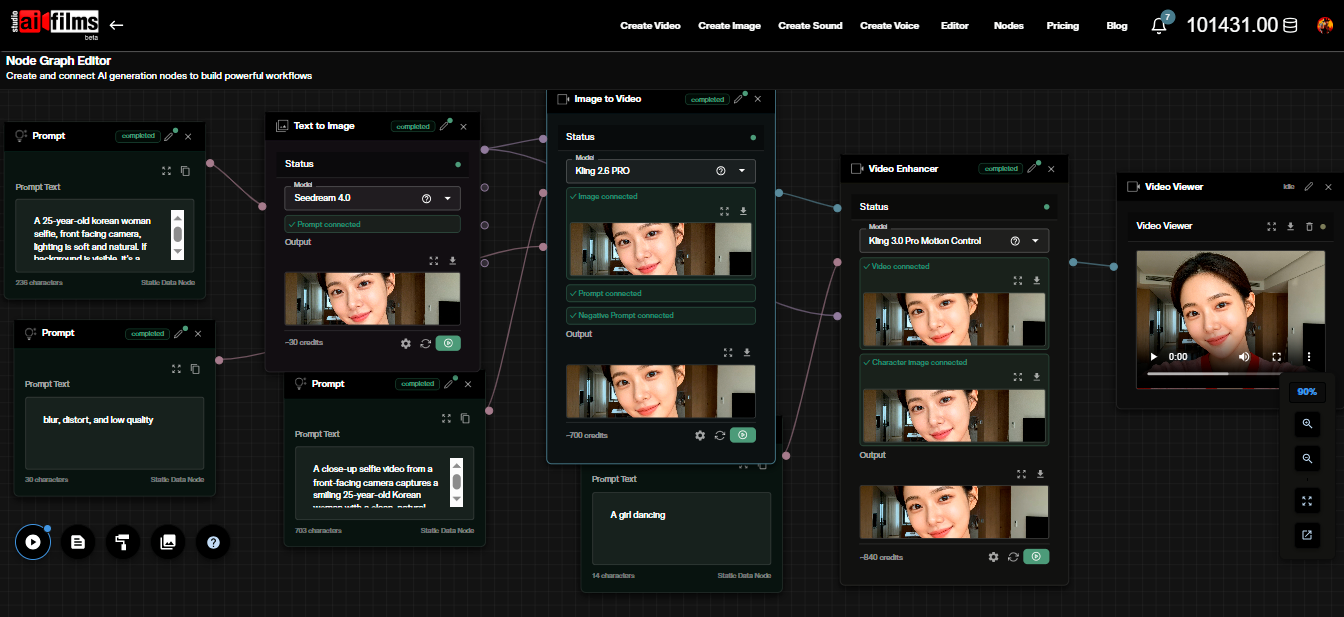
Filmmakers who want to build their own AI workflows can access video generation, image generation, and audio tools in AI FILMS Studio.
AI Backlot's model of pairing traditional and AI-native creators under a one month deadline, with full production documentation, is replicable. Any organization with institutional relationships and a technical partner can run a version of this program. SIFF has demonstrated that the structure works. Whether other festivals in 2026 or 2027 adopt a similar model will determine whether AI Backlot was a pioneering program or a one-time experiment.
Sources
China Daily | Screen Daily | Yicai Global | Asian Movie Pulse | Variety
Continue Reading
.jpg?w=3840)


.jpg)
Video & LipSync
- Video Generator
- Text to Video
- Image to Video
- Start-End Frame to Video
- Draw to Video
- Motion Control
- Video Enhancer
- Video Upscaler
- Video Extend
- Video to Video LipSync
- Audio to Video LipSync
- Image to Video LipSync
- Video FaceSwap
- Seedance 2.5
- WAN 3.0
- Seedance 2
- FLUX 3
- Minimax H3
- Vidu Q3 Pro
- Grok Imagine Video 1.5
- Gemini Omni
- Google Veo 3.1
- Kling 3.0 Pro
- Luma Ray 3.2
- LTX 2.3
- Happy Horse 1.1
- Kling 3.0 Motion
- ByteDance Upscaler
- InfiniteTalk
- InsightFace
Image & Edit
- AI Character
- AI Actor
- Art Generator
- Text to Image
- Image to Image
- LoRA Image to Image
- Draw to Edit
- Image LoRA Training
- Remove Background
- Image Enhancer
- MidJourney 8.0
- Krea 2
- OpenAI GPT Image 2.0
- Nano Banana Pro Ultra
- Nano Banana 2 Lite
- Nano Banana Pro
- Minimax Image
- Clarity Pro
- Z-Image Turbo LoRA
- Krea 2 Turbo LoRA
- Z-Image LoRA Trainer
- Qwen Image LoRA Trainer
- Background Erase Network 2 (BEN2)