
Tribeca 2026: AI Takes Center Stage at the 25th Anniversary Festival

Share this post:
Tribeca 2026: AI Takes Center Stage at the 25th Anniversary Festival
The 25th Tribeca Film Festival opens June 3 in New York City with a record 103 world premieres across 118 feature films and 86 short films. More than any prior edition, its 2026 program positions AI as a filmmaking tool, a subject of documentary inquiry, and a question the industry needs to answer in public.
Tribeca's 25-Year Arc
The festival launched in 2002 as part of the effort to revitalize Lower Manhattan following September 11. Jane Rosenthal and Robert De Niro created it as a neighborhood event; it became one of the most influential platforms for independent film in the US within its first decade. In 25 years the festival expanded from indie drama to a broader definition of what film culture includes.
AI appearing at the 25th edition is not incidental to that history. Tribeca built its identity around backing work before the industry consensus caught up with it. The 2026 program continues that pattern by presenting AI productions alongside conventionally made films without a segregated AI only strand, treating the technology as part of the programming rather than a category apart.
ChikaBOOM! and the Asteria Approach
The most technically specific AI project in the 2026 lineup is ChikaBOOM!, a 10 minute animated short produced by Asteria Film Co. and The Monk Studios, a Thai animation house, using Asteria and Moonvalley's proprietary generative technology alongside hand drawn 2D and CG animation.
Directed by C. Craig Patterson, ChikaBOOM! follows Chika Batstone, a young magician whose curiosity unleashes Kaboom, a chaotic creature, into New York City. The voice cast includes Yara Shahidi, Daveed Diggs, Roy Wood Jr., Tika Sumpter, and Natasha Lyonne.
The studio behind it, Asteria, was co-founded by Lyonne and filmmaker Bryn Mooser with a founding constraint: every AI model it uses must be trained on licensed content only. ChikaBOOM! is Asteria's first public premiere at a major festival, demonstrating what that approach produces with an A list creative team attached.
Asteria Film Co.: Structure and What It Is
Asteria was established to test whether a licensed only AI constraint is compatible with producing work at major festival caliber. Most AI film studios do not define their training data sourcing as a founding principle. Asteria built its public identity around that constraint from its first public announcement.
Bryn Mooser, Lyonne's co-founder, previously ran XTR, a documentary studio and distribution company that placed films at major festivals. The production infrastructure Asteria built reflects that background: festival ready technical specifications, A list voice talent, Oscar winning craft leads.
Ruth E. Carter and Hanna Beachler on an AI Short
Production design for ChikaBOOM! came from Hanna Beachler, whose credits include Black Panther and Moonlight. Costume design came from Ruth E. Carter, who won Academy Awards for both Black Panther films.
Tribeca Festival, Public domain, via Wikimedia Commons
Both Carter and Beachler participated in an AI assisted production at a moment when guild members are actively debating whether AI work is compatible with professional identity. Their involvement is the strongest argument ChikaBOOM! makes: that AI assisted filmmaking is not automatically below the craft floor of conventional production.
The argument is not made in a panel discussion. It is made in the credits of a Tribeca selection.
The First Fully AI Generated Feature in a Major US Festival
The festival's most discussed AI selection premieres June 10: "Dreams of Violets", a 75 minute dramatization of the 2026 Iranian civilian massacre, made for approximately $2,000 by tech entrepreneur brothers Ash and Pooya Koosha with no actors, sets, or cameras. Tribeca founder Jane Rosenthal cited both the film's subject and its production method as the reasons for the selection.
The full story of how this film was made, and what it means for festival programming, is in the existing coverage of its lineup selection.
Dreams of Violets: The $2,000 Feature
The $2,000 production budget covers the AI generation tools and the post production process. No location fees, no crew payroll, no equipment rental. The film's existence answers the question of whether a feature length AI production can pass Tribeca's selection committee without the production backing of an established studio.
Rosenthal's public statement connecting the film's subject matter to the selection rationale is significant. She is saying the committee evaluated it as a film first. The production method was relevant as context, not as the reason for acceptance or rejection.
What the selection does not resolve is the distribution question. A $2,000 feature with no conventional distribution assets faces the same streaming and theatrical market as every other Tribeca selection. Whether a film at that production level can build an audience beyond the festival circuit is what comes after the premiere.
The Hinton and Hassabis Documentary
Alongside the fictional AI films, Tribeca 2026 selected a prestige documentary featuring Nobel laureates Geoffrey Hinton and Demis Hassabis, executive produced by Barbara Broccoli. It screens AI as both a filmmaking tool and a subject of public reckoning inside the same 11-day program.
Geoffrey Hinton and Demis Hassabis as Subjects
Hinton won the 2024 Nobel Prize in Physics for foundational work on neural networks and left Google in 2023 citing concerns about AI safety. Hassabis won the same prize and runs Google DeepMind, the AI research lab that produced AlphaFold and Gemini. A documentary featuring both men is placing Tribeca at the center of the most consequential conversation in AI development.
Barbara Broccoli's executive producer credit on the documentary is the same institutional weight mechanism that Carter and Beachler bring to ChikaBOOM!. Broccoli produced the James Bond franchise for decades. Her attachment to a Tribeca documentary about AI risk is a signal about where serious producers think the important conversations are.
An Industry Panel on AI as Craft
The festival's professional track addresses AI directly. A Tribeca X session on June 8 titled "From Script to Screen: The Human-Anchored Future of AI Filmmaking" brings together director C. Craig Patterson, Asteria cofounder Benjamin Michel, and AWS representatives. The panel examines how cloud computing and AI function as part of a production workflow from the earliest creative stage, with ChikaBOOM! as the primary case study.
Tribeca describes the session's framing as AI "as a creative collaborator rather than a shortcut," with emphasis on how directorial control is maintained throughout a generative production pipeline.
Two Films Born from the OpenAI Collaboration
Two additional AI short films premiere at the 25th Tribeca Festival as the result of a year long program Tribeca Studios and OpenAI announced in 2025. The program selected two independent filmmakers, provided production funding and mentorship, and gave them access to OpenAI's generation tools. The finished films show alongside a discussion of how they were made.
The OpenAI Collaboration: How It Worked
The program ran an open call for filmmakers interested in working with Sora and related generation tools. Selected participants received model access, technical support from OpenAI, and production funding. The partnership was structured as a demonstration that AI tools can serve independent filmmakers who do not have production company infrastructure behind them.
The two premiering films are the proof of concept for that argument. They were made by individual filmmakers, using tools that were not publicly available during most of the production period. What the Tribeca selection determines is whether the results of that process are competitive with independently produced work made through conventional methods.
The collaboration model is distinct from the ChikaBOOM! production in one important respect. Asteria built its own licensed model infrastructure before beginning production. The OpenAI filmmakers worked with a provider's tools directly, without proprietary training data constraints. Both films screen at the same festival, making the 25th Tribeca edition a direct comparison of the two approaches.
The 25th Anniversary as a Turning Point
Tribeca's founding in 2002 was a response to a specific civic and cultural crisis. The 2026 edition responds to a different kind of crisis: an industry trying to determine in real time whether AI represents a tool or a replacement. The festival's decision to present both questions simultaneously, inside the same program, is the most substantive curatorial statement a US festival has made on AI filmmaking.
The programming across 25 years has always run ahead of industry consensus. In 2026 that means screening a $2,000 feature, an Asteria short with Oscar winning craft leads, and a Nobel laureate documentary in the same lineup, without treating any of them as exceptional. They are exceptional. Tribeca is saying they belong here anyway.
The 25th anniversary edition will be measured in retrospect by whether the films it championed found audiences. Dreams of Violets and ChikaBOOM! both face that test. Their Tribeca selections are the beginning of the answer, not the answer itself.
The films that defined Tribeca's first decade were not obvious choices at the time of selection. That is what it means for a festival to run ahead of consensus.
The Storytelling Summit's AI Track
The festival's Storytelling Summit returns for its second year with a "Next Wave" track covering AI, content creation, and emerging platforms. Filmmakers, distributors, and financiers discuss how AI tools are changing what productions are possible to finance and complete at the independent level.
The "Next Wave" framing is deliberate. It positions AI not as a current disruption but as an already-arrived production condition. The conversations the summit hosts in 2026 are not about whether to adopt AI but about how adoption changes the financing model, the distribution pathway, and the production team structure for independent work.
At Cannes 2026, Seth Rogen told reporters that using AI to write scripts disqualifies the activity from being called writing. Tribeca's summit is operating from a different premise: that AI has already changed the financial conditions of independent film and the question now is how filmmakers work inside those conditions. Both events took place in the same month. The gap between the two framings captures where the industry actually sits in 2026.
103 World Premieres in Context
A record 103 world premieres means the selection committee processed more original work than any prior Tribeca edition. The AI selections (ChikaBOOM!, Dreams of Violets, the OpenAI films, and the Hinton-Hassabis documentary) represent four distinct categories of AI related programming within a 103-film lineup.
Four categories across a general programming slate is a different kind of commitment than a segregated AI strand. Every one of those selections competed against conventionally produced work. The selection committee evaluated them on the same terms as everything else in the program.
The question the 103-premiere count raises is whether the next 25 years of Tribeca will look like the last 25. The festival has consistently welcomed new production methods before the industry established a consensus position on them. The 2026 AI programming suggests that pattern is continuing.
The Venice Reply AI Film Festival received 2,181 submissions in its 2026 edition and runs in September on the Venice Lido. The Venice Reply festival's model is an AI only competition; Tribeca's model integrates AI selections into a general programming slate. Both circuits are growing simultaneously, but they are building different things: one a dedicated competition infrastructure, the other a pathway into mainstream festival programming. Winning a Venice Reply prize and placing in a Tribeca lineup are not the same credential. Both now exist as options for filmmakers working in AI.
Taken together, the ChikaBOOM! premiere, the Dreams of Violets selection, the industry panels, and the OpenAI collaboration program make this the most comprehensive presentation of AI filmmaking at any major US festival to date.
The SSFF & ASIA 2026 festival in Tokyo reported AI submissions doubling to 368 in the same season, and the Venice Reply festival processed 2,181 entries. An international circuit for AI filmmaking now exists that did not exist three years ago. Tribeca is part of that circuit and currently represents the most institutional US point of entry within it.
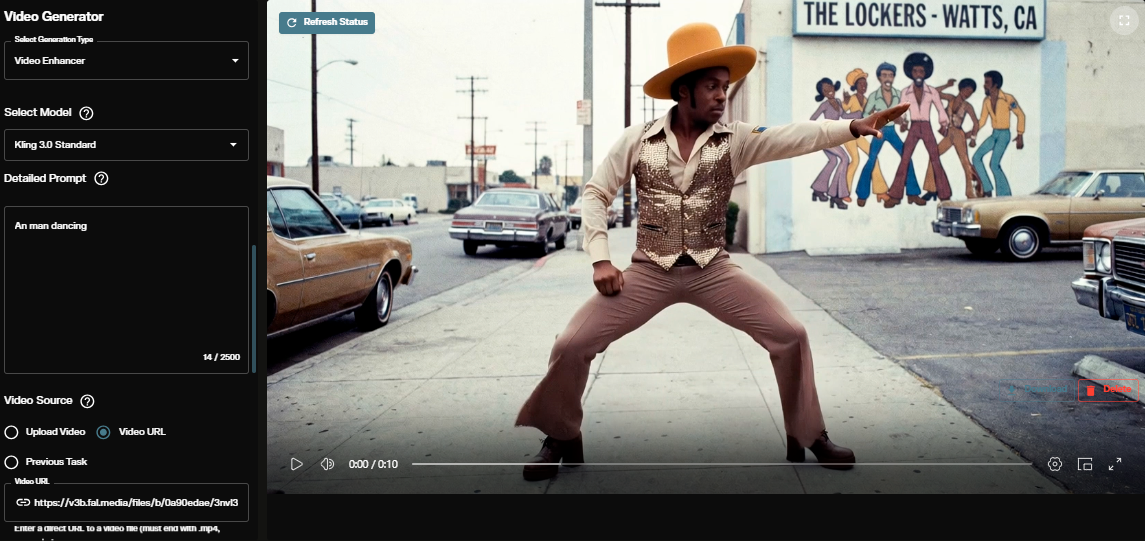
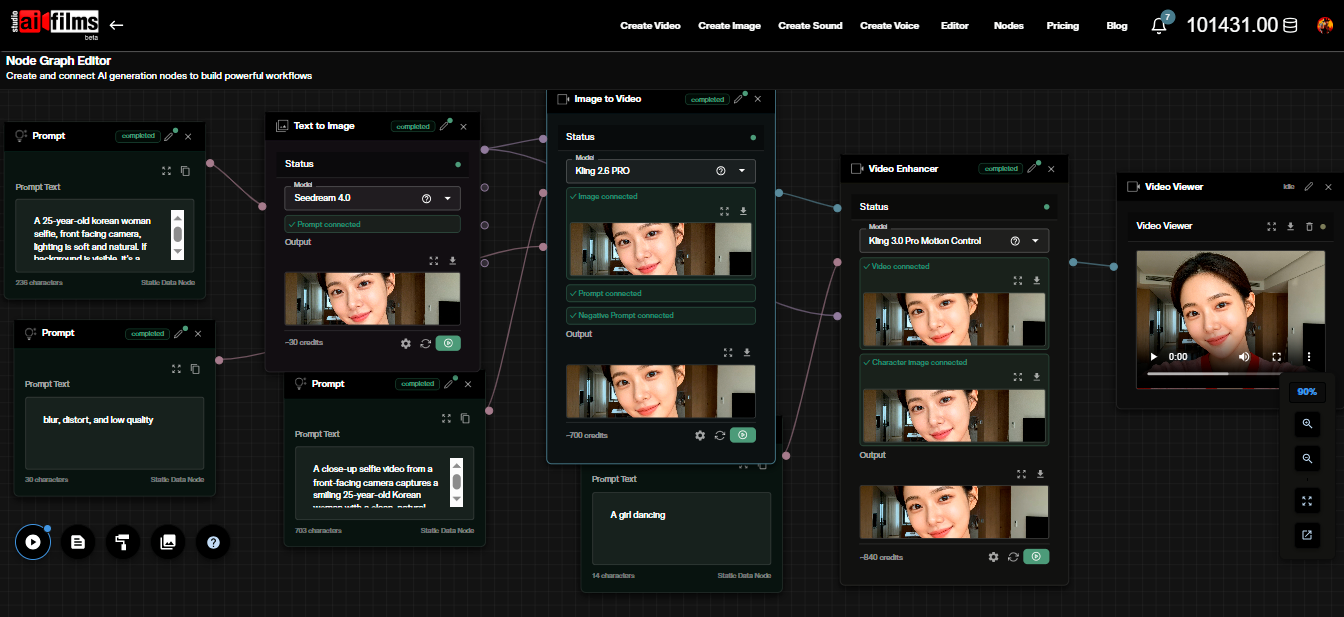
Filmmakers who want to start generating video and images for their own productions can access AI FILMS Studio now. The video workspace includes the same generation models that produced work in this year's Tribeca lineup.
Sources
IndieWire | The Hollywood Reporter | Variety | Deadline | Tribeca Film Festival
Continue Reading
.jpg?w=3840)


Video & LipSync
- Video Generator
- Text to Video
- Image to Video
- Start-End Frame to Video
- Draw to Video
- Motion Control
- Video Enhancer
- Video Upscaler
- Video Extend
- Video to Video LipSync
- Audio to Video LipSync
- Image to Video LipSync
- Video FaceSwap
- Seedance 2.5
- WAN 3.0
- Seedance 2
- FLUX 3
- Minimax H3
- Vidu Q3 Pro
- Grok Imagine Video 1.5
- Gemini Omni
- Google Veo 3.1
- Kling 3.0 Pro
- Luma Ray 3.2
- LTX 2.3
- Happy Horse 1.1
- Kling 3.0 Motion
- ByteDance Upscaler
- InfiniteTalk
- InsightFace
Image & Edit
- AI Character
- AI Actor
- Art Generator
- Text to Image
- Image to Image
- LoRA Image to Image
- Draw to Edit
- Image LoRA Training
- Remove Background
- Image Enhancer
- MidJourney 8.0
- Krea 2
- OpenAI GPT Image 2.0
- Nano Banana Pro Ultra
- Nano Banana 2 Lite
- Nano Banana Pro
- Minimax Image
- Clarity Pro
- Z-Image Turbo LoRA
- Krea 2 Turbo LoRA
- Z-Image LoRA Trainer
- Qwen Image LoRA Trainer
- Background Erase Network 2 (BEN2)