

Peking University & Tencent Hunyuan MovieRoll (arXiv:2611.21339) and SJTU DENG Lab WaveForcing (arXiv:2611.00859, Apache 2.0)
Share this post:
WaveForcing & MovieRoll: Open Source Long Video AI
WaveForcing (SJTU-DENG-Lab/WaveForcing, arXiv:2611.00859) and MovieRoll (Tencent-Hunyuan/MovieRoll, arXiv:2611.21339) are two November 2026 open source frameworks engineered to generate continuous, minute scale long takes without the color burn, contrast drift, or motion freezing that plague autoregressive video rollouts. Released under the Apache 2.0 license with 4-step and 5-step WaveForcing-1.3B weights on Hugging Face alongside MovieRoll's 5-step distilled SGLang Diffusion and vLLM-Omni pipelines, the two releases bring low latency streaming long takes to modern GPU workflows.
Studio availability. WaveForcing and MovieRoll are not available in AI FILMS Studio. This article covers public research releases from November 2026. To generate or extend long video sequences in the Studio, use WAN 3.0, Seedance 2.5 Video Extend, MiniMax H3 Video Extend, or FLUX 3 Video Extend on the Text to Video page or in the video workspace.
WaveForcing overview demonstrating wavefront pipelined streaming generation (unmute for audio)
Continuous 60 second single take rollout maintaining stable exposure and subject geometry
Why Autoregressive Video Models Drift After 10 Seconds
When an autoregressive video generator predicts chunk t+1 conditioned on its own previously decoded frames from chunk t, tiny quantization errors and high frequency noise accumulate exponentially. By second 15 or 20, colors oversaturate, textures turn plastic, and characters freeze in place.
Wait times compound the quality problem. Standard Diffusion Forcing schedules denoise chunks sequentially, leaving GPUs underutilized and forcing directors to wait minutes to inspect a 60 second blocking test.
WaveForcing (arXiv:2611.00859) and MovieRoll (arXiv:2611.21339, released November 12, 2026) solve streaming throughput and long horizon stability through complementary mechanisms.
- Wavefront pipelined causal scheduling (
WaveForcing). SJTU DENG Lab formulates causal video diffusion as a diagonal wavefront across frame chunks and noise levels. In its4-stepand5-stepWaveForcing-1.3Bcheckpoints (built on a nativeWan 1.3Bbfloat16EMA backbone), adjacent temporal chunks denoise concurrently at staggered noise levels (5+2pipeline schedule), reaching real time streaming throughput without inter chunk seam flicker. - Joint window denoising and hierarchical KV caching (
MovieRoll). Developed by Peking University and Tencent Hunyuan, MovieRoll introduces a systematic pipeline from a 50 step supervisedMovieRoll-Basemodel (usingAnnealCFGacross arbitrary480paspect ratios) to a 5-step CFG freeMovieRoll-Distilledgenerator (480x864and864x480). Its hierarchical key value (KV) cache retains anchor scene tokens while compressing mid range history, stopping error accumulation across extended rollouts. - Day-0
SGLang DiffusionandvLLM-Omniserving. MovieRoll ships native inference backends for bothSGLang Diffusion(sglang_movieroll) andvLLM-Omni(vllm_omni_movieroll), allowing production studios to serve long take video generation behind standard high throughput inference engines.
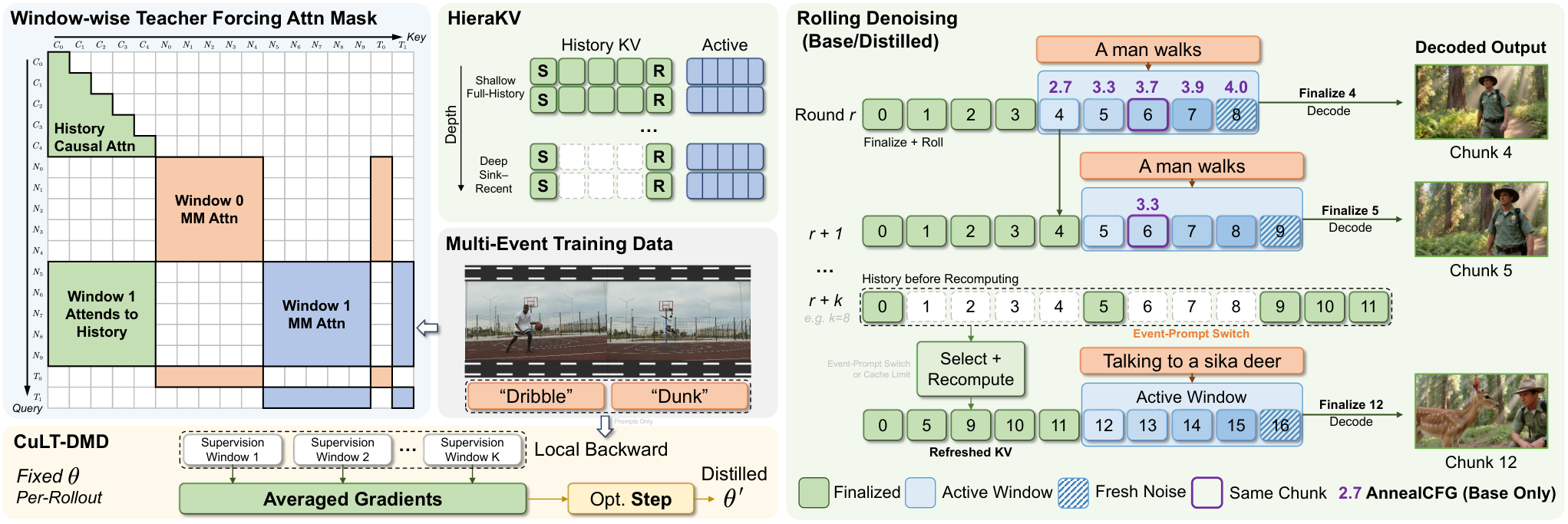
MovieRoll training and inference architecture combining AnnealCFG base training with 5-step CFG free distillation. Credit: Peking University & Tencent Hunyuan (arXiv:2611.21339).
In standard sliding window rollouts, hard boundaries between windows create visible temporal pops every few seconds.
MovieRoll's joint window denoising overlaps transition latents during both supervised training and 5-step distillation so camera pans and character walks cross window boundaries invisibly.
Try WaveForcing Live in the Browser
You can explore WaveForcing directly in the embedded Hugging Face Space below (akhaliq-wave-forcing.hf.space), which loads without login.
Side by side qualitative comparisons across 60 second continuous takes confirm that `WaveForcing-1.3B` avoids the progressive darkening and background collapse seen in earlier causal forcing baselines.
Because `WaveForcing-1.3B` uses standard `Wan` `model.safetensors` formatting under the **Apache 2.0** license, studios can drop the `4step/` or `5step/` weights straight into existing local `Wan 1.3B` pipelines.
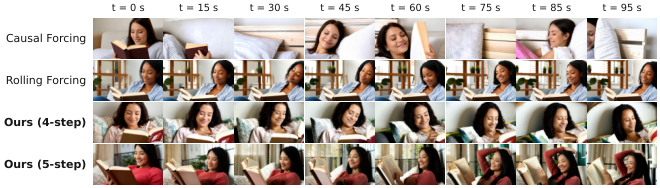
Long horizon frame stability in WaveForcing-1.3B compared against baseline causal rollouts. Credit: SJTU DENG Lab (Apache 2.0).
Checkpoints, Serving Backends & License Matrix
| Model Variant | Hugging Face ID | Denoising Steps & Guidance | Resolution & Serving Engine | License |
|---|---|---|---|---|
WaveForcing-1.3B (4-Step) |
SJTU-DENG-Lab/WaveForcing-1.3B (4step/) |
4 steps (--rf-step 4, BF16 EMA) |
480p (832x480), single GPU or pipelined multi GPU |
Apache 2.0 |
WaveForcing-1.3B (5-Step) |
SJTU-DENG-Lab/WaveForcing-1.3B (5step/) |
5 steps (--rf-step 5, 5+2 schedule) |
480p (832x480), 60s+ continuous long take streaming |
Apache 2.0 |
MovieRoll-Distilled (T2V) |
yunyangge/MovieRoll (distilled/t2v) |
5 steps (No CFG, CFG=1.0) |
480x864 / 864x480, SGLang Diffusion & vLLM-Omni |
Tencent Hunyuan Community |
MovieRoll-Base (T2V & I2V) |
yunyangge/MovieRoll (base/) |
50 steps (AnnealCFG) |
480p arbitrary aspect ratios, T2V & I2V rollouts |
Tencent Hunyuan Community |
Running WaveForcing-1.3B and MovieRoll Locally
To run WaveForcing-1.3B under Apache 2.0, clone SJTU-DENG-Lab/WaveForcing and download either the 4step/ or 5step/ native Wan checkpoint from Hugging Face.
git clone https://github.com/SJTU-DENG-Lab/WaveForcing.git
cd WaveForcing
pip install -r requirements.txt

# Download 4-step and 5-step WaveForcing-1.3B checkpoints
huggingface-cli download SJTU-DENG-Lab/WaveForcing-1.3B --local-dir ./ckpts/WaveForcing-1.3B

# Run 5-step streaming long-take video generation
python generate_waveforcing.py \
  --gen-ckpt ckpts/WaveForcing-1.3B/5step/model.safetensors \
  --rf-step 5 \
  --prompt "A continuous tracking shot following a cyclist riding along a coastal cliff road at golden hour, steady camera." \
  --num_frames 1440 \
  --output outputs/coastal_60s_take.mp4
To run MovieRoll-Distilled (5 steps, no CFG) or MovieRoll-Base with SGLang Diffusion or vLLM-Omni, clone Tencent-Hunyuan/MovieRoll and pull yunyangge/MovieRoll.
git clone https://github.com/Tencent-Hunyuan/MovieRoll.git
cd MovieRoll
pip install -r requirements.txt

huggingface-cli download yunyangge/MovieRoll --local-dir ./ckpts/MovieRoll

# Launch 5-step CFG-free long-form T2V rollout via SGLang Diffusion backend
python -m sglang_movieroll.infer \
  --model_path ./ckpts/MovieRoll/distilled/t2v \
  --prompt "An unbroken Steadicam shot moving through a bustling night market under paper lanterns, 864x480 widescreen." \
  --height 480 \
  --width 864 \
  --steps 5 \
  --output outputs/night_market_rollout.mp4
Production Playbook for Filmmakers
- Use
WaveForcing-1.3Bfor commercial Apache 2.0 previsualization. BecauseWaveForcing-1.3Bcarries an unrestricted Apache 2.0 license and runs on a compact1.3BWan backbone, indie studios can generate 60 second blocking and pacing tests locally, then upscale selected cuts to1080por4Kusing SeedVR2 or Real-ESRGAN Video. - Pair
MovieRoll-BaseI2V withMovieRoll-DistilledT2V. When a scene must start from a specific concept art plate or storyboard frame, initialize the rollout withMovieRoll-Basein image-to-video mode (AnnealCFG), or use the 5-stepMovieRoll-Distilledcheckpoint for fast widescreen (864x480) or vertical (480x864) previsualization. - Compare across long-video architectures. Explore our companion deep dives on History-Forcing and LightX2V long video inference, SkyReels V2 DF 1.3B Diffusion Forcing, LongCat Video 15-minute extended duration generation, and Apple FastFrames 2-step interactive video diffusion.
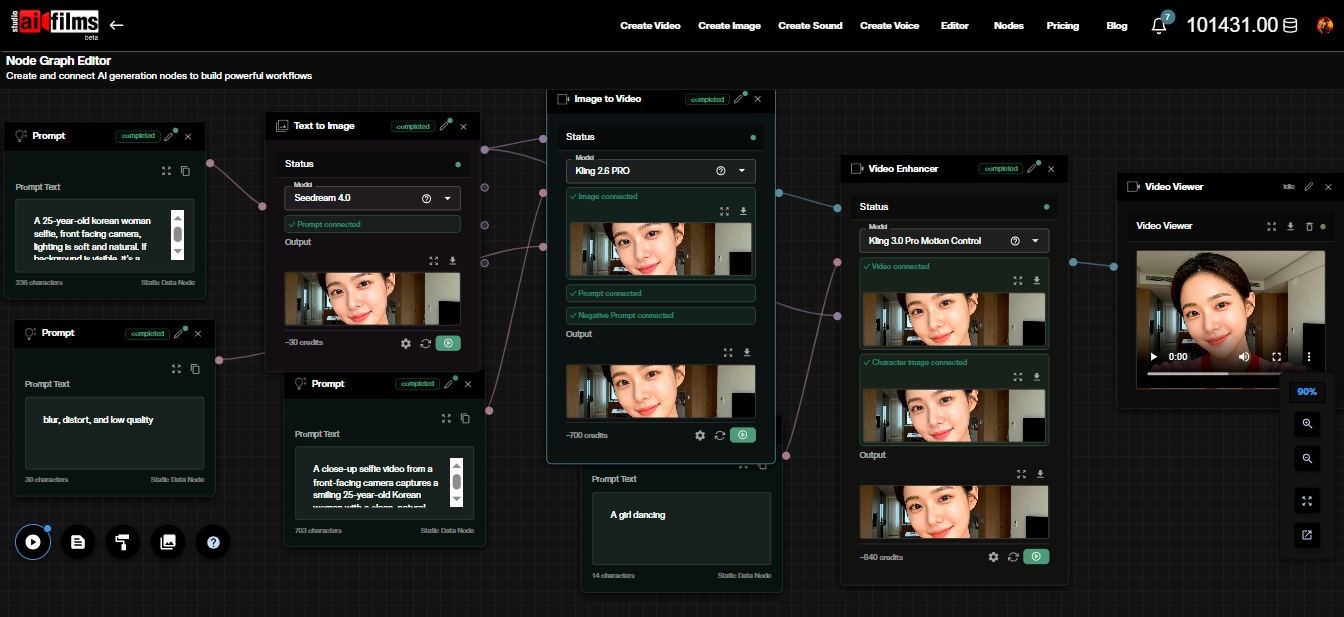
To generate extended 30 second shots with WAN 3.0 or chain Seedance 2.5 Video Extend and MiniMax H3 Video Extend in the cloud without local setup, open the Text to Video page or connect sequential video extension and upscaling nodes visually in the Nodes Graph Editor.
Sources
- SJTU-DENG-Lab/WaveForcing Official GitHub Repository (Apache 2.0)
- WaveForcing Official Project Page
- Wave Forcing: Towards Speed-of-Light Streaming Video Generation (arXiv:2611.00859)
- SJTU-DENG-Lab/WaveForcing-1.3B 4-Step & 5-Step Weights on Hugging Face
- Tencent-Hunyuan/MovieRoll Official GitHub Repository
- MovieRoll: A Systematic Framework for Rolling Out Long-Form Videos (arXiv:2611.21339)
- yunyangge/MovieRoll Base & 5-Step Distilled Weights on Hugging Face
Continue Reading


Video & LipSync
- Video Generator
- Text to Video
- Image to Video
- Start-End Frame to Video
- Draw to Video
- Motion Control
- Video Enhancer
- Video Upscaler
- Video Extend
- Video to Video LipSync
- Audio to Video LipSync
- Image to Video LipSync
- Video FaceSwap
- Seedance 2.5
- WAN 3.0
- Seedance 2
- FLUX 3
- Minimax H3
- Vidu Q3 Pro
- Grok Imagine Video 1.5
- Gemini Omni
- Google Veo 3.1
- Kling 3.0 Pro
- Luma Ray 3.2
- LTX 2.3
- Happy Horse 1.1
- Kling 3.0 Motion
- ByteDance Upscaler
- InfiniteTalk
- InsightFace
Image & Edit
- AI Character
- AI Actor
- Art Generator
- Text to Image
- Image to Image
- LoRA Image to Image
- Draw to Edit
- Image LoRA Training
- Remove Background
- Image Enhancer
- MidJourney 8.0
- Krea 2
- OpenAI GPT Image 2.0
- Nano Banana Pro Ultra
- Nano Banana 2 Lite
- Nano Banana Pro
- Minimax Image
- Clarity Pro
- Z-Image Turbo LoRA
- Krea 2 Turbo LoRA
- Z-Image LoRA Trainer
- Qwen Image LoRA Trainer
- Background Erase Network 2 (BEN2)