
Raphael: Korea's First AI Theatrical Feature at Cannes
.jpg?w=3840&q=90)
Mike is Michi, CC BY-SA 4.0, via Wikimedia Commons
Share this post:
Raphael: Korea's First AI Theatrical Feature at Cannes
Korean director Eekjun Yang told a Cannes Marché du Film panel on May 20 that his upcoming feature Raphael was produced by a team of seven, against a conventional Korean theatrical budget of $700,000 to $2 million for a comparable project. The 80 minute film, scheduled for a September release in Korea, anchors MBC C&I AI Content Lab's most ambitious slate to date.
Yang sat on a Palais des Festivals main stage panel titled "From Creative Possibility to Production Reality: Kling AI in Cinematic Workflows", alongside Chinese animator Wei Li and U.S. director Jon Erwin. The session ran across May 18 to 20 and was organized by Kling AI parent Kuaishou.
The Access Argument
Yang's core message at Cannes was that AI is not a shortcut. "If we'd filmed in real life, it would have required 150 to 300 people and a budget of up to $2M. But we had a team of just seven and much lower cost", he told Deadline. He pushed back on the cost framing in Screen Daily: "Probably the biggest misconception is the idea that we're using AI just because we want to make films cheaper and faster".
For a director without prior feature credits, Yang said AI was a prerequisite rather than a creative choice. Raphael is his first theatrical feature, following the team's win at the 2024 Korea International AI Film Festival with the short Mateo.
.jpg)
Abxbay, CC0, via Wikimedia Commons
The Cannes Marché du Film is the world's largest film and television content market, drawing buyers from over 100 countries. A main stage panel appearance at the Palais places a project in front of international distributors, sales agents, and production partners in a way that no dedicated AI film festival replicates.
Kuaishou organized the three day panel as a deliberate market entry move. Presenting three directors from three countries with active projects, rather than a single showcase, framed AI filmmaking as a production reality spread across multiple territories rather than a niche technology demonstration.
From Festival Short to Theatrical Plan
Raphael is directed by Yang Eekjun, Jung Juwon and Moon Shinwoo, the same trio behind Mateo. The new film follows an elite war android modeled after the youthful image of an aging dictator. While commanding forces in a refugee district, the android encounters a Catholic priest and begins a journey toward faith and redemption.
The film is produced by Mateo AI Studio with MBC C&I AI Content Lab. MBC C&I positioned Raphael at March's Hong Kong FilMart as one of the world's first entirely AI generated feature films, before bringing the project to Cannes as Kling AI's flagship case study two months later.
Why 4K Mattered
Yang stressed at Cannes that Kling AI's native 4K output was the technical threshold that made theatrical release viable. The team's earlier tool stack also included Midjourney, Stable Diffusion, and Runway Gen3 during development, per a March 16 Variety exclusive. The Cannes panel positioned Kling AI as the current production reality without claiming it was the only tool used.
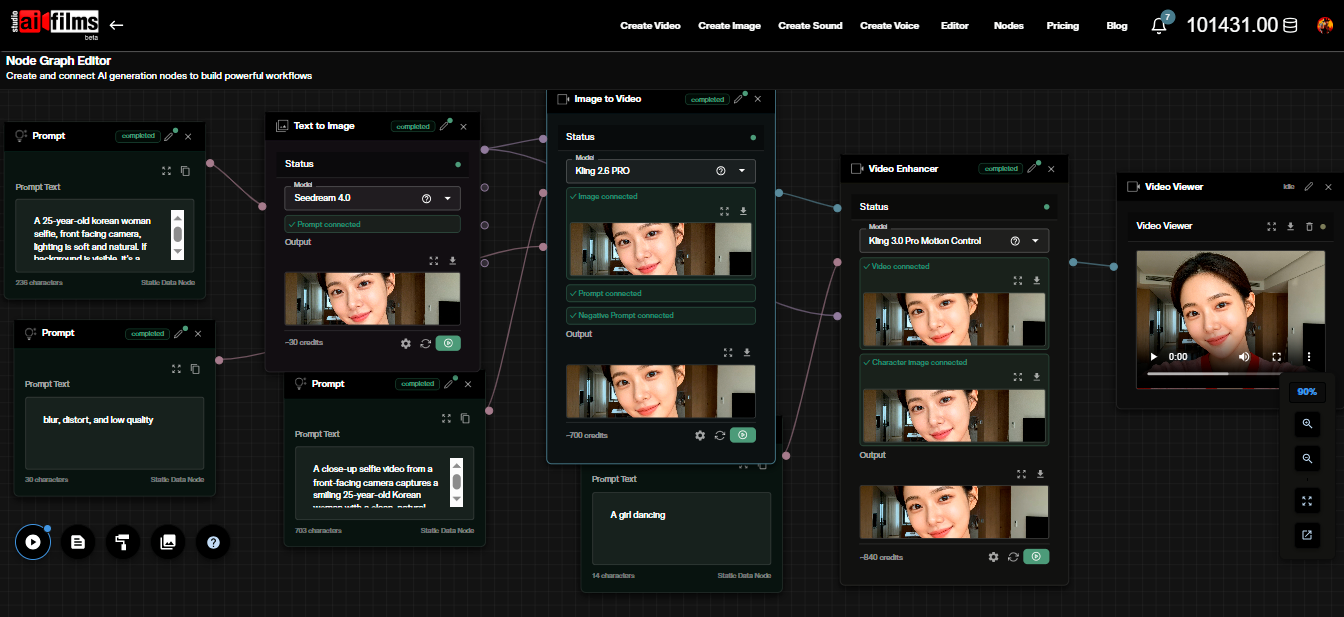
Kling AI also confirmed its Filmmaker Initiative at the same panel. The program offers cash incentives and compute resources to AI productions targeting theatrical and streaming distribution standards, head of operations Yushen Zeng said. Kling AI's tools are available in the AI FILMS Studio video workspace.
Inside the Asian AI Cinema Wave
Raphael sits within a growing slate of Asian AI features pursuing theatrical or streaming release. The project follows I'm Popo, another Korean AI theatrical title that pushed for cinema distribution earlier in 2026, and shared the Cannes panel stage with Wei Li's Chinese ink painting epic Born of the Tide. Kling AI made the broader market case at the same panel through its Filmmaker Initiative announcement and Minibots partnership, part of a Cannes 2026 shift across multiple AI productions. Directors targeting the production techniques shown at Cannes can study the underlying tools in our Kling 3 motion control tutorial.
MBC C&I and the Korean AI Content Push
MBC C&I is the content and commerce division of MBC, South Korea's oldest terrestrial broadcaster, founded in 1961. The AI Content Lab within MBC C&I backs Raphael and provides distribution infrastructure that most independent AI productions cannot access on their own.
Korean broadcasters have made calculated investments in AI content since 2024. MBC C&I's decision to fund and position Raphael at Hong Kong FilMart before bringing it to Cannes reflects an international market strategy designed for buyers rather than domestic audiences.
The FilMart appearance two months before Cannes placed the film in front of Asian and European acquisition executives before the project had completed production. International sales conversations were underway before a single Korean theater had confirmed a booking.
The Hong Kong FilMart Positioning
Hong Kong FilMart is Asia's largest film and television content market, drawing buyers from across the continent and from European distribution companies focused on Asian product. MBC C&I's March 2026 presentation described Raphael as one of the world's first entirely AI generated feature films.
The FilMart-to-Cannes sequencing placed the project in front of two distinct buyer pools within the same spring market cycle. That approach is standard strategy for films seeking international pre-sales before domestic release and reflects the same discipline applied to any high-profile Korean theatrical title.
What the September Release Tests
A September 2026 theatrical release in Korea places Raphael in a domestic market that draws over 100 million admissions annually. Korean theatrical is competitive, with domestic productions typically accounting for more than half of annual admissions in a healthy market year.
The test at Korean cinemas differs from the test at international markets. Domestic audiences evaluate films on story, character, and genre satisfaction. Yang's consistent emphasis at Cannes on narrative and faith over production technique reflects a clear understanding of what that test requires.
Whether AI generated visuals hold a Korean general audience through an 80-minute feature is the question the theatrical release will answer. Festival attendance and international buyer interest cannot substitute for that result.
The Mateo Short and What It Established
The foundation for Raphael was the short Mateo, which won the 2024 Korea International AI Film Festival. That win established Yang Eekjun, Jung Juwon, and Moon Shinwoo as a working production unit before attempting a feature.
Short film festival wins rarely translate to feature development without institutional backing. In this case, the Mateo win provided the track record and competitive visibility that drew MBC C&I to the project. The 2024 festival win is the documented origin of the Raphael feature development.
Without that win, Yang would have been approaching MBC C&I as a first time director with a concept rather than as a team with demonstrated AI production capability at festival recognized quality.
What "Entirely AI Generated" Means in This Production
The "entirely AI generated" description applied to Raphael refers to the visual construction of the film. Characters, environments, and action sequences were produced through AI generation rather than live action photography or conventional animation.
Yang's team used Kling AI for production alongside earlier work in Midjourney, Stable Diffusion, and Runway Gen3 during development, per Variety's March 16 reporting. The combination of tools reflects a typical AI feature pipeline where different models handle different stages of visual construction.
The Cannes panel positioned Kling AI as the primary production reality without claiming it was the only tool used. That framing is consistent with how most current AI features approach tool disclosure.
The Film's Narrative
Raphael centers on an elite war android modeled after the youthful image of an aging dictator. While commanding forces in a refugee district, the android encounters a Catholic priest and begins a journey toward faith and redemption.
The choice of an android protagonist pursuing Christian faith resonates within Korean cinema traditions that engage directly with religious subject matter. Korea has the highest percentage of Christian population among East Asian countries, making faith based narrative a commercially viable genre in the domestic market.
The android's arc, from weapon to seeker, is the character trajectory that AI generated visuals must carry for the film to succeed theatrically. If Raphael holds its opening weekend, it provides the first documented case of AI generation sustaining a Korean general audience through a full feature length.
Yang's Argument Against the Cost Frame
Yang's push back against the cost framing of AI filmmaking at Cannes was a deliberate rhetorical choice. The dominant narrative about AI in production focuses on cost reduction. Yang argued that access, not cost, was his motivation. "Probably the biggest misconception is the idea that we're using AI just because we want to make films cheaper and faster", he told Screen Daily.
That distinction matters for how Raphael will be covered when it opens. A director who frames AI as the prerequisite for his first feature is a different story from one who used it to save money on a project he could have made otherwise. Yang set the terms for that coverage months in advance.
The Kling Filmmaker Initiative at Cannes
Kling AI confirmed its Filmmaker Initiative at the same panel. The program offers cash incentives and compute resources to productions targeting theatrical and streaming distribution standards specifically, head of operations Yushen Zeng said.
Targeting theatrical and streaming tiers rather than web or festival only release signals that Kuaishou is positioning Kling AI as an industrial production tool. Raphael was presented as the flagship case study for what the Initiative is designed to support.
The Initiative's design reflects an understanding that the commercial credibility of AI filmmaking depends on theatrical and streaming results, not festival wins. Raphael's September release is the first major test of that proposition in a mainstream Asian theatrical market.
The Broader Korean AI Cinema Wave
Raphael is not the first Korean AI theatrical project to reach international markets. I'm Popo pushed for cinema distribution earlier in 2026, establishing that Korean AI productions can target theatrical release as a first strategy rather than a fallback from streaming rejection.
The pattern of Korean productions targeting theatrical release reflects a specific ambition in the domestic industry. Korea's film sector has a track record of absorbing new production technologies quickly, often producing genre content before other markets do.
Raphael's September release will either accelerate Korean AI theatrical investment or prompt a reassessment of what general audiences will accept. Either outcome will inform producers across the region planning their own AI feature development.
The Film's Position in September 2026
The September 2026 release positions Raphael in a window before the major studio tentpole season but after summer. That placement is standard for Korean productions targeting domestic audiences rather than competing directly with Hollywood releases during peak theatrical weeks.
MBC C&I's backing ensures the film will have conventional marketing support for its Korean theatrical run. Whether international distribution follows in markets beyond the initial FilMart and Cannes negotiations will depend on the domestic result.
Sources
- Deadline
- Variety
- Screen Daily
- The Manila Times
- Asian Movie Pulse
- GlobeNewswire
Continue Reading
.jpg?w=3840)


Video & LipSync
- Video Generator
- Text to Video
- Image to Video
- Start-End Frame to Video
- Draw to Video
- Motion Control
- Video Enhancer
- Video Upscaler
- Video Extend
- Video to Video LipSync
- Audio to Video LipSync
- Image to Video LipSync
- Video FaceSwap
- Seedance 2.5
- WAN 3.0
- Seedance 2
- FLUX 3
- Minimax H3
- Vidu Q3 Pro
- Grok Imagine Video 1.5
- Gemini Omni
- Google Veo 3.1
- Kling 3.0 Pro
- Luma Ray 3.2
- LTX 2.3
- Happy Horse 1.1
- Kling 3.0 Motion
- ByteDance Upscaler
- InfiniteTalk
- InsightFace
Image & Edit
- AI Character
- AI Actor
- Art Generator
- Text to Image
- Image to Image
- LoRA Image to Image
- Draw to Edit
- Image LoRA Training
- Remove Background
- Image Enhancer
- MidJourney 8.0
- Krea 2
- OpenAI GPT Image 2.0
- Nano Banana Pro Ultra
- Nano Banana 2 Lite
- Nano Banana Pro
- Minimax Image
- Clarity Pro
- Z-Image Turbo LoRA
- Krea 2 Turbo LoRA
- Z-Image LoRA Trainer
- Qwen Image LoRA Trainer
- Background Erase Network 2 (BEN2)