

Share this post:
Spielberg on AI: No Substitute for the Soul
Steven Spielberg told Michelle Obama's podcast on May 27 that AI cannot be the final word on any creative decision. The episode, titled "Reach for Greatness with Steven Spielberg," was only his third podcast appearance in a career spanning 57 years.
He uses AI for practical work, including location scouting and research. On creative authorship, he does not. "Use AI as a tool, but do not use AI as the final word on anything creative", he told hosts Michelle Obama and Craig Robinson. "That's where I draw the line".
The Seventh Writer
To describe what he refuses, Spielberg offered a writers' room image. Six humans sit around a table. A computer occupies an empty seventh chair. "It is the seventh writer", he said. He does not accept that arrangement.
The image appeared in a different form at SXSW in March 2026, where he told an audience there is not an empty chair with a laptop in his writing process. Two months later, the empty chair and the computer returned as the scenario he describes to explain his limit, rather than the one he denies exists.
The consistency of the image across two different public contexts suggests it is not a rhetorical device he invented for the podcast. It is how he actually thinks about the question. The seventh writer is the specific figure he is arguing against, and it is precise enough that it has appeared twice in less than three months.
Soul and Sentience
.jpg)
Spielberg placed his objection in the language of sentience. "I don't really believe in sentience", he said. "I don't believe there is any substitute for the soul".
AI can produce useful output. His argument is that what it produces is categorically different from what a person produces, and that the difference is precisely what an audience watches a film to find. The soul he is describing is not a metaphysical claim about AI. It is a claim about what audiences pay for when they watch a film.
What Spielberg Uses AI For
The line Spielberg draws is between tasks with a correct answer and decisions with no correct answer. Location research has a correct answer: the location either fits the scene's requirements or it does not. Using AI to identify candidates, compare options, and narrow a list faster is a task where the human judgment comes in at the evaluation stage, not the generation stage.
A creative decision has no correct answer. Whether a scene should be shot in a specific way, whether a character should make a specific choice, whether a film's ending resolves its emotional questions correctly are all judgments that do not have objectively verifiable answers. Spielberg's position is that AI cannot make those judgments and that a filmmaker who allows it to has abdicated the responsibility that makes the film worth watching.
That distinction between tasks with correct answers and decisions without them maps cleanly to how Spielberg has described using AI across multiple interviews. He is consistent: tools for research and logistics, human judgment for everything that requires an opinion.
A Position That Has Sharpened
He also said he is withholding judgment "until I see really how it is being used". That framing reserves the right to revise while maintaining a firm present limit.
Steven Soderbergh reached a comparable position from the opposite direction. Soderbergh confirmed in April 2026 that his new film uses AI extensively in post production, calling it "just another tool." Both directors place the same limit in the same spot: tools assist, authorship remains with a person.
The convergence is notable. Spielberg arrives at the limit from a position of skepticism about AI's creative role. Soderbergh arrives at it from a position of enthusiastic adoption. They end up in the same place not because they started from the same premises but because the distinction between tool use and creative authorship is the same distinction regardless of which direction you approach it from.
Career Context
Spielberg has directed more than 30 features including Jaws, Raiders of the Lost Ark, Schindler's List, and Saving Private Ryan. He adopted Steadicam, photorealistic CGI, digital intermediate grading, and virtual production across five decades on his own terms, each time as a tool extending what he wanted to do rather than as a replacement for the judgment behind it.
His track record of technology adoption matters for reading his AI position accurately. He is not a filmmaker who resists new tools as a matter of principle. He is a filmmaker who has adopted every significant production technology of the past 50 years. His resistance to AI as a creative authority is not technophobia. It is a specific position held by someone who has more firsthand experience with the adoption of production technology than almost anyone working in film.
The practical implication is that he will use AI when it serves a production purpose he cannot achieve otherwise, and he will not use it to substitute for creative judgment he believes a human must provide. That pattern is consistent with his stated position and with the specific way he described his current usage on the podcast.
"IMO" is hosted by Michelle Obama and Craig Robinson and releases new episodes on Wednesdays. Spielberg has appeared on a podcast only three times across his career. The full episode is available on Apple Podcasts and YouTube.
The Podcast as Platform
Choosing a podcast hosted by Michelle Obama for only his third podcast appearance in a 57-year career is itself a statement. IMO is not a film industry program. Its audience is not primarily composed of people who follow Hollywood technology debates. Spielberg's AI position reached a general audience through this appearance, not a trade publication or industry conference.
The venue choice signals what kind of statement he was making. Speaking to a general audience about AI and creativity is different from speaking to an industry audience about AI and production. His framing, centered on soul and the limits of sentience, is calibrated for that broader audience rather than for the technical and commercial discussion that dominates industry coverage.
That calibration matters for reading the statement accurately. He was not making a production argument about what AI can or cannot currently do. He was making a values argument about what audiences deserve from filmmakers.
How Spielberg Compares to His Generation
The directors of Spielberg's generation who have spoken publicly about AI in 2025 and 2026 have arrived at comparable positions from different starting points. Martin Scorsese joined Black Forest Labs as an advisor in 2026, focused specifically on AI storyboarding as a development efficiency tool. Both have adopted specific tools while drawing firm limits around AI as creative authority.
The pattern across that generation is adoption of specific tools for specific tasks paired with resistance to AI as a replacement for human creative judgment. The disagreements are about how much of the production workflow AI can appropriately handle, not about whether human authorship is required.
Spielberg's position is probably the most explicitly articulated in that group in terms of where he draws the creative line. His "seventh writer" image is a more specific statement of what he refuses than anything comparable directors have said publicly. That specificity is what makes the IMO appearance significant.
Why This Statement Matters Now
Spielberg's IMO appearance came as the first fully AI generated feature was entering festival competition and as major studios were announcing AI production programs. The timing positioned his statement as a counterweight to the institutional momentum building around AI in production.
A filmmaker of his stature saying clearly that AI cannot be the final word on any creative decision gives permission to other filmmakers who hold the same position but have been reluctant to state it publicly while the industry discourse has been dominated by enthusiasm for AI's possibilities. The statement did not stop any AI production program. It provided a reference point for what the alternative looks like when articulated by someone with the commercial track record to make it credible.
The Gareth Edwards position, enthusiastic about AI as a development partner while awaiting the right production window, represents one end of the spectrum among working directors. Spielberg's position, drawing a hard creative limit while using AI for practical tasks, represents another. Both positions are informed by direct experience rather than general observation.
The Disclosure Day Application
That stance found a concrete application on Disclosure Day, his June 2026 sci-fi release, where star Emily Blunt refused AI to create her character's alien voice and recorded the sounds herself in a four minute unbroken shot.
The production decision illustrates the practical consequence of Spielberg's position. The character required a non human vocal quality. AI could have generated a technically adequate solution faster. Blunt and Spielberg chose the version that required a human performance, even at the cost of production time, because the human origin of the sound was the point.
That choice also reflects what Spielberg means by "the soul." It is not an abstract quality. It is the specific thing that a human performer contributes that an AI output cannot replicate: the evidence of a person doing something difficult and making a series of decisions in real time. Audiences may not be able to articulate the difference, but the difference is what they are watching for.
Consistency Across Five Decades
Spielberg's AI position is most legible as a continuation of a position he has held throughout his career. He has never been a director who treats technology as an end in itself. Every tool he has adopted has been in service of a specific creative intent. His camera techniques, his use of CGI, his production approaches have all served stories rather than demonstrated capability.
His resistance to AI as a creative authority reflects that same frame. AI as a tool that helps a filmmaker achieve a specific creative intent is acceptable. AI as a participant in the decisions that define what the film is trying to do is not. The line is the same line he has drawn around every technology he has adopted across 57 years of production.
The Industry's Measurement Problem
Studios and streaming platforms that have integrated AI into production have started gathering data on whether AI generated content performs differently with audiences. Spielberg's position identifies the variable those metrics are trying to isolate. His claim is that whether a human or an AI made the creative decisions within a film produces a different audience experience, even when viewers cannot identify which decisions were made by whom.
Current audience testing evaluates finished content without disclosing the creative process. Viewers do not receive information about which decisions were made by a person and which by AI. The data on whether AI creative involvement produces measurably different responses does not yet exist at the rigor level that would confirm or contradict his position empirically.
The absence of that data means the argument stays in the domain of professional conviction for now. His conviction is grounded in 57 years of direct experience watching what audiences respond to. The studios' willingness to test AI creative involvement at commercial scale will eventually generate the empirical record that answers the question.
What the Statement Costs Him
Spielberg's AI position was delivered on one of the most widely distributed podcasts in the United States and covered in trade press globally within 24 hours. That circulation creates a credibility obligation that a statement made at a closed industry event would not.
If a future Spielberg production uses AI in a way that contradicts his IMO position, the record is publicly indexed and will be referenced against it. His previous public positions on production technology described what he was doing. The IMO statement names a limit, which makes it testable against his future output in a way that descriptive positions are not.
Most directors who have commented on AI in the past two years described their current practice or their general view of the technology. Spielberg went further by naming a specific creative line. That specificity gives the statement its weight in the industry conversation, and it is also what gives his future productions a specific benchmark to be evaluated against.
How the Position Holds Under Pressure
The most direct test of Spielberg's stated limit will come from the technology rather than from any industry argument. As AI generation becomes capable of producing outputs indistinguishable from human creative decisions in specific domains, the line between using AI as a tool and allowing AI to participate in creative decisions will become harder to locate in practice.
He has not addressed that question in any public statement. His current position describes the limit clearly at the level of intent.
What happens to that limit when the intent and the output are harder to distinguish is the question his position will eventually have to answer.
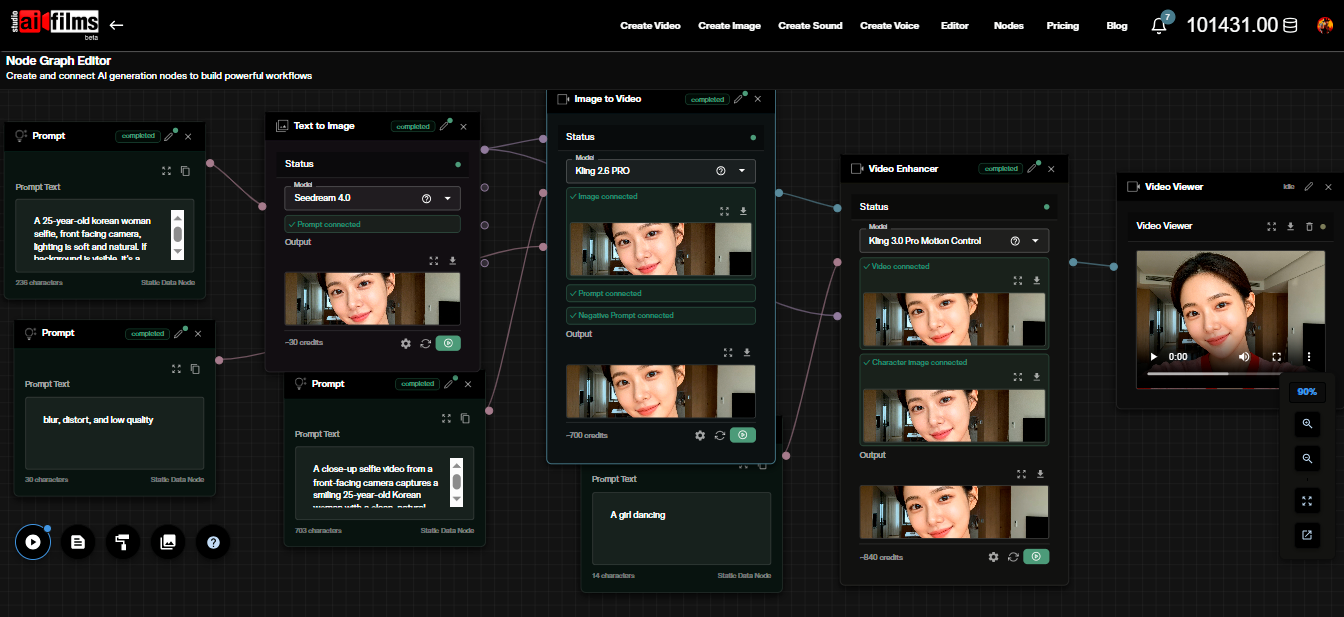
Filmmakers who want to work with AI on their own terms can generate video, images, and sound in AI FILMS Studio.
Sources
Variety | Deadline | The Wrap | IMO Podcast
Continue Reading
.jpg?w=3840)


.jpg)
Video & LipSync
- Video Generator
- Text to Video
- Image to Video
- Start-End Frame to Video
- Draw to Video
- Motion Control
- Video Enhancer
- Video Upscaler
- Video Extend
- Video to Video LipSync
- Audio to Video LipSync
- Image to Video LipSync
- Video FaceSwap
- Seedance 2.5
- WAN 3.0
- Seedance 2
- FLUX 3
- Minimax H3
- Vidu Q3 Pro
- Grok Imagine Video 1.5
- Gemini Omni
- Google Veo 3.1
- Kling 3.0 Pro
- Luma Ray 3.2
- LTX 2.3
- Happy Horse 1.1
- Kling 3.0 Motion
- ByteDance Upscaler
- InfiniteTalk
- InsightFace
Image & Edit
- AI Character
- AI Actor
- Art Generator
- Text to Image
- Image to Image
- LoRA Image to Image
- Draw to Edit
- Image LoRA Training
- Remove Background
- Image Enhancer
- MidJourney 8.0
- Krea 2
- OpenAI GPT Image 2.0
- Nano Banana Pro Ultra
- Nano Banana 2 Lite
- Nano Banana Pro
- Minimax Image
- Clarity Pro
- Z-Image Turbo LoRA
- Krea 2 Turbo LoRA
- Z-Image LoRA Trainer
- Qwen Image LoRA Trainer
- Background Erase Network 2 (BEN2)