
Soderbergh: AI Is 'Just Another Tool' and Humans Are Boring
Share this post:
Soderbergh: AI Is 'Just Another Tool' and Humans Are Boring
Steven Soderbergh told the Sands International Film Festival in St Andrews, Scotland that his new film with Wagner Moura uses "a lot of AI" across post-production. When the audience raised the industry's broader anxiety about the technology, he offered a brief diagnosis. "Human beings are boring", he said. "AI isn't the problem."
The Sands International Film Festival
The Sands International Film Festival runs annually in St Andrews, Scotland, a coastal university town about an hour north of Edinburgh. The festival focuses on international independent film and screens at venues across the historic town center. It attracts working filmmakers and students from the adjacent University of St Andrews, giving Q and A sessions an academic dimension unusual in festival contexts.
Soderbergh's appearance at the Sands in April 2026 was a standalone conversation rather than a competition screening. His willingness to discuss AI use at a mid-sized international festival rather than at a major trade event suggests the statement was calibrated for the film community audience rather than the press cycle.
Speaking to a university town festival audience rather than a trade conference gives the remarks a different register. The Sands audience skews toward people who make or study films, not people who finance or distribute them. Soderbergh's framing there, AI as just another tool, humans as the boring variable, is more direct than the anodyne language most directors use in trade press contexts.
The Wagner Moura Film
The project pairs Soderbergh with Brazilian actor Wagner Moura, best known internationally as Pablo Escobar in Narcos. Soderbergh confirmed at the festival that AI runs through the film's post production workflow at scale, describing its use as extensive rather than incidental.
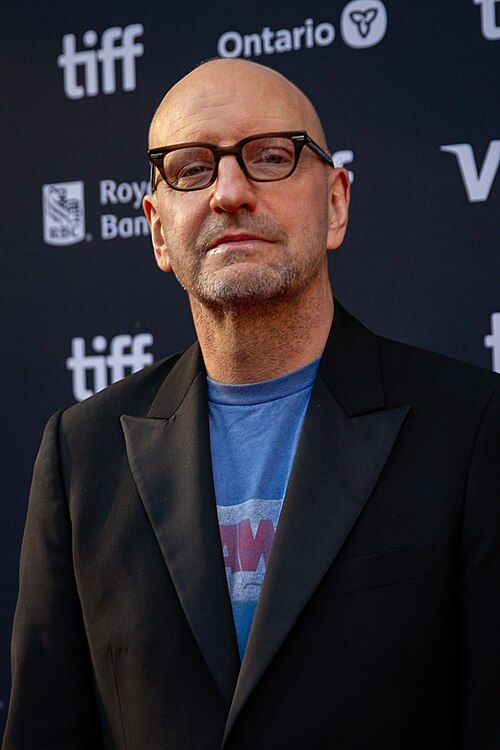
Adam Chitayat, CC BY-SA 4.0, via Wikimedia Commons
The application is enhancement based, not generative. Soderbergh's track record of cost discipline on set suggests the AI tools in question handle visual correction and consistency work: relighting shots after the fact, stabilizing footage, correcting background elements, matching exposure across cameras. None of that generates new content. It repairs and refines what already exists in the edit.
The Moura collaboration had not been widely announced before the Sands conversation. Soderbergh's description of it as relying heavily on AI post-production is the primary source for what the project involves at the workflow level. The film is not in the trade press release cycle, which is consistent with Soderbergh's pattern of minimal advance publicity before a film is close to completion.
Moura's range as a performer is the relevant context for what Soderbergh might be building. His Escobar in Narcos ran three seasons. He played the political prisoner Marco Aurelio in Wasp Network, also a Soderbergh production. He appeared in Elysium and Versus: The Life and Films of Ken Loach. A Soderbergh and Moura collaboration draws from that dramatic range toward a film that likely demands naturalistic performance against AI-enhanced or AI-corrected visual environments, rather than a generative spectacle.
That casting logic aligns with Soderbergh's consistent preference for performance as the center of the film. The AI tools serve the edit and the image, not the performance. Moura's presence in the film is the argument that this is a drama, not a technology demonstration.
.jpg)
Harald Krichel / WikiPortraits
Enhancement vs. Generation
Generative AI produces images, video, or audio from a text prompt. Enhancement AI processes existing material to correct or improve it. The two categories involve different workflows and have different implications for labor on set.
David Cronenberg described the same category of tools as "Digital Photoshop" when discussing his use of AI in post-production on The Shrouds, noting he uses it to relight scenes and fix details on actors' faces without additional takes. Soderbergh's framing lands in the same place. The technology reduces reshoots, not screenwriters.
The distinction also maps cleanly onto the Cannes competition ruling and the guild agreements that covered production in 2025 and 2026. Enhancement AI does not generate performances. It processes the performances actors and crew already produced. The SAG-AFTRA contracts that restrict AI use of performer likenesses apply to generation tools, where a synthetic likeness replaces a real performance. Enhancement tools that correct an existing performance fall outside the scope of those restrictions, which is why directors in the Soderbergh and Cronenberg tier can describe using them without triggering guild scrutiny.
Neural techniques can handle background replacement, shot consistency matching between cameras, and subtle adjustments to lighting conditions. These have been standard in large productions for years. Soderbergh's comment is that they are now standard in his productions too.
The shift is partly about cost and partly about turnaround time. A visual correction that required a facility booking with two weeks notice in 2020 can now be handled in an afternoon on a capable workstation. For a director who edits continuously rather than waiting for locked picture before starting post, that turnaround change alters the edit-and-revise cycle fundamentally. The Moura film's heavy AI post-production use is most likely a reflection of that speed change as much as a cost-saving measure.
The point at which AI post-production tools became practically fast enough to fit into a continuous editing workflow is recent. The Soderbergh Sands statement in April 2026 is among the first credible director reports of that workflow being used at scale on a feature in active production.
The Festival de Cannes formalized the same distinction in April 2026. Cannes declared generative AI ineligible for the Official Competition while explicitly permitting technical AI used for sound restoration, image cleaning, and VFX pipelines. Enhancement is acceptable. Generation is not.
What Post-Production Enhancement Tools Can Do
The specific enhancement tasks Soderbergh likely uses fall into a small number of categories that have matured significantly in 2024 and 2025. Shot stabilization and rolling shutter correction run automatically. Background replacement and clean plate generation handle visual inconsistencies between takes without a reshoot. Automated color matching across cameras reduces the time a colorist spends on intercut shots from different rigs.
For Soderbergh, who shoots his own films under the pseudonym Peter Andrews, the tools that compress post-production time are the most valuable. A director who also operates the camera is already compressing the workflow on set. AI tools that compress it further in post extend the same logic: fewer people, less time, same or better output. The AI post-production stack on the Moura film is the same approach applied after the camera stops rather than before it starts.
The specific tasks that have changed most are the ones that required expensive specialist labor but not specialist judgment. Matching color between cameras, removing a background element that was not noticed until the edit, correcting the exposure on a single shot to match the surrounding coverage: these tasks used to require a colorist or VFX artist at day rates, scheduled in advance. AI tools run them at negligible marginal cost. The creative budget goes to what requires creative decisions. The execution budget shrinks.
The workflow also changes the relationship between the director and the post-production facility. A Soderbergh who can run enhancement passes on his own hardware does not need to book facility time until the final pass that requires theatrical color grading. That changes not just the cost but the schedule: corrections can happen continuously rather than in discrete blocked sessions, which means the edit stays fluid longer.
A Career Built on Technology as Leverage
Soderbergh has consistently used technology to close the gap between the film he wants to make and the budget he has available. He shot Unsane in 2018 entirely on an iPhone 7 Plus. That project cost under $1.5 million and shot in 10 days. He cited the camera's intimacy as a creative choice, not a budget compromise.
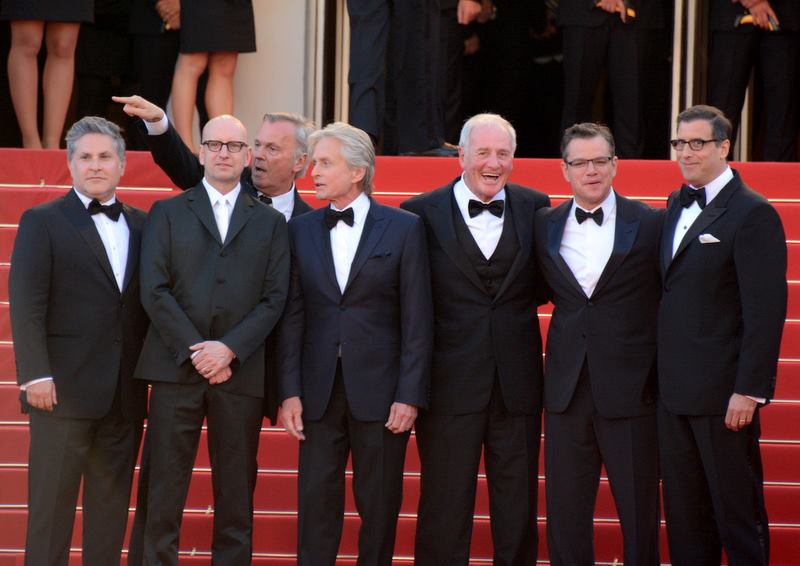
Behind the Candelabra, Cannes 2013 | Georges Biard, CC BY-SA 3.0, via Wikimedia Commons
His 2013 HBO film _Behind the Candelabra_ competed at Cannes despite being made for television. Soderbergh shot it himself, as he does on most of his projects, under the pseudonym Peter Andrews. A period production featuring Las Vegas showmanship and elaborate costumes required the same resourcefulness that defines his approach across formats. Ron Howard has drawn the same parallel, arguing that AI adoption follows the same logic as the industry's earlier shift from film stock to digital effects.
The AI tools in his current production follow that logic. Post-production corrections that once required expensive facility time can now run on a workstation. That savings either goes back into the production or lowers the budget required to get the film greenlit.
iPhone to AI: The Same Argument Applied Twice
The iPhone 7 Plus experiment in 2018 was not about the phone. It was about whether the constraint produced better creative decisions than the open budget alternative. Shooting on a phone forces intimacy. Handheld work at high focal lengths is impractical, so the imagery is close, immediate, and slightly unsettling, which was exactly what Unsane needed.
The AI post-production workflow on the Moura film follows the same structure. The constraint is budget and schedule, not aesthetics. AI tools compress the post-production timeline and reduce the cost of corrections that would otherwise require facility time. The film Soderbergh wants to make becomes achievable at a budget level that makes the project possible. That is the same argument the iPhone made, applied to a different part of the production process.
Where He Stands in Hollywood's AI Debate
Steven Spielberg told a SXSW 2026 audience he has never used AI in any of his films and rejected it as a replacement for human creativity. George Miller chairs the jury of an AI film festival and compares the technology to the Renaissance. The spectrum of working director opinion is wide. Star Wars: Starfighter director Shawn Levy has said he expects AI to become an essential tool for moviemaking, while noting he has yet to use it in any meaningful way on a production.
Soderbergh's position is narrower than either. He is not arguing for AI in principle or against it in principle. He is describing what he uses it for on one production: post-production efficiency on a specific project with a specific collaborator. That claim is harder to argue against than a general defense of the technology. At Hong Kong's Filmart 2026, Jia Zhangke took a different approach, using AI to stage a debate about authorship between two generated versions of himself.
The "boring" diagnosis of the problem deserves its own reading. Soderbergh is not saying AI is a neutral tool. He is saying the human propensity to create bad work, work that is derivative, safe, and calibrated to avoid risk, is the reason entertainment feels stale. AI generates from training data; it cannot spontaneously develop new ideas that do not exist in its training set. Boring humans using AI produce boring AI output. The tool is downstream of the problem, not the cause of it.
That argument has specific implications for how AI tools get adopted in Hollywood. If the problem is human conservatism, adding AI to a development process managed by risk-averse executives produces more polished versions of the same conservative choices. Soderbergh's use case, post-production enhancement, keeps the creative decisions with the director and uses AI only for execution. That is the adoption pattern that keeps the boring-humans problem from getting worse.
Actress and director Natasha Lyonne takes a similar stance on creative control: she founded Asteria, a studio built around AI trained only on licensed content, to produce her feature directorial debut Uncanny Valley without using models trained on scraped material.
Soderbergh put that position into practice at Cannes 2026, using Meta AI tools for 10% of his John Lennon documentary for sequences where conventional footage could not illustrate Lennon's abstract reflections on creativity and time.
What It Means for Independent Filmmakers
The workflow Soderbergh describes does not require a major studio's infrastructure. The AI tools he uses for correction, consistency, and enhancement are accessible at the independent level without a dedicated post-production facility.
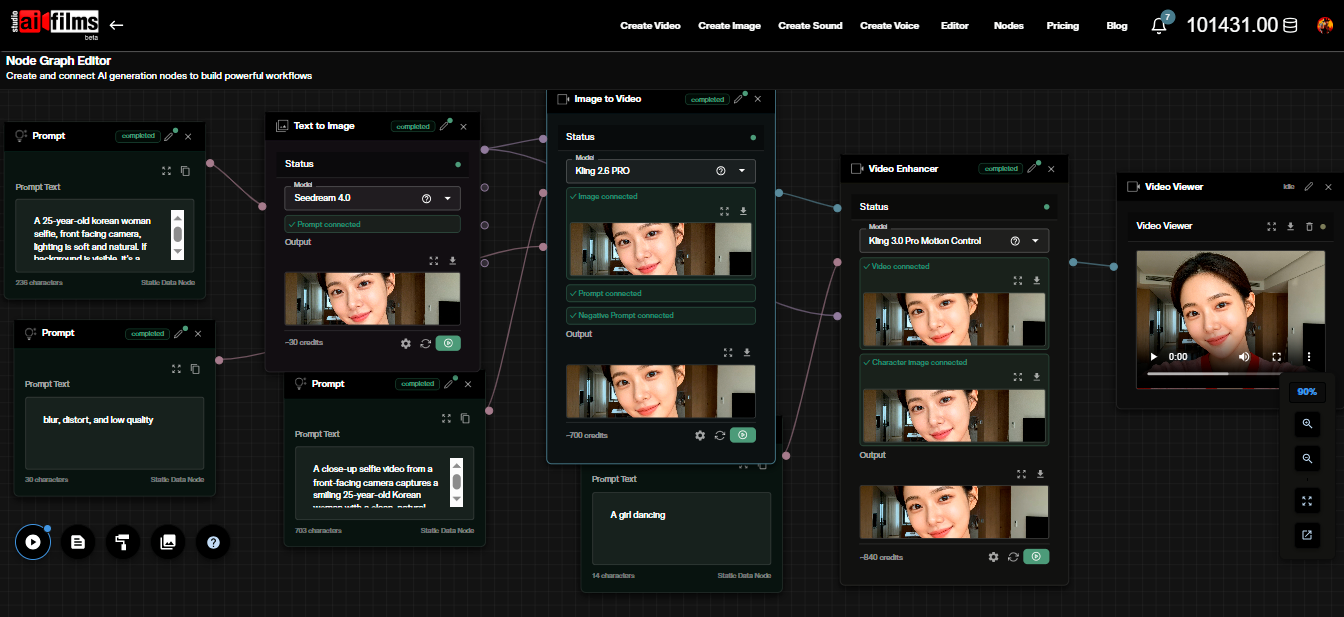
Independent filmmakers can apply the same approach through AI FILMS Studio, which gives creators access to AI generation and enhancement tools in a single workspace.
Soderbergh's track record of making films that look expensive on budgets that are not establishes a credibility floor for everything he says about production efficiency. When he says AI is "just another tool," that claim carries the weight of Traffic, Erin Brockovich, and The Informant!, films that each found cost-efficient paths to theatrical quality without sacrificing creative ambition. The Moura film is the test case for whether that same logic applies to AI-enhanced post-production at the level of a Soderbergh production.
The independent filmmaker analogue is direct. If Soderbergh's budget discipline through technology adoption has produced films that compete at the Oscar level, the same discipline applied by a smaller director on a smaller budget should produce the same proportional result. The AI tools are not gatekept by scale. They are accessible at the independent level in the same form Soderbergh uses them. The only barrier is learning how to apply them with the same restraint he describes at St Andrews.
The Sands remarks are brief but precise. They are not a manifesto. They are a working filmmaker's description of what he is doing right now on one project, offered to an audience of filmmakers who asked him a direct question. That specificity is what makes them useful as a reference point for independent directors thinking through the same decisions.
Sources
The Hollywood Reporter | Variety | Deadline | Screen Daily | IndieWire | Rolling Stone
Continue Reading
.jpg?w=3840)


Video & LipSync
- Video Generator
- Text to Video
- Image to Video
- Start-End Frame to Video
- Draw to Video
- Motion Control
- Video Enhancer
- Video Upscaler
- Video Extend
- Video to Video LipSync
- Audio to Video LipSync
- Image to Video LipSync
- Video FaceSwap
- Seedance 2.5
- WAN 3.0
- Seedance 2
- FLUX 3
- Minimax H3
- Vidu Q3 Pro
- Grok Imagine Video 1.5
- Gemini Omni
- Google Veo 3.1
- Kling 3.0 Pro
- Luma Ray 3.2
- LTX 2.3
- Happy Horse 1.1
- Kling 3.0 Motion
- ByteDance Upscaler
- InfiniteTalk
- InsightFace
Image & Edit
- AI Character
- AI Actor
- Art Generator
- Text to Image
- Image to Image
- LoRA Image to Image
- Draw to Edit
- Image LoRA Training
- Remove Background
- Image Enhancer
- MidJourney 8.0
- Krea 2
- OpenAI GPT Image 2.0
- Nano Banana Pro Ultra
- Nano Banana 2 Lite
- Nano Banana Pro
- Minimax Image
- Clarity Pro
- Z-Image Turbo LoRA
- Krea 2 Turbo LoRA
- Z-Image LoRA Trainer
- Qwen Image LoRA Trainer
- Background Erase Network 2 (BEN2)